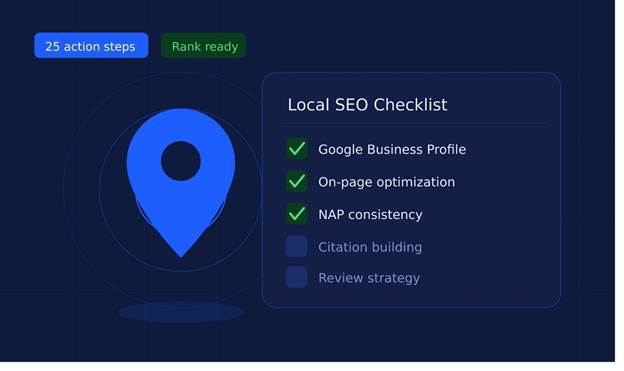
Local SEO Checklist 2026: 25 Things to Do Before You Launch
-
By Devraj
-
6th May 2026
Quick Summary
If you run a local business, showing up on Google when people nearby search for what you offer is no longer optional; it is everything. This local SEO checklist for 2026 gives you 25 practical, ready-to-action steps that cover your Google Business Profile, on-page SEO, citations, reviews, and more. Whether you are launching a new website or refreshing an existing one, these SEO strategies are designed to help you rank faster and attract real customers in your area.
Need Experts to Handle Your Local SEO?
Deftsoft offers results-driven local SEO services built for small and medium businesses. We handle everything, from Google Business Profile setup to citation building and review strategies.
Quick Navigation
Why Local SEO Still Matters Big in 2026
Section 1: Google Business Profile (GBP), Your Local SEO Foundation
Section 2: On-Page Local SEO for Your Website
Section 3: Citations and Directory Listings
Section 4: Reviews, The Trust Factor
Section 5: Local Link Building
Section 6: Content and Technical Final Checks
Why Local SEO Still Matters Big in 2026
Let’s get something straight: local SEO service is not some old trick that stopped working. It is one of the most valuable digital marketing moves a local business can make right now. Think about it, when someone searches “best dentist near me” or “pizza place open now,” Google shows local results. Those results come from businesses that did the work.
The competition is getting tighter every year. More businesses are waking up to local SEO. That means if you are not actively working on it, someone else in your area is taking your spot.
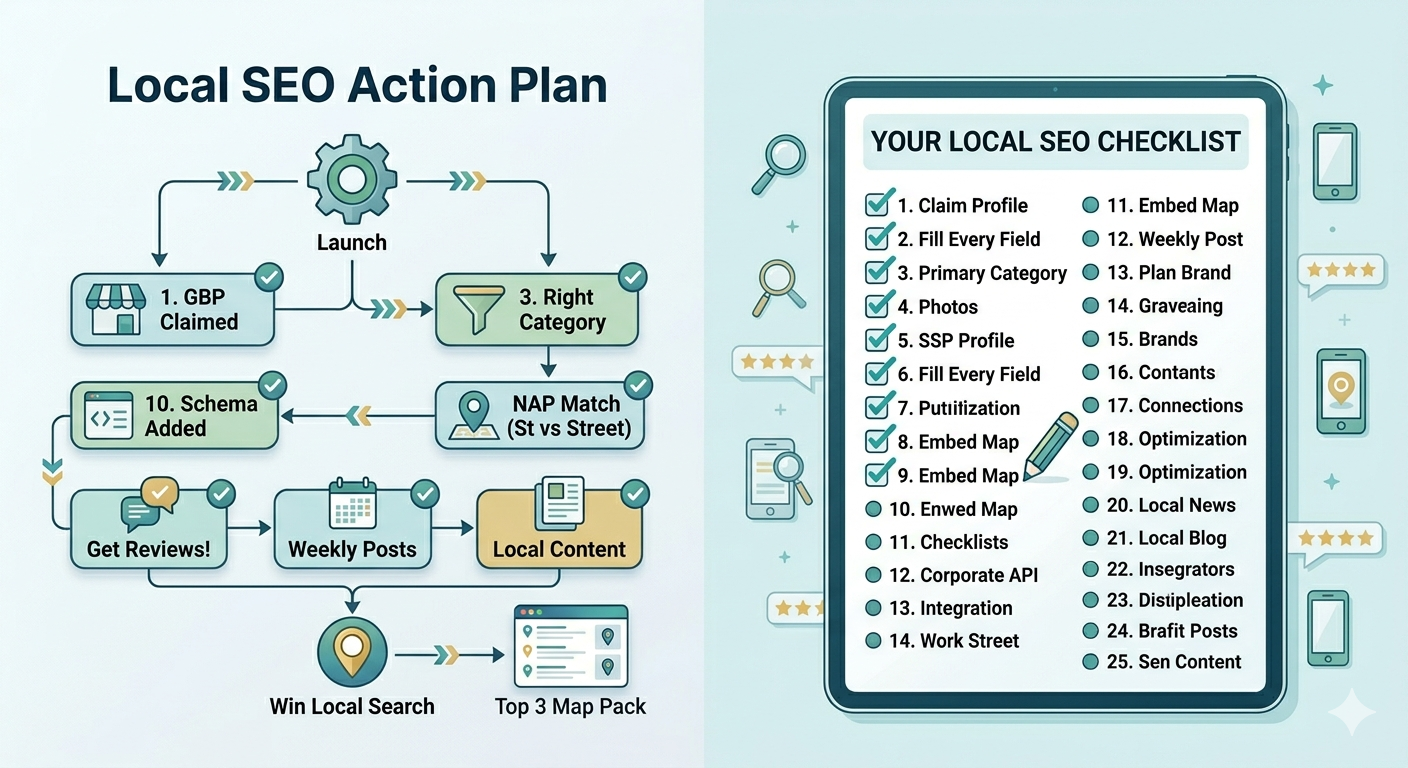
Here is your complete local SEO checklist for 2026: 25 things to lock down before you launch or relaunch your business online.
Section 1: Google Business Profile (GBP), Your Local SEO Foundation
Your Google Business Profile is the single most important piece of your local SEO strategy. It controls what shows up in the map pack, those top 3 local listings you see when you search for businesses near you.
1. Claim and Verify Your Google Business Profile
If you haven’t claimed your GBP yet, do it today. Go to business.google.com, find your listing, and verify it via postcard, phone, or video. An unverified listing can’t rank.
2. Fill Out Every Single Field
Business name, address, phone number, website, hours, category, description, all of it. Google rewards complete profiles. Incomplete profiles signal low trust.
3. Choose the Right Primary and Secondary Categories
Your primary category should match exactly what your business does. Secondary categories can cover related services. For example, a dental clinic might use “Dentist” as primary and “Cosmetic Dentist” as secondary.
4. Add High-Quality Photos Regularly
Businesses with photos get 42% more direction requests and 35% more website clicks, according to Google’s own data. Add interior shots, exterior, team photos, and product images. Keep updating them; freshness matters.
5. Write a Keyword-Rich Business Description
Use your most important local keywords naturally. At Deftsoft, our SEO services include professional copywriting that balances human readability with the data-driven insights found in our AI SEO services to help you rank in the Map Pack.
6. Enable Messaging and Keep It Active
GBP has a messaging feature. Turn it on. When potential customers can message you directly, your engagement signals improve, which helps your rankings.
7. Use Google Posts Weekly
Google Posts are short updates, offers, or events you can publish directly on your profile. Posting weekly keeps your profile active and gives Google fresh signals that your business is open and running.
Section 2: On-Page Local SEO for Your Website
Your website and your GBP need to work together. Here’s what your site needs to do its part.
8. Create a Dedicated Location Page
If you serve one area, your homepage should clearly signal that location. If you serve multiple areas, create separate location-specific pages for each one. These pages should naturally mention the city, neighborhood, landmarks, and local context.
9. Optimize Your Title Tags and Meta Descriptions
Every page should have a unique title tag that includes your main service and location. Example: “Plumbing Services in Austin, TX | Fast & Reliable | Your Brand”. Your meta description should support the click and make it compelling.
10. Use Structured Data Markup (Schema)
The Local Business schema helps Google understand your business details, including name, address, hours and service area. Implement it on your homepage and location pages. It can trigger rich results and improve how Google reads your page.
11. Embed a Google Map on Your Contact Page
This is a small but meaningful trust signal. Embedding your Google Map on your contact page reinforces your location data for both users and Google.
12. Make Your Website Mobile-First
Over 60% of local searches happen on a phone. If your website is slow or hard to use on mobile, you are losing potential customers before they even call. Use Google’s PageSpeed Insights to check your mobile score.
13. Make Your NAP Consistent Everywhere
NAP stands for Name, Address, Phone number. It should be exactly the same across your website, GBP, social profiles, and all directories. Even small differences, like “St.” vs “Street”, can confuse Google.
Section 3: Citations and Directory Listings
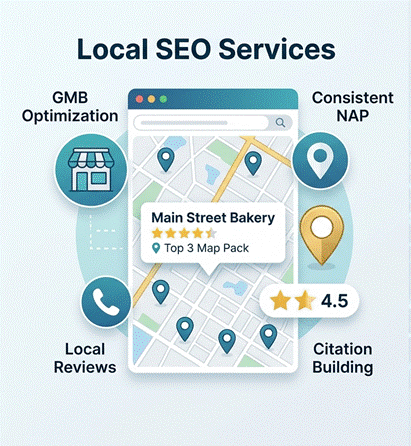
Citations are mentions of your business name, address, and phone number on other websites. Think Yelp, Yellow Pages, Bing Places, Apple Maps, and hundreds of niche directories.
14. Submit to Core Directories
Start with the big ones: Yelp, Bing Places, Apple Maps, Facebook, Foursquare, and industry-specific directories relevant to your niche. These are high-authority citations that Google trusts.
15. Fix Inconsistent or Duplicate Listings
Before building new citations, audit the existing ones. Tools like BrightLocal or Moz Local can help you find duplicate or incorrect listings. Duplicates confuse Google and hurt rankings.
16. Get Listed in Local Chamber of Commerce Directories
Local directories, like your city’s chamber of commerce website, carry strong local authority. A link from your local chamber is worth more than a generic directory listing.
Section 4: Reviews, The Trust Factor
Google reviews are one of the strongest local ranking signals. More importantly, they directly affect whether a customer chooses you over a competitor.
17. Build a Simple Review Request System
Don’t leave reviews to chance. After every job or purchase, send a follow-up text or email with a direct link to your Google review page. Make it as easy as possible.
18. Respond to Every Review
Good reviews, bad reviews, respond to all of them. Thank happy customers. Address concerns from unhappy ones. This shows Google (and potential customers) that you are engaged and professional.
19. Target 4.0+ Rating with Volume
A business with 150 reviews at 4.2 stars will usually outperform one with 10 reviews at 5.0 stars. Volume and recency both matter. Keep getting new reviews consistently.
Section 5: Local Link Building
Links from locally relevant websites tell Google that you are a legitimate, established part of your community.
20. Partner with Local Bloggers and News Sites
Reach out to local bloggers, community news sites, or local magazines for coverage or guest posts. A single link from a respected local site can make a real difference.
21. Sponsor Local Events or Organizations
Sponsoring a local school, charity run, or community event often includes a link to the sponsoring organization’s website. It’s good for community relations and great for local SEO.
22. Join Local Business Associations
Business associations, trade groups, and networking organizations often have member directories on their websites. Get listed. These are trusted local links.
Section 6: Content and Technical Final Checks
23. Create Location-Specific Content on Your Blog
Write blog posts that speak to local topics, events, or needs. “Best Time to Get HVAC Service in [Your City]” or “Why [Your City] Businesses Need Local SEO in 2026” , this type of content builds local relevance and attracts area-specific searches.
24. Check Your Core Web Vitals
Google uses Core Web Vitals as a ranking factor. These measure your site’s loading speed, interactivity, and visual stability. Use Google Search Console to identify and fix issues.
25. Set Up Google Search Console and Track Local Rankings
Google Search Console shows you what searches your site appears for, how many clicks you get, and which pages are performing. Set it up, check it monthly, and use the data to guide your local SEO strategy.
Pro Tip from Deftsoft:
Local SEO is not a one-time project. It’s an ongoing process. Businesses that treat it like a campaign, checking in monthly, refreshing their GBP, building new reviews, and updating content, are the ones that stay at the top.
How Deftsoft Helps Businesses Win Local Search
At Deftsoft, we’ve worked with local businesses across multiple industries to improve their visibility on Google Maps and local search results. Our local SEO services cover everything in this checklist, from Google Business Profile optimization to citation building, review strategies, and on-page SEO.
We don’t use cookie-cutter approaches. Every business we work with gets a strategy built around their specific city, competition, and goals. Whether you’re a dentist in Dallas, a contractor in Chicago, or a salon owner in San Francisco, we understand what it takes to show up where your customers are searching.
Beyond local SEO, Deftsoft also offers web development services, Google Ads management, and full-service digital marketing, so if you need more than just local rankings, we’ve got you covered.
Ready to Rank Locally?
Get a free local SEO audit from Deftsoft. We’ll review your Google Business Profile, website, and citations, and tell you exactly what to fix.
Frequently Asked Questions (FAQs)
How long does local SEO take to show results?
Most businesses start seeing noticeable changes within 3 to 6 months of consistently applying a local SEO strategy. Competitive markets may take longer. The key is consistency; businesses that stay active with their GBP, reviews, and content tend to see faster movement.
Is a Google Business Profile enough for local SEO?
It’s the most important piece, but not the whole picture. You also need a well-optimized website, consistent citations, strong reviews, and locally relevant content. All of these work together.
What is the most important factor for local SEO rankings in 2026?
Google uses three main factors: relevance (does your business match what someone searched for?), distance (how close you are to the searcher?), and prominence (how well-known and credible your business is?). Reviews, citations, and your GBP completeness all feed into prominence.
Do I need a separate page for each city I serve?
If you serve multiple cities or areas, yes, having individual location pages for each one significantly improves your chances of ranking for those specific locations. Generic service area pages don’t perform as well as dedicated, locally written pages.
Can I do local SEO myself, or do I need an agency?
You can absolutely start with DIY local SEO using this checklist. But if you’re in a competitive market or don’t have the time to stay consistent, working with a local SEO services provider like Deftsoft can help you move faster and achieve better long-term results.
What is NAP consistency, and why does it matter?
NAP stands for Name, Address, and Phone number. When this information is exactly the same everywhere online, your website, GBP, Yelp and directories, it builds trust signals with Google. Inconsistencies confuse Google’s understanding of your business, which can hurt rankings.
Recent Articles





Devraj
 6th May 2026