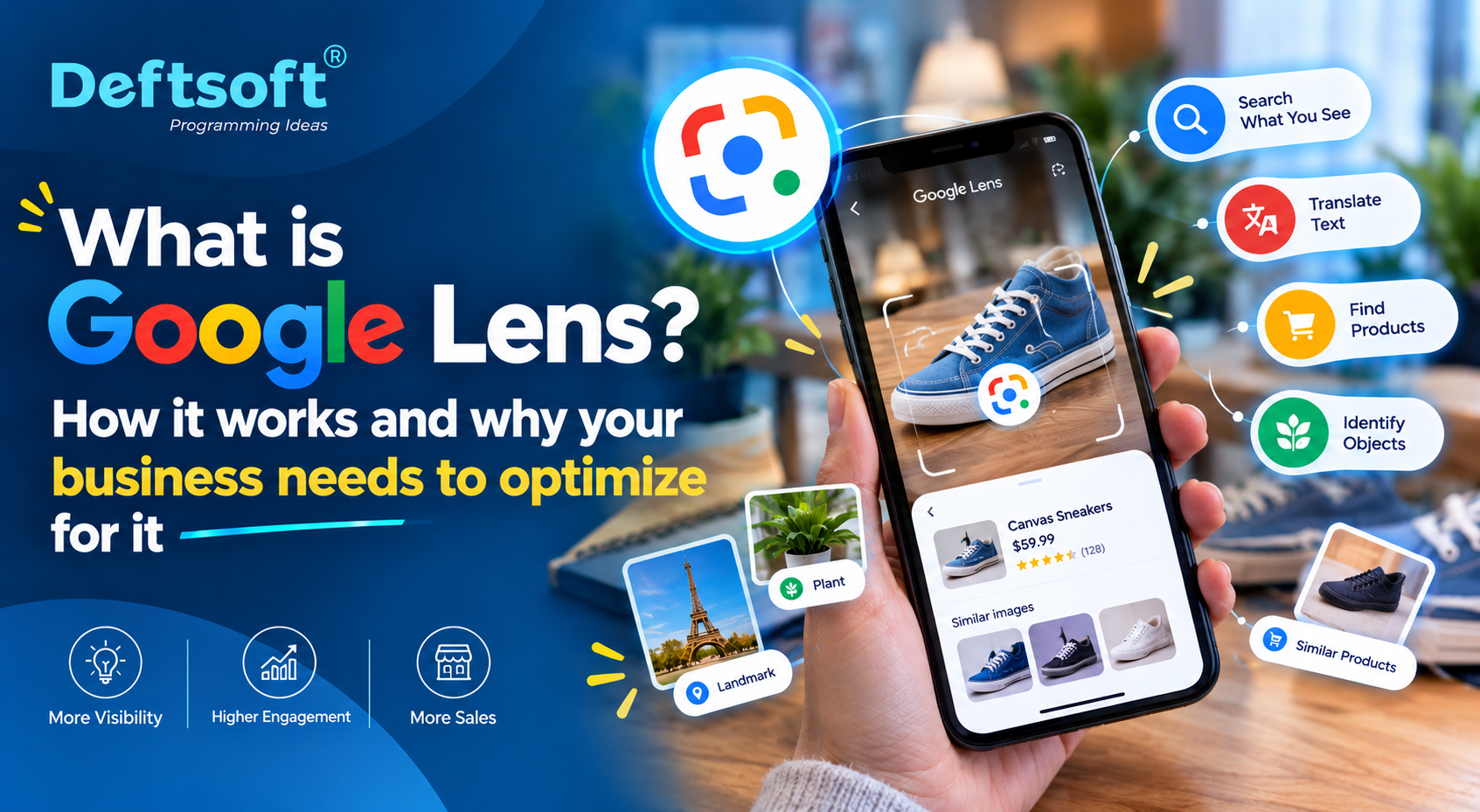
What is Google Lens? How it works and why your business needs to optimize for it
-
By Devraj
-
7th May 2026
Quick Summary:
Google Lens is a visual search tool that lets users search the internet using images instead of text. From scanning a product to identifying a plant or reading a menu in another language, it has quietly become one of the most powerful search tools available. For businesses, especially those investing in SEO and digital marketing, Google Lens is no longer optional to understand; it is a competitive advantage waiting to be claimed. This blog breaks down what Google Lens actually is, how it processes visual queries, and what your business can do right now to show up in visual search results.
Is your business invisible to visual search?
Quick Navigation
How does Google Lens actually work?
Why visual search SEO is a growing priority
How to optimize your business for Google Lens
Google Lens and local businesses
What exactly is Google Lens?
Google Lens is an AI-powered visual search engine built into Google’s ecosystem. Instead of typing a query, users point their camera at something, a shoe, a restaurant sign, a piece of furniture, a skincare product, and Google Lens identifies it, finds similar products, pulls up reviews, and surfaces relevant websites.
It was first introduced in 2017 as a feature exclusive to Google Pixel phones. Today, it is available on Android and iOS devices through the Google app, embedded in Google Photos and Google Search, and even in Chrome on desktop.

What sets Google Lens apart from a reverse image search is its intelligence. It does not just match pixels. It understands objects, text, barcodes, landmarks, plants, animals, clothing, and context. It reads labels. It translates languages in real time. It can identify a dish and take you straight to the recipe.
According to Google, Lens now handles over 12 billion visual searches every single month. That number has more than doubled in the past two years. If you are in retail, food, travel, real estate, fashion, or any product-driven industry, a significant portion of your potential customers are already searching this way.
How does Google Lens actually work?
Google Lens runs on a combination of computer vision, machine learning, and Google’s existing Knowledge Graph. Here is a simplified breakdown of what happens when someone points their camera at an object:
- Image capture and object detection: The app isolates the main subject in the frame. It identifies edges, colors, shapes, and text within the image using convolutional neural networks, the same technology used in facial recognition systems.
- Contextual understanding: Google Lens does not just identify an object in isolation. It considers context. A blue mug on a kitchen counter is analyzed differently from the same mug in a product photo against a white background. The surrounding environment adds layers of meaning.
- Matching against the index: Once the object is understood, Lens cross-references Google’s massive index of images, products, websites, and structured data. This is where your business’s online presence either shows up or does not.
- Results delivery: Users see a combination of shopping results, similar images, related websites, and informational panels, all pulled from what Google has already crawled and indexed.
The critical takeaway for businesses: if your website images are not properly labeled, compressed, or crawlable, Google Lens cannot connect your products to current searches.
Why visual search SEO is a growing priority
The phrase “visual search SEO” might sound niche, but the behavior behind it is mainstream. People shop by taking photos of things they like. They identify restaurants by photographing the exterior. They find home décor inspiration by snapping pictures from magazines or social media.
Here is what the data tells us:
- 36% of consumers have used visual search while shopping online
- 62% of millennials say they want visual search more than any other emerging technology
- Pinterest Lens (a competitor) processes 600 million visual searches monthly, and Google’s number is 20x higher
- Mobile commerce (m-commerce) now accounts for over 70% of e-commerce traffic, and visual search is a native mobile behavior
For any business running an SEO strategy or working with a digital marketing agency, visual search is where a meaningful slice of organic traffic is quietly shifting. The businesses that optimize for it now will own those positions as the behavior scales.
How to optimize your business for Google Lens
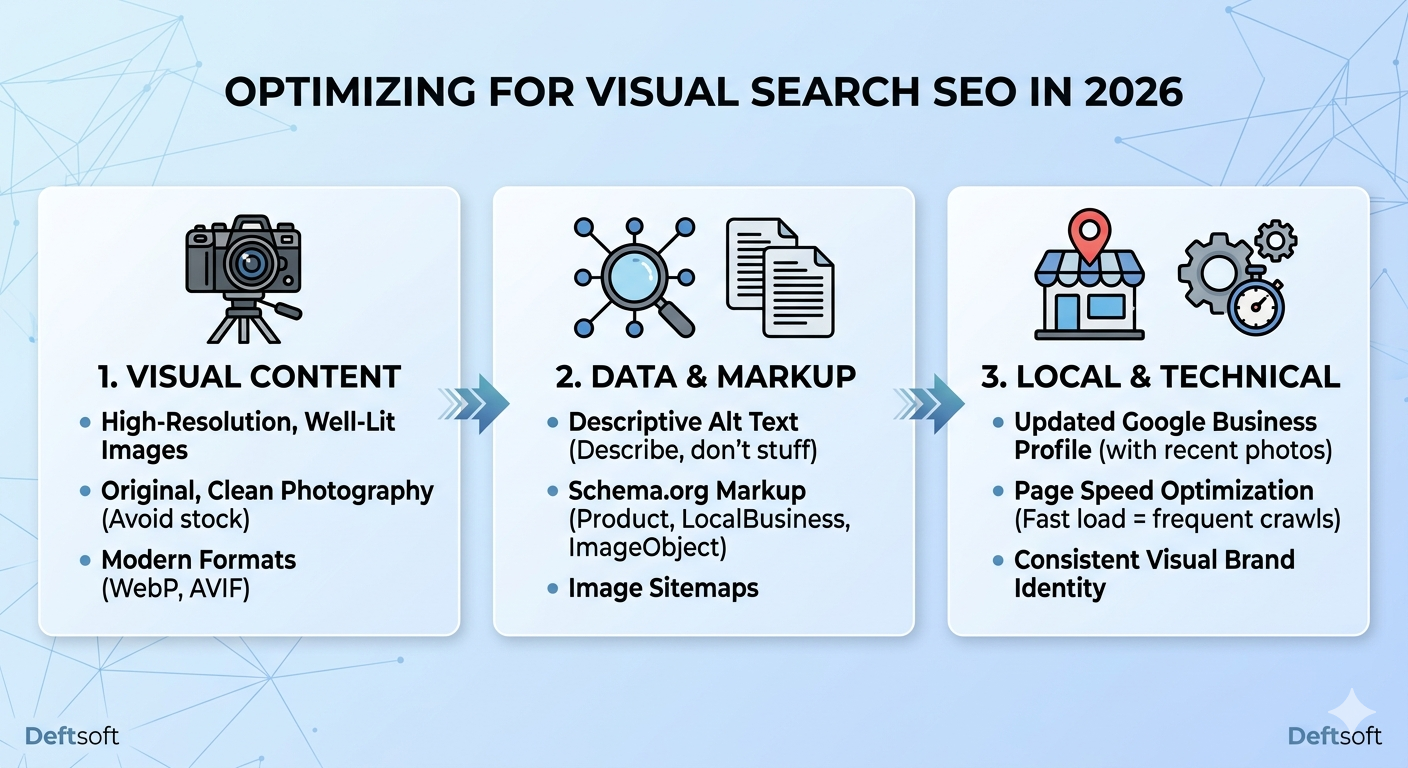
This is the practical part. Getting your content discovered through visual search requires a different set of optimization practices than traditional text-based SEO.
- Use high-quality, original images. Google Lens struggles with blurry, low-resolution, or heavily filtered images. Every product or service page should have clean, well-lit, original photography. Stock images that appear across hundreds of websites carry very little visual SEO weight.
- Write descriptive alt text for every image. Alt text is the bridge between your visual content and Google’s indexing system. It should describe what is literally in the image, not be stuffed with keywords. “Blue ceramic coffee mug with minimalist handle on white surface” is far more useful than “buy coffee mugs online cheap.”
- Add structured data markup. Schema.org markup, particularly the Product, LocalBusiness, and ImageObject schemas, provides Google with structured information about your images. This dramatically increases the likelihood that your products will appear in Lens shopping results.
- Optimize your Google Business Profile. For local businesses, Google Lens frequently surfaces Business Profile information when users photograph storefronts or products. Keep your profile updated with real, recent photos. Businesses with 100 or more photos receive 520% more calls than average, according to Google’s own data.
- Compress images without sacrificing quality. Page speed affects whether Google even gets to your images. Use modern formats like WebP. Compress without visible degradation. Images that slow down your page load time are crawled less frequently.
- Create image sitemaps. If you have a large product catalog or image-heavy website, an image sitemap ensures Google’s crawlers find every visual asset. Many businesses skip this and wonder why their images never appear in search.
- Think about visual consistency. When your product images follow a consistent style, same background, similar angles, consistent lighting, Google’s models learn to associate that visual identity with your brand. This is particularly relevant for e-commerce businesses with large catalogs.
Google Lens and local businesses
For brick-and-mortar businesses, Google Lens creates a powerful local discovery loop. A customer walks past your shopfront, photographs your sign or window display, and Lens immediately surfaces your business name, hours, reviews, and website.
This means your physical presence and your online presence need to be in sync. Your business name must match exactly across your website, Google Business Profile, and local directories. Your address must be consistent. If Lens surfaces your profile and a potential customer sees outdated hours or no photos, you have lost that moment.
Businesses working with a local SEO specialist or a full-service digital marketing company should be actively managing this visual touchpoint as part of their broader local search strategy.
How Deftsoft approaches visual search optimization
At Deftsoft, we have been helping businesses grow their organic visibility for over a decade. As search behavior evolves, from text to voice to visual, our SEO and web development teams adapt strategies accordingly. Whether it is implementing structured data at scale, rebuilding image delivery systems for speed, or auditing your Google Business Profile for visual search readiness, we treat visual search as an integrated part of your overall digital presence, not an afterthought.
If your website was built a few years ago, there is a strong chance your image infrastructure is not ready for how search is conducted in 2026.
Ready to make your business visible in visual search?
FAQs
Q: Does Google Lens work for all types of businesses?
Yes, but the impact varies by industry. Retail, food and beverage, hospitality, real estate, and fashion see the most immediate benefit.
Q: Is visual search SEO different from regular SEO?
Yes. It overlaps with traditional SEO but also focuses on image quality, alt text, and structured data.
Q: Can I track traffic coming from Google Lens?
Not directly in most analytics tools right now. It usually appears within organic or image search traffic.
Q: How long does it take to see results from visual search optimization?
It depends on the competition and current SEO setup. Some improvements may appear within weeks.
Q: Does Google Lens affect my paid search campaigns?
Lens results are mainly organic, but shopping ads can appear alongside visual search results.
Q: Is Google Lens available in India?
Yes. Google Lens is fully available in India and supports multiple Indian languages.
Recent Articles




Devraj
 7th May 2026