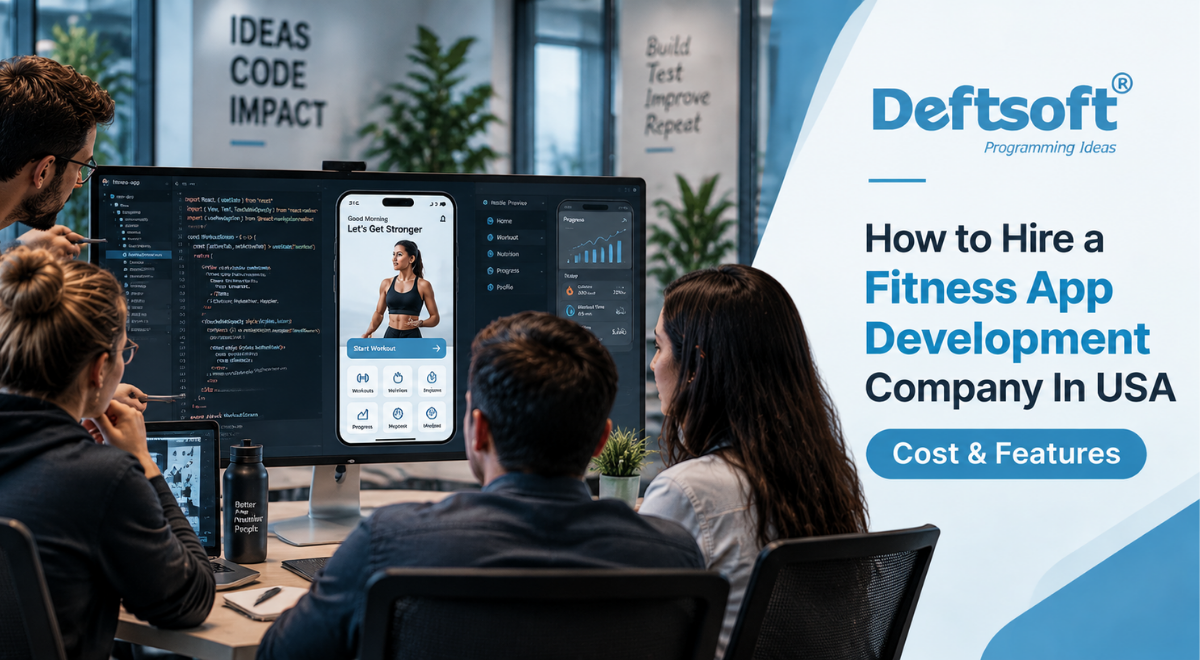
How to Hire a Fitness App Development Company in USA: Cost & Features
-
By Devraj
-
16th September 2026
Fitness app development is the process of designing and building mobile or web applications that help users track workouts, manage nutrition, connect with trainers, monitor health metrics, and achieve wellness goals. Gyms, personal trainers, healthcare brands, wellness startups, and fitness companies are investing in custom fitness applications because digital platforms now sit at the centre of how people manage their health. A fitness app development company brings together mobile engineering, AI integration, UX design, and wearable connectivity to build products that work at scale. Partnering with an experienced Enterprise Mobile App Development Company ensures that your platform is built to handle high user volume while maintaining top-tier security standards.
Build Your Fitness App With Experts
From MVP to full-scale platform Deftsoft’s fitness app development services cover iOS, Android, AI, and wearables
Table of Content
Why Are Fitness Apps Becoming Popular?
What Types of Fitness Apps Can You Build?
Essential Features of a Fitness App
Advanced Features That Make a Fitness App Stand Out
How to Build a Fitness Tracking App?
Fitness App Development Technology Stack
How Much Does Fitness App Development Cost?
Fitness App Development Services We Provide
How to Choose the Right Fitness App Development Company
Why Choose Deftsoft for Fitness App Development?
Fitness App Development in USA
How Do Fitness Apps Make Money?
Fitness App Development Challenges
Fitness App Development Timeline
Why Are Fitness Apps Becoming Popular?
The global fitness app market is estimated to cross $14 billion in 2026 and is growing at over 17% annually. Users expect personalised workouts, real-time coaching, nutrition tracking, and data-driven progress insights—not just a step counter. When planning your launch, having a clear strategy for seamless App Storing and app store optimization is vital for reaching target users efficiently.
Key demand drivers: personalised workout plans · activity and workout tracking · nutrition and calorie planning · wearable device integration (Apple Watch, Garmin, Fitbit, WHOOP) · online personal training · AI-powered adaptive recommendations · subscription-based recurring revenue models
Who Can Benefit From a Fitness App?
| Business Type | How a Fitness App Helps |
|---|---|
| Gyms and fitness centres | Member management, class booking, workout tracking |
| Personal trainers | Client management, custom plans, progress monitoring |
| Fitness startups | Build scalable digital-first fitness products |
| Wellness businesses | Combine fitness, mindfulness, sleep, and nutrition |
| Healthcare organisations | Remote patient fitness monitoring and rehabilitation |
| Sports organisations | Athlete performance tracking and recovery monitoring |
| Nutrition coaches | Meal plans, calorie tracking, and client communication |
| Corporate wellness programmes | Employee health initiatives and engagement platforms |
What Types of Fitness Apps Can You Build?
Understanding the category you are building in shapes every decision from features to technology stack to monetisation strategy.
Workout and Exercise Apps
Exercise libraries, video-guided workouts, custom routines, and session logging. Examples: Peloton, Nike Training Club.
Fitness Tracking Apps
Record steps, distance, heart rate, calories burned, sleep, and activity across devices and workouts. Fitness tracking app development is one of the highest-demand categories in the market.
Personal Trainer Apps
Connect trainers with clients through custom plans, video sessions, progress tracking, messaging, and subscription billing.
Gym Management Apps
Membership management, class scheduling, check-in, payment processing, and trainer assignment for fitness facilities.
Nutrition and Diet Apps
Calorie counting, macro tracking, meal planning, food databases, and hydration monitoring are often combined with workout tracking.
Wellness Apps
Broader than fitness combining workout tracking with mindfulness, sleep monitoring, stress management, and mental health content. A specialist wellness app development company builds platforms that address the whole-person health picture.
Wearable Fitness Apps
Apps that connect directly to smartwatches, fitness bands, heart rate monitors, and health sensors via HealthKit, Google Fit, or custom APIs.
AI-Powered Fitness Apps
The fastest-growing category in 2026. AI fitness app development uses machine learning to personalise workout recommendations, adapt training loads, provide real-time form feedback via computer vision, and deliver coaching that improves the more a user trains.
Essential Features of a Fitness App
| Feature | What It Does | User Benefit |
|---|---|---|
| User Registration | Creates user profiles | Personalised experience |
| Fitness Profile | Stores goals, fitness level, and preferences | Better recommendations |
| Workout Plans | Structured training programmes | Consistent progress |
| Exercise Library | Exercises with instructions and video demos | Easier, safer workouts |
| Fitness Tracking | Records activity and progress | Measures improvement |
| Nutrition Tracking | Tracks meals, macros, and calories | Supports diet goals |
| Progress Dashboard | Shows history, trends, and achievements | Motivates continued use |
| Push Notifications | Reminders, check-ins, and coaching prompts | Improves retention |
| Wearable Integration | Connects fitness devices automatically | Seamless data tracking |
| Subscription Management | Enables paid plans and recurring billing | Creates revenue for the business |
Advanced Features That Make a Fitness App Stand Out
Incorporating cutting-edge features transforms a standard tracking tool into an intelligent, highly engaging digital health companion.
- AI-Powered Workout Recommendations — Machine learning analyses goals, fitness level, training history, and recovery data to recommend workouts that are appropriately challenging and varied.
- AI Fitness Coach — A conversational AI interface that answers questions, adjusts plans, and provides real-time coaching prompts 24/7.
- Personalised Training Plans — Adaptive plans that update based on performance, missed sessions, and user feedback rather than following a fixed programme.
- Real-Time Activity Tracking — Live GPS, real-time heart rate zone monitoring, and session intensity feedback during training.
- Voice-Based Fitness Assistance — Hands-free coaching and control through voice commands during active workouts.
- Computer Vision for Exercise Monitoring — AI analysis of movement via device camera to detect form errors, count reps, and provide corrective feedback. A key differentiator for ai fitness app development.
- Wearable and IoT Integration — Apple Health, Google Fit, Fitbit, WHOOP, and Garmin integration for automatic, unified health data.
- AI-Based Nutrition Recommendations — Machine learning that links nutrition to workout performance and suggests adjustments based on training load.
By leveraging AI, real-time analytics, and seamless hardware connectivity, your platform can deliver a truly differentiated user experience that drives long-term retention.
How to Build a Fitness Tracking App?
Building a Mobile App requires more than development skill; it needs a clear product strategy, a well-defined user experience, and technical architecture that scales. Here are essential Mobile App Development Tips to follow:
- Step 1: Define Your Fitness App Idea — What problem does it solve? Who is it for? What makes it different?
- Step 2: Identify Your Target Users — Beginners, athletes, gym members, or corporate employees all have different needs. Design for a specific user.
- Step 3: Research Competitors — Analyse top fitness apps for features, gaps, and what users complain about. That’s what makes it better.
- Step 4: Select Core Features — Start with the minimum set that delivers the core value. A fitness tracking app MVP doesn’t need everything on day one.
- Step 5: Design the User Experience — Fitness apps need to be frictionless during a workout. Design for real use context, not just demo screens.
- Step 6: Choose the Technology Stack — Based on platform targets and performance requirements. See the technology table below.
- Step 7: Develop the MVP — Build the core version for stability and primary value. An MVP lets you test real behaviour before investing in advanced features.
- Step 8: Integrate APIs and Wearables — HealthKit, Google Fit, Fitbit, payment gateways, mapping, and video. Integrations extend capability without rebuilding.
- Step 9: Test the Application — Functional, performance, UX, device compatibility, and security testing before launch.
- Step 10: Launch and Monitor — Release to App Store and Google Play. Monitor crashes, user behaviour, and retention from day one.
- Step 11: Continue Improving — Post-launch improvement is the product strategy. Analytics, feedback, and market changes drive the roadmap.
Process flow: Idea → Research → UI/UX → MVP → Development → Testing → Launch → Optimisation
Fitness App Development Technology Stack
| Development Area | Technologies |
|---|---|
| Android | Kotlin |
| iOS | Swift |
| Cross-Platform | Flutter / React Native |
| Backend | Node.js / Python / PHP |
| Database | PostgreSQL / MySQL / MongoDB |
| Cloud | AWS / Google Cloud / Azure |
| AI/ML | Python / TensorFlow / PyTorch |
| APIs | Fitness, Maps, Payment, and Health APIs |
| Analytics | Firebase / Google Analytics / Mixpanel |
How Much Does Fitness App Development Cost?
Fitness app development cost depends on complexity, features, platforms, AI requirements, wearable integration, backend architecture, APIs, security, team location, and maintenance scope. There is no single fixed price scope that determines cost.
Fitness App Development Cost by App Type
| App Type | Complexity | Typical Development Scope |
|---|---|---|
| Basic Fitness App | Low | Profiles, workout library, basic tracking |
| Fitness Tracking App | Medium | Activity, progress, analytics, and wearable sync |
| Trainer App | Medium | Trainer profiles, client management, and plans |
| AI Fitness App | High | AI recommendations, personalisation, and coaching |
| Full Fitness Platform | Very High | Users, trainers, payments, AI, and integrations |
Deftsoft provides detailed project estimates after a scoping conversation, not generic price lists that ignore your actual requirements. Contact our team to discuss your project.
Fitness App Development Services We Provide
Our comprehensive suite of fitness app development services covers every stage of product growth, turning your vision into a scalable, high-performance digital platform.
- Custom Fitness App Development End-to-end fitness application development services tailored to your business model and platform requirements.
- Fitness Mobile App Development —High-performance ios app development and specialized Android App Development Services, as well as cross platform app development using Flutter and React Native. Our mobile fitness app developers build for real workout conditions.
- Fitness Application Development for Web — Web-based fitness platforms and progressive web apps for browser-based access.
- Fitness App UI/UX Design — User research, wireframing, and interface design for fitness contexts where clarity and speed of interaction matter.
- Fitness App MVP Development — A focused MVP that tests user behaviour before full investment.
- Fitness App API Integration — HealthKit, Google Fit, Fitbit, Garmin, Stripe, YouTube, and other APIs that extend your app’s capabilities.
- AI Fitness App Development — Machine learning for personalised recommendations, adaptive plans, computer vision form analysis, and AI coaching.
- Fitness App Testing — Functional, performance, security, and device compatibility testing before launch.
- Fitness App Maintenance and Support — Post-launch monitoring, updates, and feature development. Our fitness app development solutions cover the full lifecycle.
From initial concept to continuous optimization, we provide end-to-end technical expertise to ensure your fitness application delivers long-term engagement and business success.
Ready to Build Your Fitness App?
Our fitness app developers cover iOS, Android, AI, wearables, and everything in between
How to Choose the Right Fitness App Development Company
Choosing a fitness app development agency is a long-term decision. Partnering with industry leaders ranked among the Top 10 Mobile App Development Companies in 2027 ensures you work with experts who stay ahead of technology trends.
- Relevant Experience — ask to see fitness or health app case studies, not just general mobile portfolios
- Technical Expertise — Specialized experience in android app development, iOS frameworks, AI, wearables, and scalable backends.
- UI/UX Capabilities — in-house UX designers with health and fitness context experience
- AI and Wearable Integration — confirm they have actually built this before, not just “we can do that”
- Security Practices — data encryption, HIPAA awareness for US markets, and secure API handling
- Development Process — sprint cycles, milestone reviews, how they handle scope changes, and who you talk to daily
- Post-Launch Support — response times, maintenance contracts, and update cycle commitments
- Portfolio and Case Studies — look at real shipped products; ask about challenges solved, not just features listed
- Communication — time zone alignment, project tracking visibility, and decision-making clarity matter as much as technical skill
Why Choose Deftsoft for Fitness App Development?
Deftsoft is a fitness app development company with experience delivering custom mobile applications across iOS, Android, and cross-platform frameworks. Our fitness app development agency covers mobile engineering, AI development, wearable integration, UX design, and post-launch support.
What we deliver: custom iOS and Android builds · AI and ML integration · wearable connectivity (HealthKit, Google Fit, Fitbit, Garmin) · scalable backend architecture · fitness-focused UX design · full API integration · security-first practices · QA before every release · post-launch monitoring and feature development.
Whether you are a gym, a fitness startup, a healthcare organisation, or a trainer building your first platform, Deftsoft’s fitness application development services are built around your actual requirements.
Fitness App Development in USA
A fitness app development company in USA must understand specific requirements that differ from other markets:
- UX expectations are benchmarked against Peloton, MyFitnessPal, and Apple Fitness+ — design and performance standards are high.
- Payment integration must cover Stripe, Apple Pay, Google Pay, and Braintree, with proper subscription billing and cancellation flows compliant with App Store and Google Play rules.
- Health data requires HIPAA-aware architecture even apps not technically required to comply benefit from following its principles as a security baseline.
- iOS share in the US is higher than most markets iOS needs to be the primary platform target.
- Scalability matters; US fitness apps can grow rapidly; architecture decisions at build time need to handle that.
- Wearable connectivity and Apple Health/Google Fit integration are expected as standard by US users.
Deftsoft’s mobile fitness app developers understand both the technical requirements and the user expectations specific to the US market.
Fitness App Business Models
Choosing the right monetization strategy is critical for balancing user growth, long-term retention, and profitability in the fitness digital space.
- Subscription — Monthly or annual fee for premium access. The most predictable revenue model for fitness platforms.
- Freemium — Core features free, premium gated. Effective for user acquisition.
- Paid App — One-time purchase; less common given expectations of ongoing updates.
- In-App Purchases — Individual programmes or content sold separately.
- Trainer Commission — Marketplace model where trainers pay a fee or commission to offer services.
- Advertising — Free app with targeted ads; works at scale but can conflict with premium UX expectations.
- Corporate Wellness — B2B sales to employers; typically the highest revenue per user model.
Combining multiple revenue strategies allows platforms to maximize average revenue per user while maintaining an accessible entry point for new customers.
How Do Fitness Apps Make Money?
The most successful fitness apps combine multiple revenue streams: subscriptions, paid programmes, in-app purchases, personal training sessions, brand partnerships, and corporate wellness contracts. The key is aligning your model with what users are willing to pay and your ability to continuously deliver value that justifies the cost.
Fitness App Development Challenges
Common challenges experienced fitness app developers plan for from day one:
- User retention — churn is high; engagement features, habit loops, and personalisation are critical
- Data privacy — health data requires stronger security than most app categories
- Wearable compatibility — multiple devices, firmware updates, and inconsistent manufacturer APIs
- Accurate tracking — GPS drift, sensor limitations, and workout detection edge cases
- Personalisation at scale — recommendations that feel personal, not generic
- App performance — battery drain, GPS accuracy, and crash rates matter during physical activity
- Scalability — fitness apps can grow rapidly; infrastructure must handle sudden load
- Cross-platform consistency — users switch between iOS and Android; data and experience must be consistent
Fitness App Development Timeline
| Development Stage | Estimated Time |
|---|---|
| Research and Planning | 1–2 weeks |
| UI/UX Design | 2–4 weeks |
| MVP Development | 6–10 weeks |
| Advanced Development | 4–8+ weeks |
| Testing | 2–4 weeks |
| Launch Preparation | 1–2 weeks |
Total for a standard fitness app MVP: approximately 12–18 weeks. Full platforms with AI, wearable integration, and advanced features take longer. Timeline depends on scope, team size, and integration complexity.
FAQs About Fitness App Development
How much does it cost to develop a fitness app?
Cost depends on complexity, features, platforms, and AI requirements. A basic MVP typically ranges from $20,000–$50,000. A full AI fitness platform with wearables and multi-platform support can reach $80,000–$200,000+. Contact Deftsoft for a project-specific estimate.
How long does it take to build a fitness app?
A basic MVP takes approximately 12–16 weeks. A full platform with AI and wearables typically takes 6–12 months depending on scope.
How do I build a fitness tracking app?
Define your concept, research users and competitors, design the UX, choose your tech stack, build the MVP, integrate APIs and wearables, test, launch, and monitor. Partnering with an experienced fitness tracking app development team accelerates every stage.
What features should a fitness app have?
Core: user registration, fitness profiles, workout plans, exercise library, activity tracking, progress dashboards, push notifications, and wearable integration. Advanced: AI recommendations, AI coaching, nutrition tracking, computer vision form analysis, and live training.
How does AI improve fitness apps?
AI personalises recommendations, adapts training plans, provides real-time coaching, analyses exercise form through computer vision, and optimises nutrition. AI fitness app development turns a static tool into a dynamic personal training system.
What is the best technology for fitness app development?
Swift (iOS), Kotlin (Android), Flutter or React Native (cross-platform), Node.js or Python (backend), TensorFlow or PyTorch (AI/ML), and AWS or Google Cloud for scalable infrastructure.
Can a fitness app connect with wearable devices?
Yes. HealthKit connects to Apple Watch, Google Fit to Android and Wear OS, and direct manufacturer APIs connect Fitbit, Garmin, WHOOP, and others. Wearable integration is standard in modern fitness apps.
How do fitness apps make money?
Primarily through subscriptions, in-app purchases, paid training programmes, corporate wellness contracts, and trainer commissions. Most successful platforms combine multiple revenue streams.
How do I choose a fitness app development company?
Look for fitness app experience, AI and wearable capability, strong UX design, clear processes, transparent communication, and post-launch support. Ask about challenges they have solved, not just features they have listed.
Can I build a fitness app for both iOS and Android?
Yes. Flutter and React Native enable a single codebase for both platforms, reducing cost and time. Native builds offer maximum performance where platform-specific capabilities are required.
Final Thoughts
A successful fitness app starts with a clear idea, gets built with the right features and technology, launches with a tested and stable product, and grows through continuous improvement based on real user data.
The path from idea to market:
Idea → Features → Technology → Development → Launch → Growth
The most important decision is who you build it with. Experienced fitness app developers, strong UX, and post-launch commitment separate fitness apps that grow from those that stall. Deftsoft’s fitness app development solutions are built for businesses that want to create real, scalable digital fitness products.
Recent Articles





Devraj
 16th September 2026