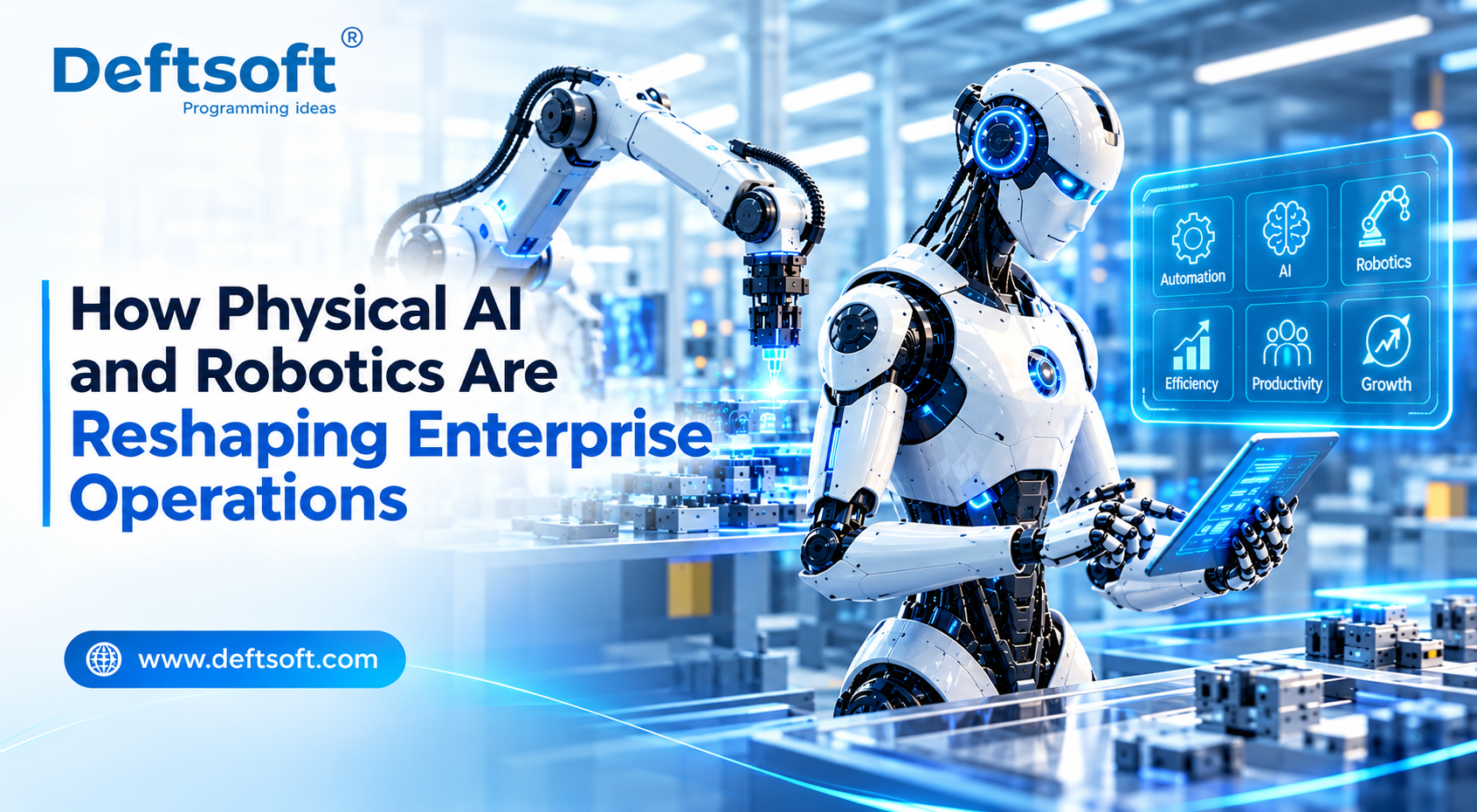
How Physical AI and Robotics Are Reshaping Enterprise Operations
-
By Devraj
-
14th September 2026
Something fundamental shifted in how artificial intelligence works and where it works. For most of the last decade, AI lived on screens. It analysed data, generated text, answered questions, and powered dashboards. Useful, certainly. But confined to the digital layer of business. The machines that actually built things, moved things, and handled things in the physical world? Those still ran on fixed programming and human oversight.
That boundary no longer holds.
Physical AI is an artificial intelligence embedded in robots, autonomous systems, sensors, and hardware that perceives, reasons, and acts in the real world has moved from research labs to production floors, hospital corridors, and logistics warehouses. Jensen Huang declared at CES 2025 that physical AI has reached its ChatGPT moment. In 2026, we are seeing what that moment actually means for enterprise operations at scale.
This article explains what physical AI is, where it is already delivering measurable results, how it connects to the broader AI landscape, including agentic AI, generative AI, and AI agents, and why early movers will build advantages that slower movers will struggle to close.
Ready to explore how physical AI can improve your operations?
Talk to Deftsoft’s AI specialists and identify the right automation opportunities for your business.
Table of Content
The Market Opportunity Is Enormous and Accelerating Fast
How Physical AI and Robotics Are Reshaping Key Industries
The Role of AI Agents and Agentic AI in Physical Systems
Generative AI and the Physical World: Simulation and Training
The Metaverse Layer: Digital Twins and Physical Operations
AI Governance: The Foundation of Safe Physical AI Deployment
Enterprise AI Development for Physical Systems: What It Actually Requires
How Deftsoft Is Positioning for the Physical AI Era
What Is Physical AI?
Physical AI refers to artificial intelligence systems that operate in and interact with the physical world. Unlike traditional software AI, which processes data and returns outputs inside a digital environment, physical AI combines perception, reasoning, and physical action in a continuous loop.
A physical AI system receives input from its environment through cameras, LiDAR, sensors, and actuators. It processes that data using AI models often combining computer vision, natural language processing, reinforcement learning, and generative AI and then takes physical action: moving, gripping, navigating, assembling, or responding to what it has observed.
Unlike classically programmed industrial systems, these machines operate in a closed loop: they record their environment via sensors, make autonomous decisions, and act in real time. Classic robots work with high precision but blindly follow instructions regardless of what is happening around them. Physical AI systems adapt.
This difference changes everything for enterprise operations.
The Market Opportunity Is Enormous and Accelerating Fast
The business case for physical AI is not theoretical. Market data tells a clear story about the scale of the transformation underway.
The global physical AI market is projected to grow from USD 1.50 billion in 2026 to USD 15.24 billion by 2032, at a CAGR of 47.2%, making it one of the world’s fastest-growing technology markets.
Deloitte’s State of AI in the Enterprise 2026 report found that physical AI adoption is expanding fastest in manufacturing and industrial sectors, with 58% of organisations already deploying and 80% expecting to within two years.
North America leads with a 37.2% market share in 2026, driven by defence robotics investment and deep enterprise AI adoption across manufacturing and logistics. Asia Pacific is the fastest-growing region at a CAGR of 38.2%, propelled by China’s industrial AI mandates and India’s production-linked incentive schemes.
For enterprise leaders, these numbers signal one thing clearly: physical AI is not a future investment. It is a present-tense competitive reality.
How Physical AI and Robotics Are Reshaping Key Industries
Manufacturing: From Precision to Adaptive Intelligence
Manufacturing has long been the domain of industrial robots: precise, fast, and entirely rule-bound. Physical AI is changing what those machines can do.
Classic industrial robots work with high precision, but blindly. Physical AI marks the turning point: machines can now observe, adapt, and respond to what is actually happening on the production floor rather than executing a fixed sequence regardless of real-world conditions.
BMW is testing Figure AI’s humanoid robots at its South Carolina factory for tasks requiring dexterity that traditional industrial robots cannot handle, such as precision manipulation, complex gripping, and two-handed coordination. Mercedes-Benz is piloting Apollo humanoid robots for material handling and logistical support directly in production. Tesla began mass-producing its Optimus Gen 3 humanoid in January 2026, converting automotive production lines to the new format.
For enterprise manufacturers, physical AI delivers three immediate operational improvements: predictive maintenance that catches equipment failures before they occur, quality inspection systems that detect defects more accurately than human inspectors, and adaptive production lines that reconfigure without manual reprogramming when product specifications change.
Logistics and Warehousing: Autonomous Orchestration at Scale
By 2026, the global warehouse automation sector is projected to be between $9.5 billion and $14.2 billion, growing at 15–20% annually. Amazon’s Sequoia system improved inventory identification and storage speeds by 75% compared to previous methods.
In logistics, physical AI powers smart routing and asset tracking, using connected sensors and edge analytics to optimise fleet movement, reduce delays, and improve safety. AI orchestration platforms now manage mixed fleets of robots and human workers within the same operational space, coordinating movement, task assignment, and safety in real time without centralised human control of each decision.
For enterprise operations teams, the shift from fixed conveyor-and-scanner systems to adaptive physical AI means dramatically higher throughput, lower labour costs for repetitive tasks, and supply chains that respond dynamically to demand signals rather than running on pre-set schedules.
Healthcare: Precision, Remoteness, and Scale
Healthcare is one of the most active deployment environments for physical AI in 2026. Surgical robotics, AI-powered diagnostic systems, and assistive devices are all moving from pilot to production.
Physical AI enables rehabilitation and assistive devices, including AI-driven prosthetics and exoskeletons that offer personalised rehabilitation by adjusting to the user’s movements in real time. Telepresence robots allow clinicians to assess patients in remote or underserved areas, improving access while reducing exposure risks.
For healthcare enterprise operations, physical AI reduces the burden on clinical staff for routine and physically demanding tasks, improves surgical precision and consistency, and enables care delivery in environments where human presence is constrained.
The Role of AI Agents and Agentic AI in Physical Systems
Physical AI doesn’t operate in isolation. The most capable physical systems in 2026 run on AI agents, autonomous software components that perceive inputs, make decisions, and act without requiring human instruction at each step.
A single warehouse robot might be guided by several specialised AI agents working in coordination: one handling navigation and obstacle avoidance, one managing inventory identification, one communicating with the central logistics platform, and one flagging anomalies for human review. This is agentic AI at the hardware layer: multiple agents working together inside a physical system to achieve a broader operational goal.
Agentic AI coordinates multiple specialised AI agents to autonomously execute multi-step workflows and make cross-system decisions. A traditional AI might flag an anomaly; an agentic system can flag it, initiate a response, notify the relevant team, and route the case for human review, all without manual handoffs.
For enterprises deploying physical AI, this means the intelligence is not just inside the robot. It extends across the entire operational environment, connecting physical systems to digital workflows, supply chain data, and enterprise software through AI development infrastructure built specifically to handle real-time, multi-agent coordination.
Build smarter autonomous systems with AI agents designed for enterprise workflows.
Generative AI and the Physical World: Simulation and Training
Generative AI plays one of the less visible but critically important roles in physical AI. Training physical AI systems requires massive amounts of scenario data, and in the real world, generating that data is slow, expensive, and often dangerous.
At NVIDIA’s GTC 2026 conference, ABB Robotics, FANUC, KUKA, and YASKAWA announced integrating NVIDIA Omniverse and Isaac simulation frameworks into their virtual commissioning workflows. These generative AI simulation environments let robotics teams train physical AI systems through billions of simulated scenarios before a single real-world test, dramatically accelerating development timelines and reducing the risk of deploying untested behaviour in production environments.
For enterprise development teams, this means they can design, train, test, and refine physical AI systems largely in simulation, reducing the capital cost of physical prototyping and enabling much faster iteration cycles than traditional robotics development allows.
The Metaverse Layer: Digital Twins and Physical Operations
The connection between physical AI and metaverse development is closer than it might first appear. Digital twins, virtual replicas of physical facilities, machines, or supply chains, are becoming core operational infrastructure for enterprises deploying physical AI at scale.
A digital twin of a manufacturing facility, built using metaverse development principles and powered by real-time sensor data from physical AI systems, allows operations teams to monitor, simulate, and optimise physical processes without stopping production. Engineers can test configuration changes, model new product lines, or predict failure scenarios in the virtual environment before applying them to the physical one.
Physical AI generates the real-time data that makes digital twins meaningful. Digital twins provide the simulation environment in which physical AI systems are trained and tested. The two technologies reinforce each other, and together they create an operational advantage that is extremely difficult to replicate without both.
AI Governance: The Foundation of Safe Physical AI Deployment
Deploying AI in physical environments introduces a category of risk that digital AI does not face: system errors can be physical, immediate, and potentially irreversible. A software bug in a recommendation engine costs a missed sale. A software bug in a warehouse robot can cause equipment damage, operational shutdown, or injury.
That is why AI governance is not optional in physical AI deployment—it is foundational. Enterprise physical AI programmes need clear frameworks for how systems make decisions, what oversight mechanisms are in place, when human intervention is triggered, and how system behaviour is monitored and audited over time.
Semi-autonomous functionality captures a decisive 52% market share in the physical AI market in 2025 not because fully autonomous systems are unavailable, but because strict industrial safety regulations and the inherent unpredictability of human-populated environments still necessitate human-in-the-loop oversight to prevent operational failures.
Strong AI governance in physical systems includes fail-safe protocols that return control to humans when system confidence drops below a threshold, continuous performance monitoring that detects anomalous behaviour before it causes operational damage, and clear accountability structures that define who is responsible for decisions made by physical AI systems. Enterprises that build governance in from the design stage rather than retrofitting it after deployment run more reliable systems and face significantly lower regulatory and operational risk.
Enterprise AI Development for Physical Systems: What It Actually Requires
Building physical AI capability is more demanding than deploying digital AI tools. The technical requirements span hardware integration, real-time inference, multi-agent coordination, simulation, and safety engineering, all of which need to work together reliably under real-world conditions.
Enterprises typically need support across five areas:
- Embedded AI and edge computing: physical AI systems often can’t rely on cloud round-trips for every decision. Models need to run locally on the device with the speed and reliability that physical operations demand.
- Multi-agent system architecture: coordinating multiple AI agents across a physical environment requires careful design of how agents communicate, share state, and resolve conflicts when their goals interact.
- Simulation and synthetic data generation: training physical AI at scale without real-world data requires sophisticated generative AI simulation infrastructure.
- Integration with enterprise systems: physical AI systems need to connect with ERP, supply chain, MES, and other enterprise platforms to be operationally useful, not isolated automation islands.
- Ongoing monitoring and governance: physical AI systems need continuous performance tracking, anomaly detection, and audit trails to meet operational and regulatory requirements.
This is exactly the kind of enterprise AI development work that separates organisations that get lasting value from physical AI from those that end up with expensive pilots that never reach production.
Ready to Build Smarter Autonomous Systems?
From AI models to enterprise integration, Deftsoft helps businesses build scalable AI solutions ready for real-world deployment.
How Deftsoft Is Positioning for the Physical AI Era
Deftsoft is establishing itself as an emerging force in physical AI and robotics-driven enterprise transformation, bringing together the AI development depth, agentic system architecture experience, and connected technology capabilities that physical AI programmes require.
As a full-service AI development company, Deftsoft’s work spans the technology stack that powers physical AI, from generative AI simulation and training environments to multi-agent system design, real-time inference architecture, digital twin integration, and enterprise system connectivity.
Deftsoft’s AI agent development practice builds the autonomous software layer that powers physical systems agents that perceive, decide, and act in coordination across complex operational environments. The company’s metaverse development capability enables the digital twin infrastructure that modern physical AI programmes depend on for simulation, monitoring, and optimisation. Deftsoft’s established AI governance approach ensures physical AI deployments are built with the safety architecture, accountability structures, and audit mechanisms real-world enterprise operations demand.
For businesses in manufacturing, logistics, healthcare, or any enterprise sector exploring physical AI as a strategic capability, Deftsoft offers the rare combination of technical depth and strategic understanding that moves organisations from concept to production reliably.
What Enterprises Should Do Right Now
Physical AI adoption does not need to start at scale. The enterprises seeing the strongest early returns start with a specific, high-value use case with clear success metrics, measurable ROI, and realistic implementation timelines, then build from there.
Practical first steps:
- Identify one high-impact physical process: where sensing, autonomous decision-making, or adaptive response would deliver clear operational improvement. Predictive maintenance, quality inspection, and warehouse navigation are common strong starting points.
- Assess your data infrastructure: Physical AI systems generate and consume large volumes of real-time sensor data. If your data pipelines, storage, and processing infrastructure can’t handle that load, physical AI deployment will be constrained from the start.
- Evaluate your integration requirements: Physical AI systems that don’t connect to your ERP, MES, supply chain, or other enterprise platforms are isolated automation. The operational value comes from connected systems.
- Start simulation before physical deployment: Generative AI simulation environments let you train and test physical AI behaviour before deploying hardware, reducing cost, accelerating timelines, and lowering deployment risk.
- Build governance in from the start: Define oversight mechanisms, human intervention protocols, and performance monitoring requirements during the design phase, not after something goes wrong.
Conclusion
Physical AI is not a distant prospect. It is an active, measurable shift in how enterprise operations work in manufacturing, logistics, healthcare, and beyond. The enterprises deploying it now are building operational advantages in efficiency, quality, and adaptability that will compound over the years ahead.
The technology stack that makes this possible generative AI for simulation, AI agents for autonomous coordination, agentic AI for multi-step decision-making, digital twin platforms for operational visibility, and strong AI governance for safe deployment is already mature enough for production use. What separates early winners from late followers isn’t access to technology. It is the expertise to deploy it correctly.
Deftsoft is building that expertise and is ready to help enterprises move from physical AI interest to physical AI impact.
Frequently Asked Questions
What is physical AI?
Physical AI refers to AI systems that can understand, make decisions, and interact with the real world using robotics, sensors, and intelligent software.
How is physical AI different from traditional robotics?
Traditional robots follow fixed instructions, while physical AI systems can adapt, learn from their environment, and make real-time decisions.
Which industries use physical AI?
Manufacturing, logistics, healthcare, and industrial operations are among the fastest-growing areas adopting physical AI solutions.
How do AI agents support physical AI systems?
AI agents provide the decision-making layer that helps physical systems analyse information, coordinate tasks, and operate autonomously.
What role does generative AI play in physical AI?
Generative AI helps train physical AI systems through simulations, synthetic data generation, and virtual testing environments.
What are digital twins in physical AI?
Digital twins are virtual replicas of physical systems that help businesses monitor, test, and optimise operations before making real-world changes.
Why is AI governance important for physical AI?
AI governance helps ensure physical AI systems operate safely through monitoring, human oversight, and accountability frameworks.
How can Deftsoft help with physical AI development?
Deftsoft helps enterprises build AI-powered solutions through AI development, AI agents, digital twins, generative AI, and enterprise integration services.
Recent Articles




Devraj
 14th September 2026