AI SEO Audit Checklist: How to Check If Your Website Is Ready for AI Search
-
By Devraj
-
3rd June 2026
Traditional technical checklists are no longer enough to protect your traffic. If your optimization strategy is still running on a playbook from two years ago, you are likely auditing for a version of the web that is rapidly fading.
Search engines have evolved from indexers into synthesis engines and we have entered the new era of AI search. When users look for solutions, they are increasingly relying on summaries, direct citations, and conversational recommendations. To capture traffic in this environment, your website must be formatted so that large language models can effortlessly crawl, parse, contextualize, and credit your content.
An AI SEO audit checklist provides the technical framework needed to transition your site from a standard keyword-matching page into a structured data asset optimized for conversational answers.
Quick Summary:
An AI search audit assesses whether your technical architecture, data structures, and entity profiles are fully optimized for natural language parsers. The process goes beyond superficial keyword tracking to assess core site health, crawler access controls, semantic data layer maps, and natural-language text readability. The ultimate goal is to structure your pages so automated scrapers can easily extract summaries, connect your brand to specific entities, and drop links back to your domain. Achieving true visibility requires broad coverage across Google AI Overviews, ChatGPT, Gemini, Perplexity, and Bing Copilot.
Not sure if your website is ready for AI search?
Get a tailored, comprehensive AI SEO audit from Deftsoft and find the underlying gaps affecting your modern search visibility.
Quick Navigation
Why AI Search Readiness Matters
Crawlability and Indexing Checklist
Robots.txt and AI Crawler Checklist
Entity and Brand Signal Checklist
Phase 1: Quick Structural Wins
Phase 2: Priority Strategic Updates
What Is an AI SEO Audit?
A traditional web audit checks for missing title tags, broken links, and keyword density. A website AI SEO audit goes deeper, analyzing how machine learning algorithms interpret your business asset as a whole.
Instead of treating your pages as independent text documents, a modern AI search audit evaluates your entire digital footprint across multiple performance vectors. It starts by verifying your technical infrastructure so that automated user-agents can parse your raw site assets without rendering issues. From there, it reviews your semantic layer mapping to confirm your structured microdata clearly identifies your organization, services, and core subject matter.
Finally, it analyzes your natural-language processing formatting alongside synthetic citation verification. This ensures your text blocks cleanly answer user intent without unnecessary filler, while actively monitoring your brand’s overall share of voice, situational mentions, and link attribution within conversational responses. Running an intentional AI SEO audit reveals exactly why your content might be indexed in traditional search, yet completely ignored by generative answer blocks, and all this is a part of a new form of SEO, i.e., AI SEO Service.
Why AI Search Readiness Matters
User behavior has shifted. Instead of typing fragmented keywords into a search bar, clicking through ten separate links, and doing the research manually, users are asking complex, conversational questions. They expect the search engine to do the heavy lifting for them.
When an engine synthesizes an answer, it acts as an editor. It scans the web in milliseconds, extracts the most relevant data points, and presents a single, cohesive response. If your site structure makes it difficult for an automated scraper to extract that data, your competitor will get the citation instead.
To win visibility, your commercial pages must answer long-tail questions with absolute clarity. Figuring out how to improve AI search visibility requires optimizing for both standard rankings and active LLM citations. If you are learning how to optimize a website for AI search engines, your first step is to verify your raw technical health to ensure no digital barriers are blocking these new crawlers.
Technical SEO Checklist
A language model cannot cite a page that it cannot quickly load or properly render. Foundational technical health remains your ticket to entry. Your audit must prioritize site delivery speed, maintaining an overall Time to First Byte (TTFB) under 200ms to keep automated bots from timing out during an active scrape.
Mobile layout fluidity and alignment with Core Web Vitals are equally critical. You need to keep Cumulative Layout Shift (CLS) near zero and Largest Contentful Paint (LCP) under 2.5 seconds to ensure clean layout rendering. Furthermore, severe link hygiene issues like broken redirects, loops, and dead server status codes must be eliminated immediately.
The biggest trap for modern sites is heavy JavaScript ingestion. If your technical architecture delivers critical text inside a client-side rendering script rather than the primary HTML payload, fast-moving search bots will often skim past your content entirely. Addressing these foundational elements is the first step in a thorough AI SEO website audit.
Crawlability and Indexing Checklist
An intensive AI crawlability audit ensures your most valuable conversion pages are readily discoverable by automated discovery agents. The focus here is on clearing out any structural roadblocks that prevent deep scanning.
First, you must verify your sitemap ingestion paths to ensure that your XML sitemaps include only clean, live, status-200 URLs, free of redirect loops or non-canonical parameters. Next, audit the consistency of your header tags across all high-priority service directories. It is surprisingly common for staging environments to leave trailing “noindex” directives in the HTTP response headers, which completely blinds modern search engines.
Finally, look for and eliminate orphan pages. If your core commercial landing pages are isolated from your primary internal site structure, automated discovery bots will rarely allocate the crawl budget required to find and index them.
Robots.txt and AI Crawler Checklist
If your robots.txt configuration blocks machine learning agents, your brand will remain invisible inside conversational platforms. You must actively manage access permissions for specific modern user-agents rather than relying on a blanket directive.
User-agent: Googlebot
Allow: /
User-agent: OAI-SearchBot
Allow: /
User-agent: GPTBot
Allow: /
User-agent: PerplexityBot
Allow: /
While maintaining open indexing access for primary engines like Googlebot and Bingbot is standard practice, a modern AI search audit requires explicit crawl allowances for specialized data-gathering agents like OAI-SearchBot, GPTBot, and PerplexityBot.
Beyond basic user-agent permissions, you must ensure that your CSS, asset files, and JavaScript paths are fully accessible. When an AI engine attempts to understand your page context, it needs to render the layout exactly as a human user would. To stay ahead of the curve, consider hosting an active llms.txt file in your root directory. This acts as a clean, text-only overview of your site structure, making it incredibly easy for automated agents to digest your core business offerings.
Schema Markup Checklist
A schema markup audit ensures your business data is delivered in a machine-readable format. This structured layer removes ambiguity for search algorithms, directly fueling your performance in algorithmic roundups and powering your Google AI Overview audit strategy.
{
“@context”: “https://schema.org”,
“@type”: “LocalBusiness”,
“name”: “Deftsoft”,
“url”: “https://deftsoft.com”,
“image”: “https://deftsoft.com/assets/logo.png”,
“priceRange”: “$$”
}
Your deployment strategy should begin with corporate entity definitions, using explicit Organization or LocalBusiness data layers to declare your exact brand parameters. From there, layer on core offering schema, such as Service or Product markups, to detail your precise transactional capabilities, pricing bands, and target locations.
To support your informational content, apply editorial attribute layers like Article and ProfilePage markups. This explicitly connects your blogs to verified authors and expert reviewers, which signals authority to the algorithm. Lastly, integrate clean FAQPage code structures to provide direct answers for question-based search queries. The gold standard of a structured data audit is absolute alignment—every piece of hidden JSON-LD code must perfectly match the visible copy on the page.
Content Quality Checklist
When evaluating content for conversational search, you must look past simple keyword density and focus on information gain. AI systems look for deep topical authority, meaning you need to evaluate your content against a rigorous AI content optimization checklist.
Every high-value landing page must deliver immediate query resolution by addressing the user’s primary intent within the first two paragraphs, rather than burying it beneath generic introductions. Your text should favor original insights based on proprietary data, internal case studies, or firsthand project experience. If your content reads like a rehash of the top 3 Google results, language models will view it as low-value duplication.
To improve your chances of being cited, structure your pages using a clear subheading hierarchy (H2 and H3 tags) and integrate strategic FAQ injections that address conversational long-tail queries. Back up every general claim with specific statistics and real-world case studies to provide the concrete data points that search engines love to extract.
Entity and Brand Signal Checklist
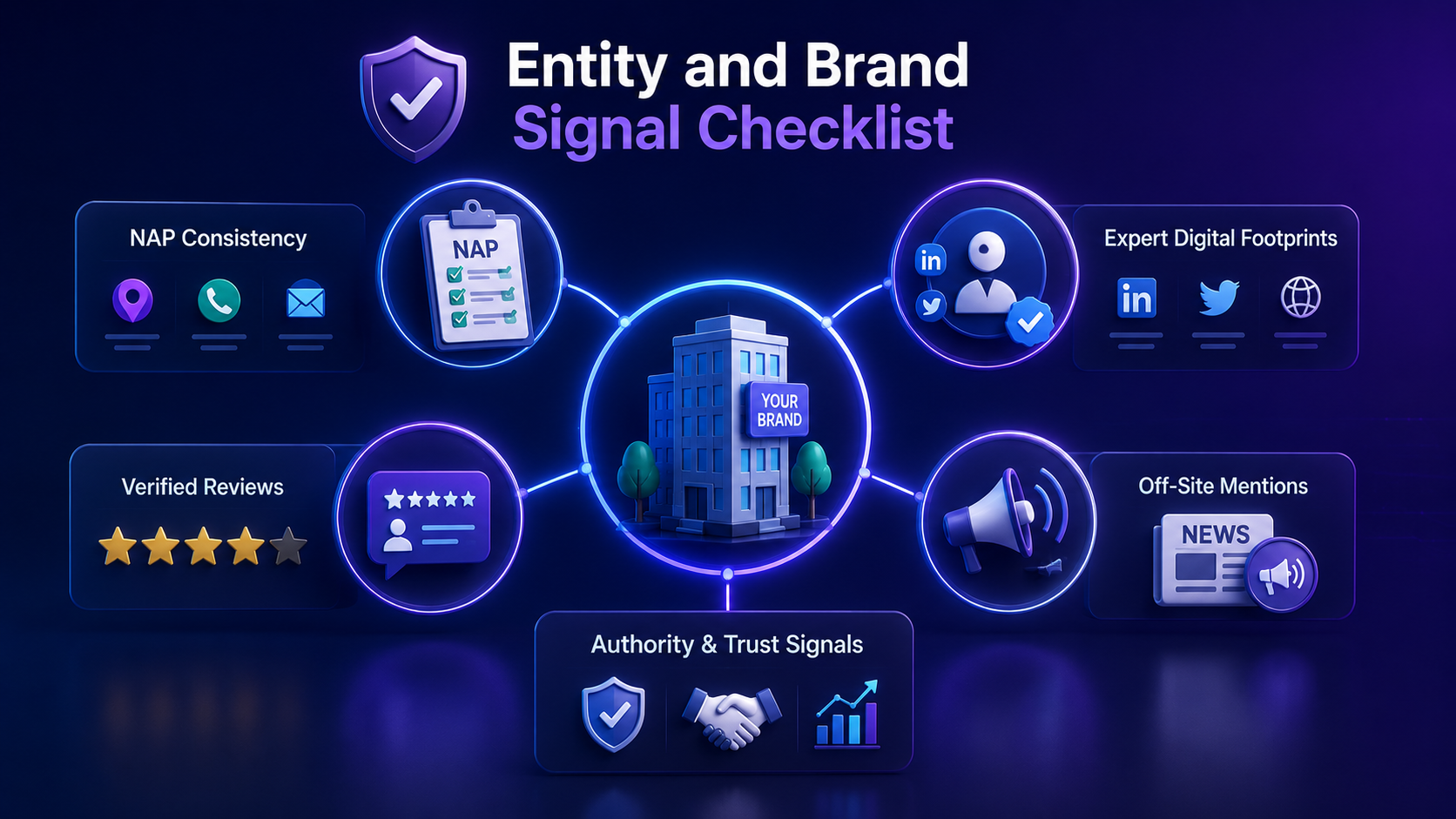
AI engines do not view your brand as an isolated website; they see it as an entity connected to an entire digital ecosystem. An entity SEO audit tracks how consistently your brand signals are broadcast across the web, ensuring there is no confusion about who you are.
This begins with strict Name, Address, Phone (NAP) consistency. Your corporate contact signatures must be identical across your website footer, social channels, and third-party business registers. Next, build out expert digital footprints by connecting your content authors to verified social accounts, professional directories, and external industry contributions.
The algorithm validates your authority by cross-referencing these off-site signals. To reinforce this trust, actively collect verified client reviews on authoritative, independent platforms and secure earned off-site mentions on industry news sites. Every external citation serves as a validation node, directly contributing to your overall AI visibility audit performance.
LLM Visibility Checklist
To figure out how to audit a website for AI search visibility, you have to test the platforms directly. Running intentional prompt tests allows you to analyze how different engines talk about your brand and where your competitors are stealing real estate.
| LLM PROMPT TESTING FRAMEWORK |
|---|
| 1. “What are the best [your industry] services?” |
| 2. “Which companies specialize in [your niche]?” |
| 3. “Give me a breakdown of [your brand name].” |
Begin by conducting a ChatGPT visibility audit alongside a Perplexity visibility audit using high-intent commercial prompts. Observe whether the engines include your brand in their recommendations, pull accurate data regarding your pricing, or drop direct, clickable source citations back to your domain.
Expand this testing into a Gemini visibility audit to monitor how Google’s language model synthesizes information about your services. If you find that old, outdated details are appearing, or that your brand is entirely missing from competitor roundups, it means you have critical content gaps that are blocking your business from earning high-value brand mentions.
Internal Linking Checklist
A calculated internal linking strategy shows web scrapers how your different topics connect, passing authority from informational guides directly to your high-value commercial landing pages. It builds a map of your expertise.
Your audit should ensure that all supporting informational posts link back to your primary commercial assets using descriptive anchor variation. Avoid generic phrases like “click here” or “read more”; instead, use natural anchors that clearly indicate the destination page.
Keep a close eye out for dead links or broken internal redirections, as these create immediate dead ends for automated crawlers. Finally, resolve orphaned content by ensuring every page is reachable through logical user navigation paths, reinforcing your site’s overall topical authority audit.
E-E-A-T Checklist
Generative engines are highly selective about the sources they cite, prioritizing content that demonstrates high levels of Experience, Expertise, Authoritativeness, and Trustworthiness (E-E-A-T).
To satisfy these algorithms, your content must feature verified author profiles complete with clear bios, links to professional histories, and documented industry credentials. Transparency is a powerful trust signal, so ensure your site provides easy access to an up-to-date corporate footprint, including an in-depth about page, clear contact details, a comprehensive privacy policy, and explicit terms of service.
Finally, support your educational content with verified proof of service. Integrating deep-dive case studies, client success video interviews, and direct customer testimonials across your transactional pages provides the real-world validation that algorithms require before recommending your business to users.
Final AI SEO Action Plan
Once you complete your AI SEO audit checklist, organize your findings into a practical, phased development roadmap rather than trying to fix everything at once.
Phase 1: Quick Structural Wins
Start by cleaning up your immediate technical errors. Repair all broken internal links, fix redirect chains, and clear out any JSON-LD schema code errors using validation tools. Update your root directory files to properly allow modern search bots, and add conversational FAQ text blocks to your highest-performing service pages to capture low-hanging search real estate.
Phase 2: Priority Strategic Updates
Focus on improving your core content machine readability. Reformat dense text blocks using clear structural headings and scannable paragraph layouts. Deploy comprehensive organizational, product, and service schema layers across your commercial pages, and systematically build internal links from high-authority informational articles down into your transactional landing pages.
Phase 3: Long-Term Growth Work
Establish sustainable market dominance by launching comprehensive content clusters tailored to specific industry niches. Build out detailed pricing guides and transparent agency comparison matrices to satisfy commercial intent queries. Finally, establish a workflow to monitor your conversational share of voice monthly, allowing you to accurately measure your long-term performance shifts.
Want a clear view of your AI search readiness?
Deftsoft can audit your website for technical SEO, schema, content quality, internal linking, brand signals, and AI visibility.
FAQs
What is an AI SEO audit?
It is a structural review of a website designed to evaluate how easily generative engines crawl, interpret, and cite your content. Unlike traditional audits that focus solely on standard keyword placements, it analyzes schema microdata, machine readability, entity mapping, and visibility in conversational engines.
Why does my website need an AI SEO audit?
Traditional optimization tools are blind to conversational layouts. If your site code or content structure makes it difficult for automated scrapers to pull summaries or verify your brand details, your business will miss out on direct citations inside Google AI Overviews, ChatGPT, and Perplexity answers.
What should an AI SEO audit include?
A thorough review covers six critical areas: foundational technical performance, crawler access configuration in your robots settings, semantic schema maps, content formatting for natural language processing, off-site entity brand signals, and direct visibility testing across conversational engines.
How do I check if ChatGPT mentions my brand?
You must test the interface directly with commercial search queries such as “What are the top software solutions for [your industry]?” or “Who provides specialized services for [your niche]?” This helps you analyze whether the system recommends your brand or cites your domain as a trusted source.
Is schema markup important for AI SEO?
Yes, it is vital. A structured schema serves as a direct, machine-readable data layer for search algorithms. Properly implementing code layers such as organization, service, and product markup removes ambiguity about what your business offers, making it easier for AI tools to extract accurate details.
How often should I run an AI SEO audit?
You should run a full technical and structural check at least once every six months. Because generative platforms, LLM user-agents, and search scraper rules evolve rapidly, keeping tabs on your system access controls and citation trends prevents sudden drops in digital visibility.
Can an AI SEO audit improve Google rankings?
Yes. The technical updates required for machine readability—such as fast loading times, clean code, logical internal linking, and rich schema markup—align directly with Google’s core ranking signals for traditional organic search results.
Recent Articles





Devraj
 3rd June 2026