Is AI Really Saving Costs? Why Uber and Microsoft Are Rethinking Their AI Spending
-
By Devraj
-
29th May 2026
Quick Summary:
AI was supposed to be the ultimate cost-saving machine. But in 2026, two of the world’s most tech-forward companies, Microsoft and Uber, are openly admitting that their AI spending has spiralled far beyond expectations. Uber burned through its entire annual AI budget in just four months. Microsoft quietly cancelled thousands of AI tool licences after costs exceeded what it would have paid humans for the same work. This blog unpacks what actually happened, what it means for enterprise AI strategy, and, critically, how businesses can invest in AI intelligently without blowing their budgets.
Are You Worried About Your AI Spendings
Deftsoft helps businesses build AI strategies that actually deliver ROI.
Quick Navigation
The Token Problem Nobody Talked About
Will Tokens Get Cheaper? Yes, But Not in the Way You Hope
The Real Culprit: Adoption Without Strategy
What Smart Enterprise AI Strategy Actually Looks Like
The Bigger Picture: AI Is Still Worth It, If You’re Strategic
The Promise vs The Reality
When companies started rolling out AI tools at scale in 2024 and 2025, the pitch was consistent: automate repetitive work, reduce headcount costs, ship products faster, and watch ROI compound over time.
That pitch wasn’t wrong. But it was incomplete.
Uber’s CTO Praveen Neppalli Naga told The Information that his company had burned through its entire 2026 AI coding budget in just four months. His exact words: “I’m back to the drawing board, because the budget I thought I would need is blown away already.”
Microsoft, meanwhile, started cancelling most of its direct Claude Code licences after employees rapidly embraced the AI coding assistant, shifting developers towards GitHub Copilot CLI to try to control growing AI-related expenses.
These aren’t struggling companies making rookie mistakes. These are two of the most sophisticated technology organisations on the planet. So what went wrong, and what does it mean for your enterprise AI strategy?
The Token Problem Nobody Talked About
Here’s the core issue with AI spending at scale, and it’s surprisingly simple once you understand it.
Traditional software is priced per seat or on a subscription basis. You pay £X per user per month, and your costs are predictable. AI tools don’t work that way.
Unlike salaries, AI systems are charged on a token-per-work-run basis. Each prompt, each response, and every automated workflow consumes tokens that must be paid for continuously. As companies scale AI use across more teams, token consumption surges.
Around 70% of code committed at Uber now originates with AI, and 11% of live backend updates are shipped by an agent with no human in the loop. That level of adoption sounds impressive, and it is, but it also means token consumption at an industrial scale, running 24 hours a day.
AI software prices across the US have climbed 20–37%. GitHub is responding to the pressure by shifting all Copilot plans to usage-based billing through GitHub AI Credits starting June 1, 2026, signalling that even the largest AI platforms are redesigning their commercial models around the reality that heavy usage at enterprise scale creates unpredictable cost exposure.
The lesson: the cost of AI is not fixed. It scales with usage, and usage tends to grow faster than budgets do.
Will Tokens Get Cheaper? Yes, But Not in the Way You Hope
A natural response is: “Fine, but AI compute costs are falling. Won’t this sort itself out?”
Partially, a recent Gartner report found that by 2030, inference on a one-trillion-parameter LLM will cost AI firms nearly 90% less than it did in 2025. But Gartner also predicted that cheaper tokens won’t translate to cheaper enterprise AI, because agentic models require far more tokens per task than standard models, increased consumption outpaces falling unit costs, and AI providers won’t fully pass through lower costs to consumers.
Gartner senior director analyst Will Sommer warned: “Chief Product Officers should not confuse the deflation of commodity tokens with the democratization of frontier reasoning.”
Translation: yes, a single token gets cheaper. But agentic AI, the kind that takes autonomous multi-step actions across your systems, uses vastly more tokens per task. The net bill doesn’t shrink. For most enterprises, it grows.
A separate Gartner study forecasts AI agent software spending will reach nearly $207 billion in 2026 and $376.3 billion in 2027, up more than 139% from the $86.4 billion spent in 2025. The market is not slowing down. The costs are not going away.
The Real Culprit: Adoption Without Strategy
Reading these stories carefully, one notices a pattern. Neither Microsoft nor Uber failed because AI doesn’t work. They ran into trouble because adoption outpaced strategy.
Uber had actively incentivized adoption through internal leaderboards that ranked teams by AI tool usage, essentially gamifying AI consumption. More usage meant more recognition. But more usage also meant more tokens, more compute, and more cost with no corresponding budget framework to manage the scale.
Back in late 2025, Microsoft gave thousands of its people, engineers, product managers, designers, and even folks in non-technical roles, access to Claude Code. Blanket rollout, minimal governance, and the bills followed.
This is the pattern that defines poor enterprise AI strategy in 2026: deploy fast, measure later. The companies that are getting AI right are doing the opposite, starting with clear use cases, defined ROI metrics, and cost guardrails built in from the beginning.
What Smart Enterprise AI Strategy Actually Looks Like
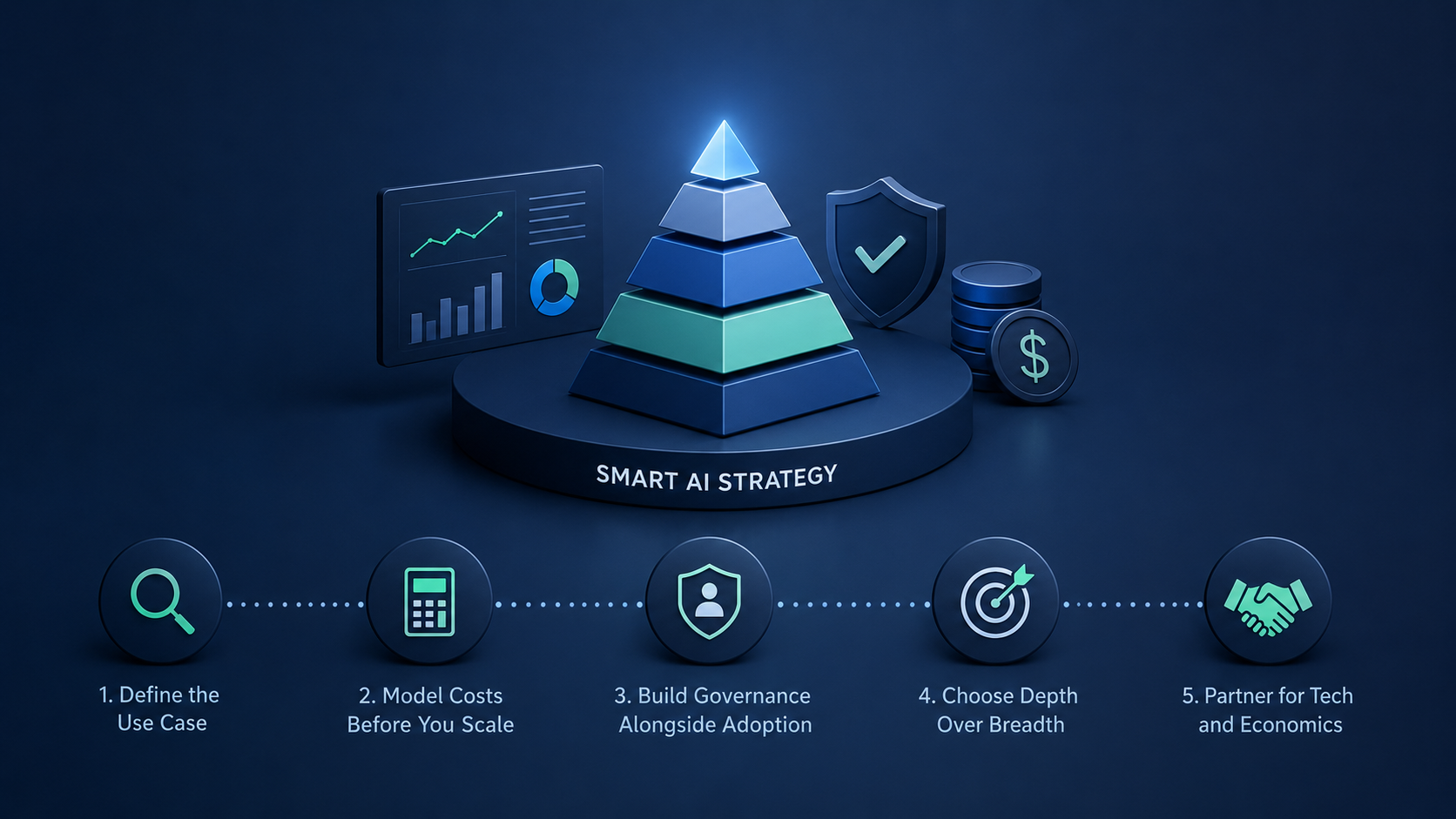
The Uber and Microsoft stories are cautionary, but they’re not arguments against AI. They’re arguments against adopting unstructured AI. Here’s what a more deliberate enterprise AI strategy looks like in practice.
1. Define the use case before the tool. Don’t ask “how can we use AI?” Ask “which specific workflows have measurable inefficiency, and what would a 30% improvement be worth?” AI investments tied to concrete outcomes have defensible ROI. Broad AI rollouts don’t.
2. Model your token costs before you scale. If you’re adopting AI coding tools, AI agents, or LLM-powered workflows, model token consumption at 50%, 80%, and 100% adoption. The cost of AI at scale is not linear, and most enterprise buyers don’t discover this until the invoice arrives.
3. Build governance alongside adoption. Usage dashboards, team-level budgets, and clear policies on when to use which AI tool aren’t bureaucracy. They’re the difference between AI that compounds value and AI that compounds bills.
4. Choose depth over breadth. Instead of giving every employee access to every AI tool, identify the 2–3 use cases where AI genuinely transforms output quality or speed, and go deep on those. Concentrated, well-governed AI investment consistently outperforms scattered adoption.
5. Work with a partner who understands both the technology and the economics. This is where Deftsoft comes in. Our AI consulting services help businesses design enterprise AI strategies that are grounded in real use cases, real cost modelling, and real integration, not vendor demos and enthusiasm.
The Bigger Picture: AI Is Still Worth It, If You’re Strategic
None of this means AI is overhyped or not worth investing in. The productivity gains are real. 70% of Uber’s code now originates with AI; that’s a genuine shift in engineering output, even if the cost management needs work. Microsoft’s AI products remain central to its growth story.
The problem was never AI itself. The problem was treating AI as a cost-saving tool rather than a capability-building investment that requires its own strategy, governance, and economic model.
Businesses that approach AI this way, with clear objectives, measured rollouts, and a partner who can help them build and manage AI systems intelligently, are seeing real returns. Those who deploy first and figure out the economics later are writing the next round of cautionary headlines.
How Deftsoft Helps Businesses Get AI Right
At Deftsoft, we’ve spent years building AI-powered products and advising businesses on where and how AI actually delivers value. Our AI consulting services go beyond recommending tools; we help you build a structured enterprise AI strategy that fits your budget, your team, and your actual business goals.
Whether you’re evaluating AI adoption for the first time, trying to bring runaway AI spending under control, or ready to build custom AI systems that give you a genuine competitive advantage, our team has the technical depth and strategic experience to do it properly.
The Uber and Microsoft stories aren’t reasons to avoid AI. There are reasons to approach it smarter.
Don’t let unplanned AI spending become your next headline.
Deftsoft helps businesses build AI strategies that actually deliver ROI.
FAQs
1. Why did Uber’s AI spending go over budget so quickly?
Uber burned through its 2026 AI coding budget in four months because token-based AI pricing scales with usage, and Uber actively encouraged maximum adoption across its engineering teams without corresponding cost controls. More usage meant exponentially higher token consumption.
2. What does “cost of AI” actually include for enterprises?
The cost of AI includes tool licences or usage-based API fees (charged per token), compute infrastructure, integration development, maintenance, staff training, and governance overhead. Most budget estimates focus only on licences and miss the full picture.
3. Is enterprise AI still worth investing in despite these challenges?
Yes, but strategically. The productivity and capability gains are real. The issue is unstructured adoption without cost governance. Businesses with a clear enterprise AI strategy consistently see positive ROI; those that deploy broadly without a framework typically overspend.
4. What is an enterprise AI strategy?
An enterprise AI strategy is a structured plan that defines which AI use cases a business will pursue, how AI tools will be governed and measured, what the expected ROI is, and how adoption will be managed across teams, preventing the kind of runaway spending seen at Uber and Microsoft.
5. Will AI token costs fall over time?
Token costs are falling, but Gartner research suggests this won’t reduce enterprise AI bills, because agentic AI requires far more tokens per task than standard models, and consumption growth outpaces unit cost reductions.
6. What’s the difference between AI tools and a custom AI strategy?
AI tools (like Claude Code or Copilot) are off-the-shelf products. A custom enterprise AI strategy involves selecting the right tools, defining governance policies, modelling costs, building custom AI systems where needed, and tying everything to measurable business outcomes.
7. How can Deftsoft help with enterprise AI strategy?
Deftsoft’s AI consulting team helps businesses design, build, and govern AI systems, from initial strategy and use case selection through to custom AI development, integration, and ongoing cost optimisation. We help you get AI right the first time.





Devraj
 29th May 2026