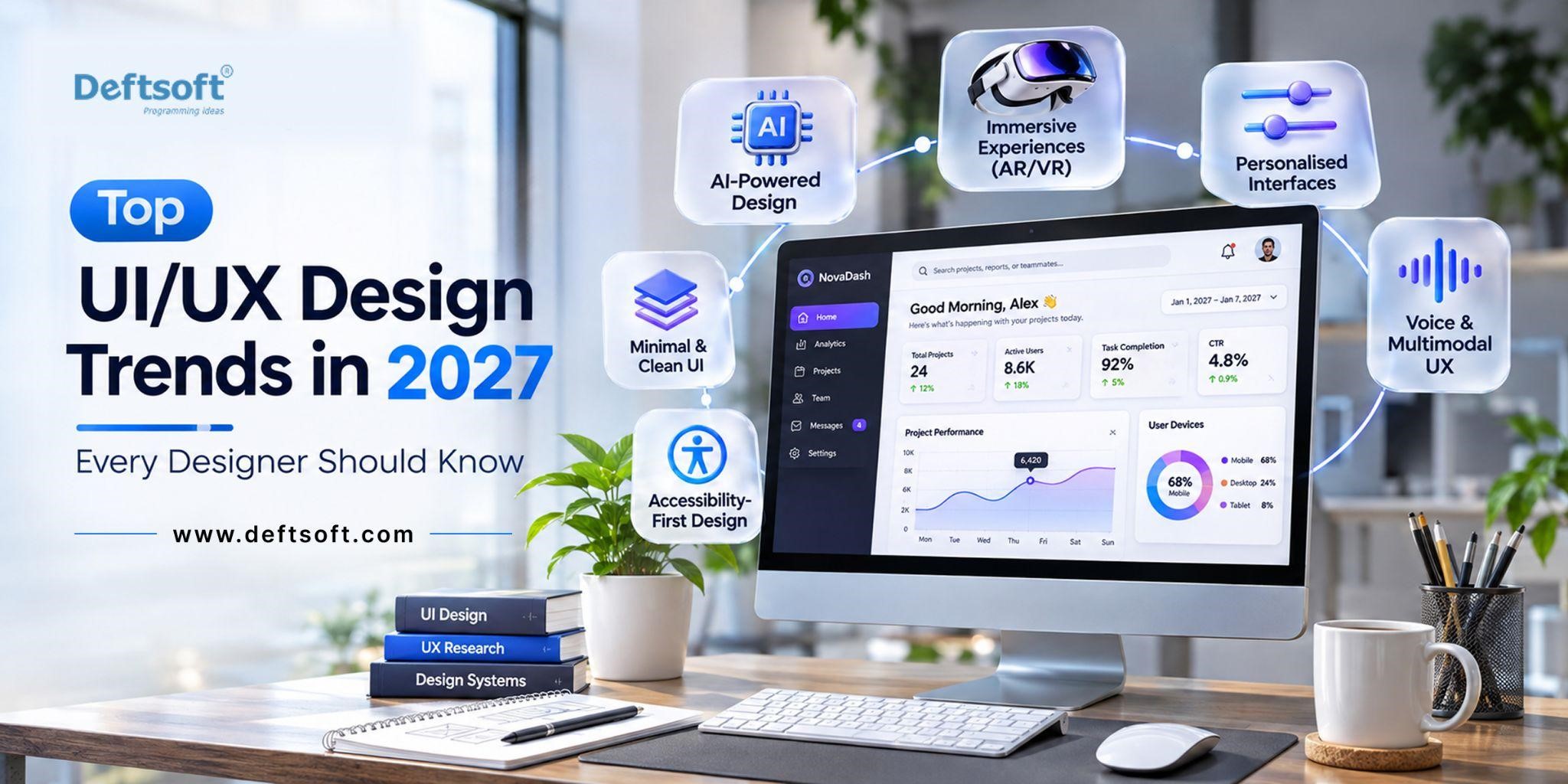
Top UI/UX Design Trends in 2027 Every Designer Should Know
-
By Devraj
-
3rd November 2026
UI UX design trends are shifting faster than ever, and 2027 will reward teams that pair bold creativity with real usability. Features that felt experimental a few years ago, such as dark mode, gradients and playful motion, are now baseline expectations, so designers must look further ahead to stand out.
At Deftsoft, we design and build digital products every day, which gives us a front-row view of what users respond to. This guide covers the UX design trends 2027 and UI design trends 2027 that matter most, from immersive 3D and expressive typography to AI-driven personalization. Whether you lead a design team or are building your first product, use it to decide which ideas fit your audience.
In this guide, you will learn:
- 13 key UI UX design trends for 2027
- 4 ways AI in UI UX design is changing the craft
- Why following the latest UI UX trends pays off
- 5 frequently asked questions answered
Stay Ahead of the Curve in 2027
Don’t let your digital product fall behind. Partner with Deftsoft to build future-ready, high-performing UI/UX designs that captivate users.
Table of Content
13 Key UI UX Design Trends for 2027
AI in UI UX Design: 4 Trends to Watch
Why Follow UI UX Design Trends?
13 Key UI UX Design Trends for 2027
Trend 1: 3D and Immersive Elements
3D design in UI UX is moving from decoration to function. With WebGL and lightweight 3D libraries, interfaces now offer rotatable product models, scroll-triggered scenes and AR previews that let users try before they buy. A shopper can spin a sneaker, place a sofa in their living room or walk through a virtual showroom without leaving the page. Keep performance in view. Compress models, lazy-load heavy scenes and always provide a static fallback so the experience stays fast on mid-range phones.
Trend 2: Experimental Navigation
Not every site needs a standard Home, About, Contact bar. Designers are testing radial menus, hidden drawers, interactive maps and nonlinear journeys that feel more like exploring than clicking. These patterns suit portfolios, campaigns and brand storytelling sites. Use them with care: if users cannot find the checkout or the contact page in a few seconds, the novelty has cost you conversions. Prototype and test before you ship.
Trend 3: Vibrant Color Palettes
Color is turning the volume up. Saturated neon gradients, high-contrast pairings and playful hues, influenced by Y2K nostalgia and “dopamine design”, are replacing muted tones, especially for lifestyle, beauty, wellness and youth-focused brands. Pair bold color with accessible contrast ratios so that energy never comes at the expense of readability.
Trend 4: Bold Typography
In modern UI design trends, type does more than carry words; it tells the story. Oversized headlines, custom typefaces, variable fonts and kinetic lettering create strong first impressions, and layered text over imagery gives hero sections real impact. Variable fonts help here too, since one file can flex across weights and widths and keep pages light.
Trend 5: Dark Mode UI Design
Dark mode UI design is now a default expectation rather than a bonus. It reduces eye strain in low light, can save battery on OLED screens and gives interfaces a premium look. The 2027 shift is toward adaptive theming: interfaces that follow system settings, schedule themes automatically and let users fine-tune contrast. Design both themes together from day one. Test color contrast in each, avoid pure black on pure white, and check that shadows, charts and illustrations still read well.
Trend 6: Microinteractions in UX Design
Microinteractions in UX design are the small moments that make a product feel alive: a button that ripples on tap, a heart that pulses when saved, a progress bar that celebrates completion. Done well, they confirm actions, guide attention and reduce uncertainty without slowing anything down. Match motion to brand tone. Smooth, slow easing suits luxury and finance, while snappy, springy motion suits playful consumer apps. Always respect reduced-motion settings.
Bring Your Interface to Life
From subtle button ripples to engaging feedback loops, our designers craft meaningful microinteractions that elevate your user experience.
Trend 7: Gamified Design
Gamification turns routine flows into rewarding ones. Streaks, badges, progress bars, levels, challenges and micro-rewards motivate users to return and finish tasks such as onboarding, learning or checkout. Language apps and retail loyalty programs have shown how effective this can be. Keep rewards meaningful. Points that serve no purpose feel gimmicky, while progress tied to a real user goal builds lasting habits.
Trend 8: Soft UI and Neumorphism
Neumorphism blends the tactile realism of skeuomorphism with modern simplicity. Soft shadows and subtle gradients make buttons and cards look gently raised or pressed into the surface, which suits fintech, wellness and productivity apps that want a calm, polished feel. The main risk is low contrast. Reinforce soft surfaces with clear borders, icons and labels so every control stays obvious and accessible.
Trend 9: Retrofuturism
Retrofuturism fuses nostalgia with optimism. Think chrome textures, neon accents, pixel art and bold gradients inspired by sci-fi films, arcade games and the early web. It works especially well for entertainment, music, gaming and creative portfolios that want a memorable personality.
Trend 10: Maximalism and Minimalist UI Design
Maximalism is gaining ground, with layered visuals, rich color, dense compositions and expressive type. Even so, minimalist UI design is not going away. Clean layouts, generous whitespace and clear hierarchy remain the best choice for data-heavy dashboards, SaaS products and checkout flows. The smart move is to match intensity to context: go expressive on landing pages and campaigns, and stay minimal where users need to focus and complete tasks.
Trend 11: Responsive UI Design and Mobile App UI UX Trends
With most browsing happening on phones, responsive UI design is a baseline, not a feature. In 2027, responsive thinking extends to foldables, tablets, wearables and large displays, using fluid grids, container queries and flexible components. Among mobile app UI UX trends, expect more thumb-friendly layouts with bottom navigation, gesture-based controls, haptic feedback, one-handed reachability and fast, offline-aware experiences.
Trend 12: Neo-Brutalism and “Anti-Design”
Neo-brutalism embraces raw, unpolished visuals: thick outlines, flat blocks of color, stark grids and deliberately rough type. It stands out in a sea of sleek templates and suits edgy fashion brands, creative agencies and product teams that want to feel irreverent and confident. Stay disciplined underneath the rawness. Keep spacing consistent, hierarchy clear and tap targets large so the look never hurts usability.
Trend 13: Sustainable, Accessible and Ethical Design
Sustainable design is shaping how products get built. Leaner code, optimized images and efficient hosting reduce a product’s digital carbon footprint and also speed up load times. Accessibility and ethics belong in the same conversation: high-contrast palettes, screen reader support, keyboard-only flows, captions and voice navigation, plus a firm stance against dark patterns that trick users. These practices are quickly moving from nice-to-have to expected.
Build Inclusive & Sustainable Digital Products
Ensure your platform is accessible to everyone while optimizing performance. Let Deftsoft help you meet modern accessibility and ethical design standards.
AI in UI UX Design: 4 Trends to Watch
AI in UI UX design is making products smarter, more personal and faster to build. Here is how it is showing up in 2027.
AI Trend 1: Agentic Chatbots
Chatbots are moving from scripted FAQ boxes to proactive, conversational agents that complete multi-step tasks, such as rebooking a trip or configuring a plan, and anticipate what users need next. Design for transparency: show what the agent is doing, let users correct it and make human handoff easy.
AI Trend 2: Voice-Activated Interfaces
Voice navigation is becoming more capable and more common. It improves accessibility, enables hands-free use and lets people search, filter and control features by speaking naturally. Treat voice as a companion to touch, not a replacement, and design clear visual confirmation for every spoken command.
AI Trend 3: Adaptive Personalization and Progressive Profiling
Smarter interfaces learn from behavior over time. Forms ask only what is needed at each step, dashboards surface the features each person uses most, and recommendations improve with every interaction. Always give users visible control over what is personalized and why.
AI Trend 4: AI-Assisted Design Workflows
Design teams use generative tools to explore layouts, draft copy, build prototypes and automate repetitive tasks, which frees time for research and craft. At Deftsoft, we see AI as an accelerator: it widens the range of ideas a team can test, while human judgment still decides which ones are right for users.
Why Follow UI UX Design Trends?
Keeping up with the latest UI UX trends helps you:
- Improve usability and accessibility for every kind of user
- Stand out from competitors with similar features and pricing
- Keep your product feeling fresh, credible and relevant
- Stay compatible with new devices, standards and user habits
- Encourage experimentation and learning across your team
Trends are a menu, not a mandate. Choose the ones that serve your audience, your brand and your business goals.
Why Choose Deftsoft for UI UX Design?
Deftsoft is a software development and design company that turns ideas into intuitive, high-performing digital products. Here is what sets our UI UX design services apart:
- Strong user research foundation: We start with your audience, goals and data, so every design decision is backed by real user insight.
- Designers and engineers working side by side: Concepts are checked for feasibility, speed and performance from day one, which avoids costly rework later.
- Trend-aware, brand-first design: We apply the latest UI UX trends, from 3D and microinteractions to AI-driven personalization, only where they fit your brand and users.
- Accessibility and responsiveness built in: Our interfaces work across devices and meet accessibility best practices.
- Prototype, test and refine: Interactive prototypes and usability testing validate ideas before development begins.
- End-to-end delivery: We support websites, web apps and mobile apps, from research and wireframes through development, launch and ongoing improvement.
- Transparent, collaborative process: Clear communication and regular reviews keep you involved at every stage.
Ready to Design What’s Next?
Transform your vision into an intuitive, award-winning digital product with Deftsoft’s end-to-end UI/UX design and development services.
UI UX Design Trends FAQs
1. What are the top UI UX design trends for 2027?
The biggest UI UX design trends for 2027 are AI-driven personalization and agentic assistants, immersive 3D and AR, adaptive dark mode, expressive typography and vibrant color, purposeful microinteractions, responsive and mobile-first layouts, and sustainable, accessible design.
2. How is AI changing UI UX design?
AI is changing both the product and the process. In products, it powers conversational agents, voice control and interfaces that adapt to each user. In the design process, it speeds up ideation, prototyping and testing. Designers still guide strategy, ethics and quality.
3. Is minimalist UI design still relevant in 2027?
Yes. Minimalist UI design remains the best fit for dashboards, SaaS tools and transactional flows where clarity and speed matter most. Many teams now mix minimal layouts with expressive accents, such as bold type or motion, to add personality without clutter.
4. How do I choose which UX design trends to adopt?
Start with your audience, goals and brand personality. Test a trend with a quick prototype and real users, and adopt it only if it improves task completion, accessibility or engagement. If a trend hurts speed or clarity, skip it.
5. Why are microinteractions and dark mode important for user experience?
Microinteractions give instant feedback and make an interface feel responsive and human, while dark mode improves comfort in low light and lets users personalize their experience. Together they raise satisfaction and make products feel polished and accessible.
Conclusion: Design for What’s Next with Deftsoft
The user experience design trends and user interface design trends of 2027 share one theme: experiences that feel more personal, more immersive and more inclusive. Pick the trends that fit your users, test them early and keep usability at the center of every decision. Ready to build a product that looks ahead? Talk to the Deftsoft design team about a UI UX audit, a redesign or a brand-new digital product.
Recent Articles



Devraj
 3rd November 2026