Top IoT Application Development Trends to Watch in 2027
-
By Devraj
-
21st October 2026
What Are the Top IoT Application Development Trends in 2027?
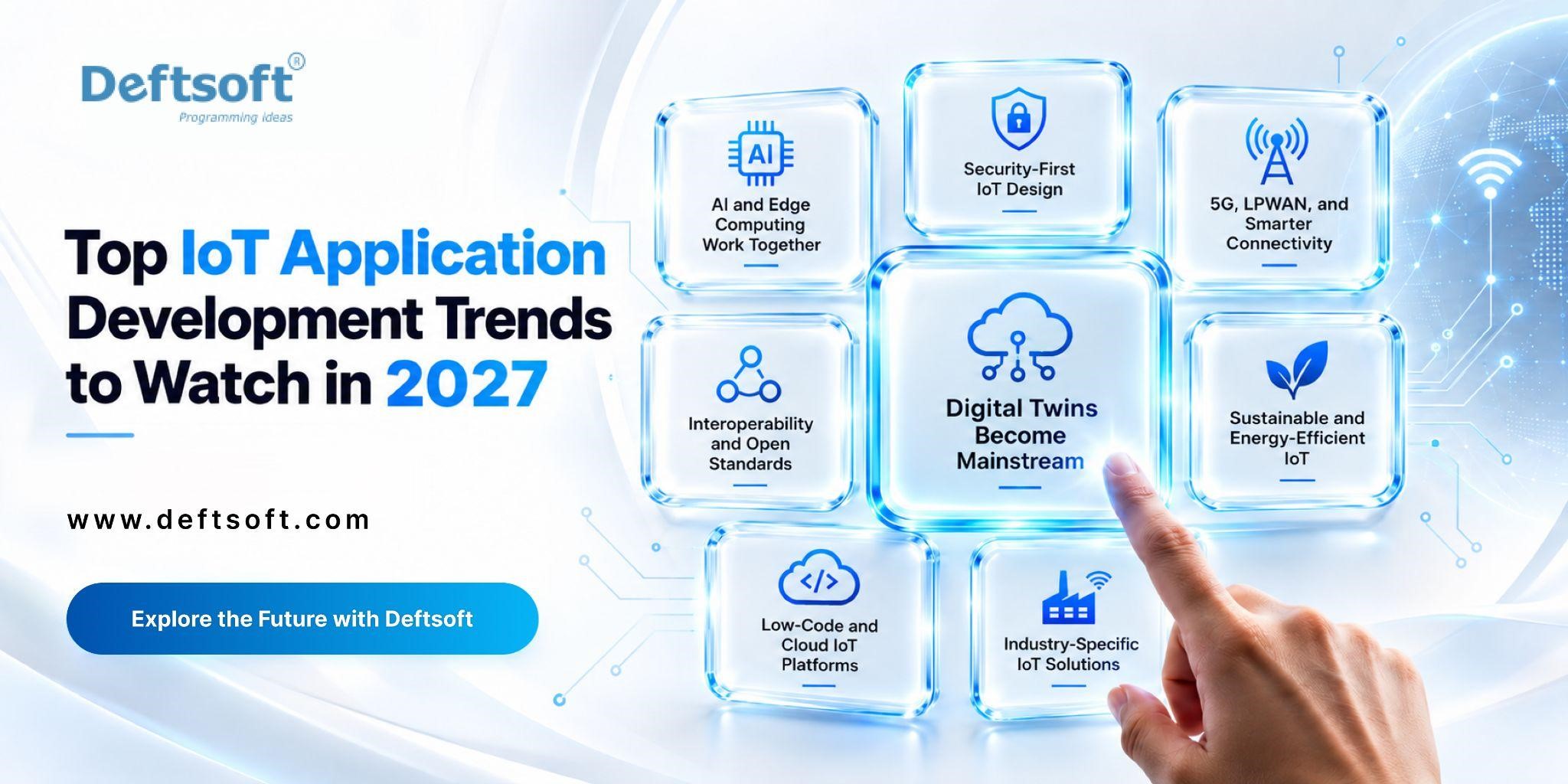
The biggest IoT Application Development trends in 2027 are:
- AI and edge computing: devices process data and run AI models locally for faster responses and lower cloud costs.
- Stronger IoT security: zero-trust design, end-to-end encryption, secure boot, and regular over-the-air updates.
- 5G and low-power networks: 5G, LoRaWAN, and NB-IoT deliver faster, longer-range, battery-friendly connectivity.
- Digital twins: live virtual copies of machines and systems used to predict failures and test changes.
- Interoperability through open standards: Matter, MQTT, and OPC UA let devices from different brands work together.
- Sustainable and energy-smart IoT: ultra-low-power sensors and smart energy monitoring.
- Low-code and platform-based IoT app development: cloud IoT platforms help teams launch and scale faster.
- Industry-specific IoT solutions: tailored solutions for healthcare, manufacturing, logistics, and smart cities.
Ready to plan your IoT product?
Talk to our team about your idea and get a clear roadmap.
Table of Content
Quick Answer: What Are the Top IoT Application Development Trends in 2027?
Why IoT Development Matters More Than Ever in 2027
Eight IoT Application Development Trends to Watch
How to Choose an IoT Application Development Company
Why IoT Development Matters More Than Ever in 2027
The Internet of Things (IoT) connects physical devices such as sensors, machines, wearables, and vehicles to software that collects data and acts on it. In 2027, IoT is no longer a “nice to have.” It is how modern businesses cut costs, prevent failures, and serve customers better.
Whether you run a factory, a hospital, a fleet, or a retail chain, smart IoT development helps you:
- Monitor assets in real time
- Predict problems before they happen
- Automate routine work
- Make decisions using live data
But the technology moves fast, and choosing the wrong approach today can mean expensive rework tomorrow. That is why understanding the trends below matters before you start IoT app development. Strong IoT application development is not only about connecting devices. It also depends on the apps people use to control them, which is why most projects combine device work with mobile app development and web dashboards.
Eight IoT Application Development Trends to Watch
1. AI and Edge Computing Work Together
Instead of sending all data to the cloud, devices now process data locally, at the edge, using built-in AI models. This gives faster responses, which is critical for safety systems and machines. It also lowers cloud and bandwidth costs, keeps working when the connection is weak or missing, and improves privacy because sensitive data stays on the device.
Picture a camera on a production line that spots a defect instantly and stops the machine, with no wait for a cloud response. When planning IoT application development, decide early which tasks run on the device and which run in the cloud. That one decision shapes cost, speed, and reliability for the life of the product.
2. Security-First IoT Design
Every connected device is a possible entry point for attackers. In 2027, Cyber security is built in from day one, not added at the end. The practices to expect include:
- Zero-trust architecture, where no device is trusted by default
- Secure boot and signed firmware updates
- End-to-end data encryption and a unique identity for every device
- Regular over-the-air (OTA) security patches
Ask any IoT software development company how it handles device authentication and OTA updates. A weak answer is a red flag.
3. 5G, LPWAN, and Smarter Connectivity
Better networks open new possibilities, but each suits a different job. Choosing the right connectivity affects cost, battery life, and performance, so a good IoT solution development plan matches the network to your real-world use case.
| Network | Best For |
|---|---|
| 5G | Real-time video, connected vehicles, smart factories |
| LPWAN (LoRaWAN, NB-IoT) | Battery-powered sensors over long distances |
| Wi-Fi 6/7 | Dense indoor deployments |
| Bluetooth Low Energy | Wearables, asset tags, and short-range devices |
4. Digital Twins Become Mainstream
A digital twin is a live virtual copy of a physical asset, such as a machine, building, or supply chain. It lets you test changes, predict failures, and optimize performance without touching the real thing. The benefits are less unplanned downtime, smarter maintenance schedules, faster product testing, and better planning and forecasting. As sensor data becomes cheaper to collect, twins are moving from large enterprises into mid-sized businesses.
5. Interoperability and Open Standards
One of the biggest IoT headaches has been devices from different brands that cannot talk to each other. Open standards such as Matter, MQTT, and OPC UA are making integration easier. For your business, that means building on open standards to avoid vendor lock-in and make future upgrades simpler and cheaper. It also helps when your app has to work across phones and tablets, since cross platform app development tools can reuse the same logic when the device layer is standardized.
6. Sustainable and Energy-Efficient IoT
Businesses want IoT that saves energy, not IoT that wastes it. Expect more focus on energy-harvesting and ultra-low-power sensors, smart building and energy management, and water, waste, and emissions monitoring. Live data is also starting to support ESG (environmental, social, governance) reporting, so sustainability goals can be tracked with evidence instead of estimates.
7. Low-Code and Cloud IoT Platforms
Cloud platforms such as AWS IoT, Azure IoT, and Google Cloud-based tools, plus low-code dashboards, are shortening development time. Teams can launch a working prototype faster and then scale it. Platforms speed things up, but custom logic, security, and integrations still need experienced engineers. This is where professional IoT application development services and wider app development services make the difference between a demo and a dependable product.
8. Industry-Specific IoT Solutions
Generic solutions are giving way to tailored ones. In healthcare, that means remote patient monitoring and smart medical devices. Manufacturing leans on predictive maintenance and quality control, while logistics uses fleet tracking and cold-chain monitoring. Retail applies IoT to smart inventory and customer analytics, agriculture to soil, crop, and irrigation sensing, and smart cities and buildings to traffic, lighting, energy, and safety. The closer a solution fits its industry, the faster it delivers value.
Not sure which trends fit your business?
Share your use case and our IoT experts will help you prioritize.
How to Build an IoT Solution
Here is a simple process to take your idea from concept to launch.
Step 1: Define the business problem. Start with the problem, not the technology. Decide whether you want to improve cost, speed, safety, or customer experience, and set clear goals and success metrics.
Step 2: Validate the use case. Check feasibility, expected ROI, and risks. A short discovery workshop saves months of wasted effort.
Step 3: Choose hardware and sensors. Select devices based on range, accuracy, power use, and cost. Plan for how many devices you will need at scale.
Step 4: Pick the connectivity. Match the network (5G, LoRaWAN, Wi-Fi, BLE) to your environment and battery needs.
Step 5: Design the architecture. Plan the device layer, gateway, cloud platform, data storage, and apps. Decide what runs at the edge and what runs in the cloud.
Step 6: Build the IoT app and dashboard. Develop the web and mobile apps users will interact with. This is where Android app development and iOS app development come in, so field teams and customers can control devices from their phones. Keep the interface simple, with live data, alerts, and easy controls.
Step 7: Integrate with existing systems. Connect your IoT data to your CRM, ERP, and analytics tools so insights actually reach decision-makers.
Step 8: Test everything. Test device performance, network failure scenarios, security, and load. Real-world field testing is essential.
Step 9: Launch with a pilot. Roll out to a small group first. Collect feedback, fix issues, then scale.
Step 10: Maintain, monitor, and improve. Plan for OTA updates, security patches, performance monitoring, and new features. IoT is never “done.” It keeps evolving.
How to Choose an IoT Application Development Company
Use this checklist when comparing an IoT application development company. A strong partner should check most of these boxes, and any gap is worth asking about directly.
| What to Check | Why It Matters |
|---|---|
| Proven experience with real IoT projects | Case studies show the team has shipped working products |
| Skills across hardware, firmware, cloud, and app development | IoT fails at the weakest layer, so you need full coverage |
| Strong security practices | Connected devices are attractive targets |
| Experience with your industry | Domain knowledge shortens discovery and avoids mistakes |
| Clear communication, timelines, and transparent pricing | Prevents scope surprises |
| Post-launch support and maintenance | Devices need updates for years after launch |
| Ability to scale from prototype to full rollout | A pilot that cannot grow is a dead end |
Beyond the table, pay attention to how a team talks about trade-offs. A good IoT development partner will explain why one connectivity option or platform suits you better than another, instead of selling the same stack to everyone.
Why Businesses Choose Deftsoft for IoT Development
Deftsoft is an IoT software development company that helps startups and enterprises turn connected ideas into working products. Our IoT application development services cover:
- IoT consulting and strategy
- Custom IoT app development (web and mobile)
- Cloud and edge integration
- Device connectivity and firmware support
- Dashboards, analytics, and AI features
- Security, testing, and ongoing support
With Deftsoft you get a dedicated team that understands your goals, a clear roadmap, scope, and timeline, transparent communication at every stage, and solutions built to scale as your business grows. Because the same team handles the device layer and the app layer, you avoid the handoff gaps that often slow IoT projects down.
Have an IoT idea you want to build?
Tell us about your goals and get a project-specific plan.
Frequently Asked Questions
What is IoT application development?
IoT application development is the process of building software that connects, controls, and analyzes data from smart devices. It includes device firmware, cloud services, and web or mobile apps.
How much does IoT app development cost?
Cost depends on the number of devices, features, connectivity type, security needs, and integrations. A small prototype costs much less than a full enterprise platform. Sharing your requirements with an IoT application development company like Deftsoft gives you an accurate estimate.
How long does IoT solution development take?
A basic prototype can take a few weeks, while a complete solution with hardware integration, apps, and testing may take several months.
What technologies are used in IoT development?
Common technologies include MQTT, REST APIs, cloud platforms (AWS, Azure, Google Cloud), embedded firmware, React or Flutter for apps, and AI/ML for analytics.
How do I keep my IoT solution secure?
Use device authentication, encryption, secure updates, network segmentation, and regular monitoring from the start.
Which industries benefit most from IoT?
Healthcare, manufacturing, logistics, retail, agriculture, energy, and smart cities all see strong results.
How do I choose an IoT software development company?
Look for proven projects, full-stack IoT skills, strong security, clear communication, and long-term support.
Can Deftsoft build both the app and the device integration?
Yes. Deftsoft handles IoT app development, cloud setup, and device connectivity so you get one team from idea to launch.
Conclusion
The IoT landscape in 2027 is shaped by edge AI, security-first design, better connectivity, digital twins, open standards, sustainability, platform-based development, and industry-specific solutions. Businesses that act early gain a clear advantage: lower costs, faster decisions, and happier customers.
The key is to start with a clear goal, choose the right architecture, and partner with an experienced team. With the right IoT development partner, your idea can move from concept to a working, scalable product faster than you think.
Recent Articles


Devraj
 21st October 2026