iOS App Development Trends in 2026: What’s Changed and What Businesses Need to Know
-
By Devraj
-
1st July 2026
The App Store isn’t slowing down. There are now over 4.4 million iOS apps available, iOS devices generate more than 70% of total app store revenue globally, and Apple’s ecosystem produced $1.4 trillion in economic activity in 2025 alone. Yet the gap between apps that people actually use and apps that sit uninstalled after three days is wider than ever. The difference in 2026 isn’t just about design or marketing; it’s about whether the app was built with current technology and real user behaviour in mind.
Apple made several sweeping changes this year that most business owners haven’t fully processed yet. Some of them are cosmetic. Many of them are structural and directly affect how apps are built, how they’re reviewed, and how they perform in the hands of real users.
Quick Summary
Apple’s iOS ecosystem shifted significantly in 2026. iOS was rebranded as iOS 26, Swift jumped to version 6.4, Xcode gained agentic AI coding, and Apple Intelligence moved from a headline feature to a core development framework. For businesses planning or maintaining an iOS app, these aren’t just developer-facing updates; they directly affect how your app performs, how users experience it, and how competitive it looks on the App Store. This guide breaks down the biggest iOS app development trends of 2026 in plain language, what they mean for businesses, and what any company should understand before commissioning a new iOS app or updating an existing one.
Planning an iOS app in 2026?
iOS 26: What the Rebrand Actually Means
One of the least-discussed but most significant signals Apple sent this year was renaming iOS 19 to iOS 26, aligning it with the calendar year and unifying the naming convention across macOS, watchOS, iPadOS, and visionOS. This isn’t just a branding decision. It signals that Apple is treating all of its platforms as a single connected ecosystem rather than as separate products with distinct update cycles.
For businesses, this matters because an app built well in 2026 should work across iPhone, iPad, Mac, and Apple Watch with far less duplicate development effort than before. The underlying frameworks, particularly SwiftUI, are now designed to share UI logic across all Apple platforms from a single codebase. That means a business investing in a well-architected iOS app today is also laying the groundwork for an iPad or Mac version without having to start from scratch.
Apple Intelligence and On-Device AI: The Biggest Shift of 2026
If there’s one trend that separates iOS development in 2026 from every year before it, it’s the maturity of Apple Intelligence Apple’s on-device AI framework and what it now allows developers to build.
Apple recently announced that its Foundation Models framework now supports more powerful on-device models that accept image input, integrate server models, and enable building custom AI skills directly into apps using a single native Swift API. Critically, Apple built these next-generation foundation models in collaboration with Google’s Gemini, which means the AI capabilities available to iOS developers in 2026 are meaningfully more powerful than those available even 12 months ago.
What does this mean in practice? Running AI models directly on the device, rather than sending data to a server, means zero latency, complete privacy, and no ongoing server costs for AI functionality. An iOS app can now deliver personalised content recommendations, image recognition, natural language processing, predictive features, and intelligent automation entirely on the user’s device without any of the user’s data leaving it.
This is a genuine competitive advantage for any business building an iOS app in sectors where privacy is sensitive, like healthcare, finance, or legal services. It’s also a user experience advantage: on-device AI responds instantly, doesn’t require an internet connection, and builds user trust in ways that cloud-dependent AI features simply can’t.
For businesses, the practical question is: what intelligent features could genuinely improve your users’ experience of your app, and how can on-device AI deliver them without adding complexity or privacy risk? The apps getting the strongest App Store ratings right now are the ones that treat AI as a tool to remove friction from the user journey, not as a headline feature in a press release.
Swift 6.4 and Xcode 27: What Changed for Developers
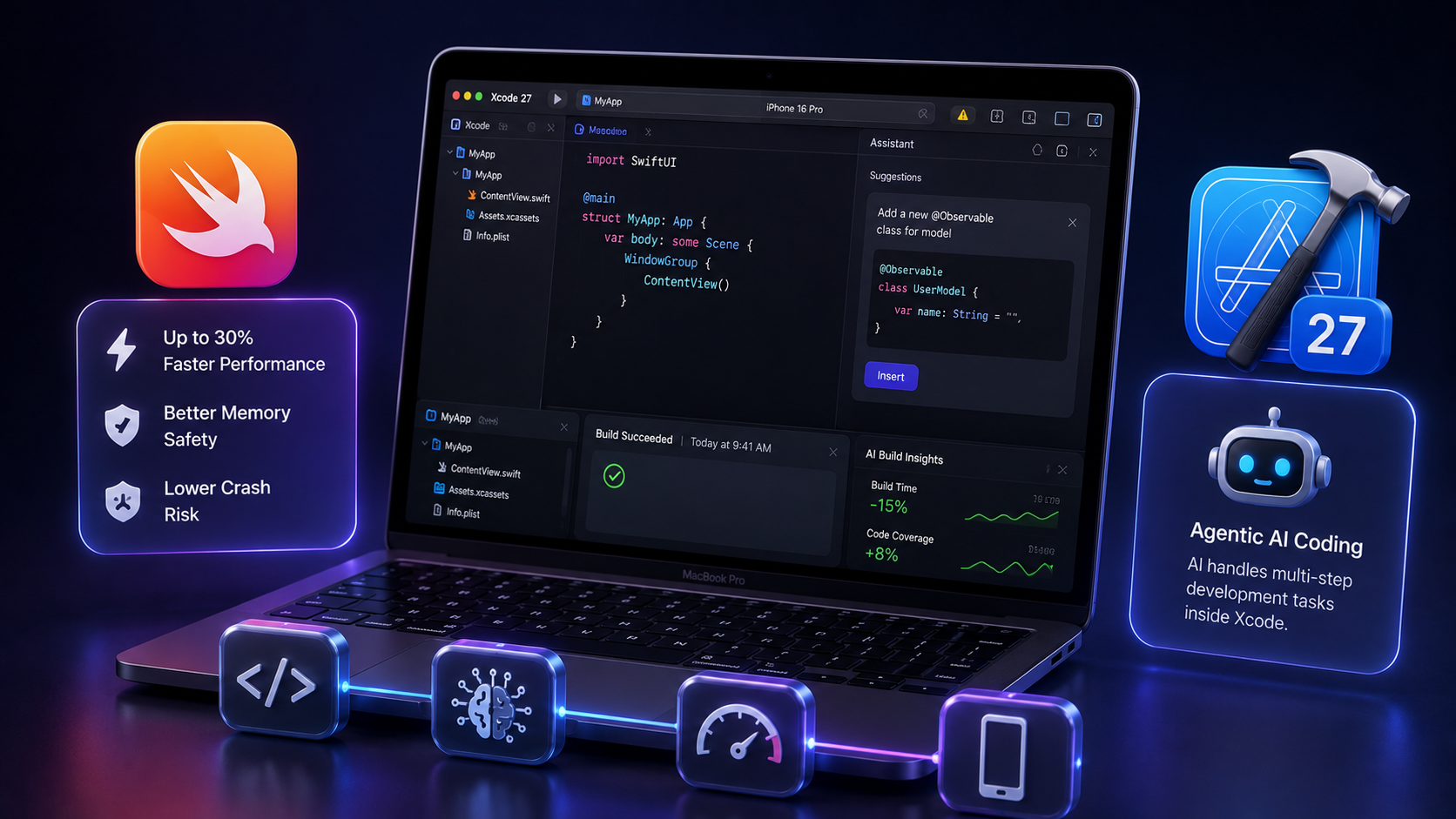 Apple shipped Swift 6.4 alongside Xcode 27 this year, and both updates matter for businesses evaluating iOS development projects.
Swift 6.4 focuses on making everyday development feel smoother: better compiler diagnostics, simplified availability checks across Apple platforms, and targeted improvements that reduce the boilerplate developers have to write. Apps built with Swift 6 run up to 30% faster than those built with older Swift versions, with significantly better memory safety and lower crash risk at runtime. Major companies, including PayPal, LinkedIn, and Uber, have already migrated their codebases to Swift 6, which is a useful signal of production readiness.
Xcode 27 introduces agentic AI coding, meaning AI models can now take on multi-step development tasks inside the IDE rather than just suggesting single lines of code. This doesn’t replace experienced iOS developers, but it does meaningfully affect development speed and the cost of building features, particularly for repetitive or well-defined tasks. For businesses, this is a positive signal: the cost and timeline for iOS app development projects are becoming more predictable as the tooling improves.
SwiftUI Is Now the Default, Not the Alternative
A few years ago, SwiftUI was the exciting new option, and UIKit was the safe, battle-tested choice. In 2026, that dynamic has fully reversed. Apple now builds most of its own first-party apps using SwiftUI, new APIs are almost exclusively SwiftUI-first, and the framework has matured to the point where it handles nearly every use case that previously required UIKit.
SwiftUI allows developers to write cleaner, faster code with less code, and share UI logic across iPhone, iPad, Mac, and Apple Watch from a single codebase. For businesses commissioning a new app, this means faster iteration, lower maintenance costs over time, and a more consistent experience across devices. For businesses with existing apps still on UIKit, a gradual migration to SwiftUI is increasingly worth planning not urgent, but worth building into a roadmap.
Privacy-First Design Is Now a Ranking Factor, Not Just a Value
Apple has spent years talking about privacy as a core principle. In 2026, it has teeth. The App Store review process is genuinely stricter about data collection transparency, and the reputational cost of a privacy incident in the current market is severe enough to reshape how development teams build from day one.
The practical impact is specific. Apps that ask for permissions location, camera, contacts, notifications before users have understood why they’re being asked are getting worse App Store reviews and lower conversion through the permissions prompt. The principle that’s emerged from performance data across the iOS ecosystem is that permission requests work best when they’re contextual: ask for location when the user tries to use a map feature, not on the first screen after download.
Privacy compliance in iOS app development now also means planning for data minimisation from the architecture stage. What data does your app actually need to function? Where does it go? How long is it retained? These questions used to be asked by legal teams after an app launched. In 2026, answering them at the design stage is what keeps an app out of trouble with both Apple’s review team and an increasingly privacy-aware user base.
AR and Spatial Computing: From Novelty to Functional Tool
Augmented Reality features in iOS apps have been available since ARKit launched in 2017, but adoption among business apps was slow for years because the use cases felt forced. That’s changing. The combination of more powerful iPhone hardware, improved ARKit frameworks, and the halo effect of Apple Vision Pro raising user familiarity with spatial interfaces is pushing AR from a novelty into a genuinely functional tool for specific industries.
The clearest current use cases are retail (letting users see how furniture or products look in their physical space before buying), real estate (interactive property tours without visiting in person), healthcare (visualising anatomy or procedure steps), and field service industries where technicians need hands-free access to schematics or instructions while working. In each of these, AR solves a real problem, not just adds something impressive to a demo. For businesses in these sectors, asking “could AR reduce a friction point in how users interact with our product?” is a more productive question than “should we have AR in our app?”
Performance and App Store Optimisation Still Win
Amid all the new technology trends, the fundamentals remain unchanged: users abandon slow apps, and undiscoverable apps don’t get downloaded regardless of quality.
A delay of even a few seconds at the wrong moment during checkout, login, or a search measurably impacts both conversion rates and App Store ratings. Performance optimisation isn’t a one-time task; it’s an ongoing discipline that the best iOS development teams treat as part of every release cycle, not a cleanup task before launch.
App Store Optimisation (ASO), the practice of improving how an app appears in App Store search results and category rankings, has also grown more sophisticated in 2026. With over 4.4 million apps competing for attention, keyword strategy in app titles and descriptions, screenshot design, preview videos, and rating management all contribute meaningfully to organic discovery. For businesses launching a new app or relaunching an existing one, ASO is as important as the development itself.
Cross-Platform vs Native iOS: Where the Decision Lands in 2026
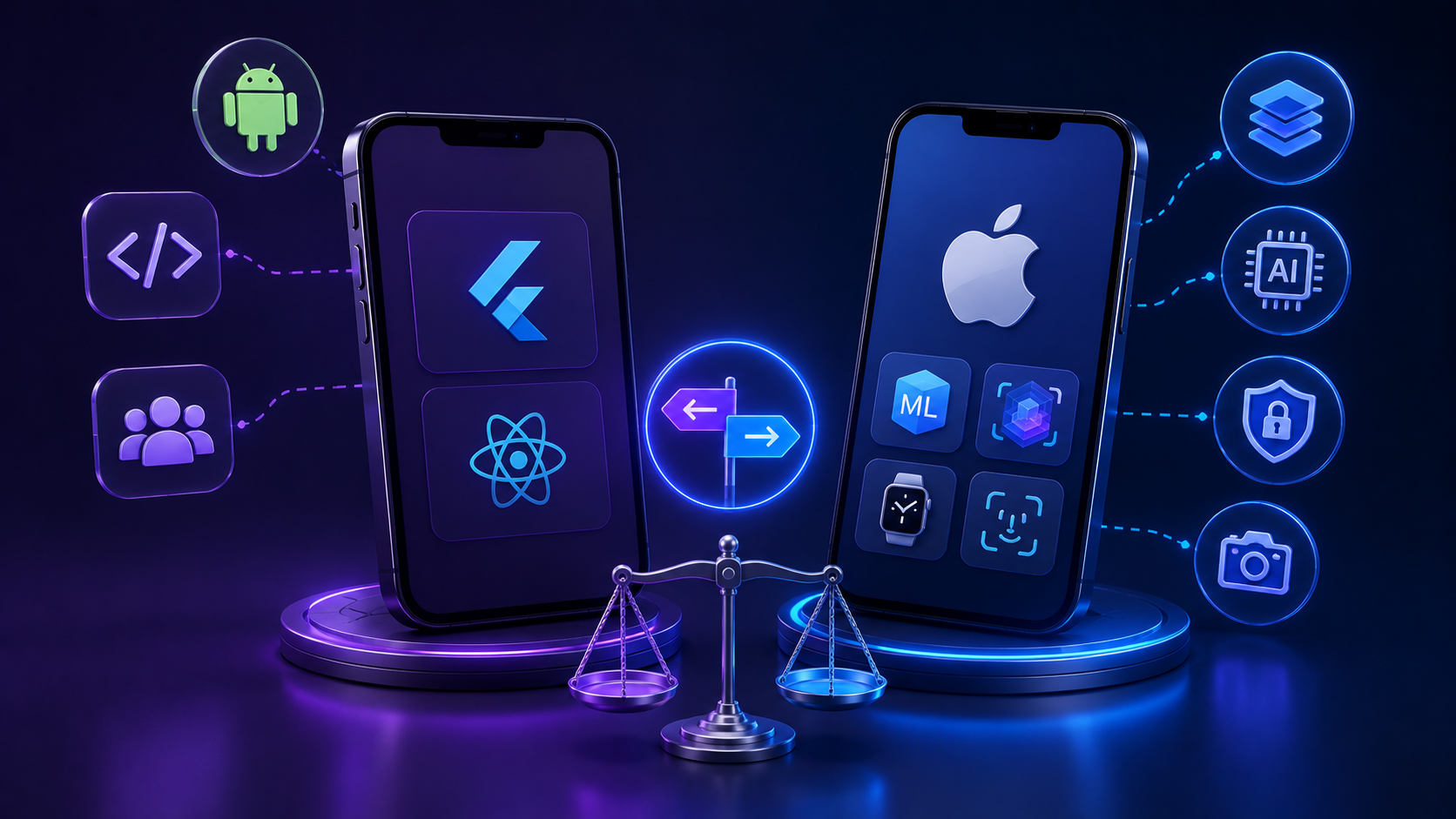 Businesses with limited budgets frequently ask whether they should build native iOS apps or use a cross-platform framework like Flutter or React Native that targets both iOS and Android from a single codebase.
The honest answer in 2026 is that cross-platform frameworks have closed the gap significantly, and Flutter, in particular, produces apps that are hard to distinguish from native apps in most use cases. For businesses that need to reach both iOS and Android audiences and have a defined budget, cross-platform is a genuinely viable choice.
Where native iOS development still wins is when the app needs deep integration with Apple-specific hardware or frameworks, on-device AI via Core ML, ARKit, Apple Watch, Face ID, or advanced camera features. If your app’s value proposition depends on any of these, native Swift development is worth the additional investment. If your app is primarily a content or transaction layer that doesn’t rely on Apple-specific capabilities, cross-platform is a legitimate path.
What This Means If You’re Building or Updating an iOS App
Pulling these trends together, a few decisions stand out for any business planning iOS development in 2026:
If you’re building a new app, start with SwiftUI and Swift 6.4, not legacy UIKit, unless there’s a specific reason to do otherwise. Treat on-device AI as something worth exploring for your core user journey from the design stage, not as an add-on later. Build privacy compliance into the architecture from day one. Design for mobile-first with a clear path to iPad and Mac via the same codebase.
If you’re updating an existing app, audit your permission request flows first; they’re one of the cheapest fixes with the highest impact on ratings and user trust. Plan a SwiftUI migration roadmap. Evaluate whether any of your current cloud-dependent AI features could be moved on-device for better performance and privacy.
Why Deftsoft for Your Next iOS App
Building an iOS app that genuinely performs in 2026 means staying current with a platform that moves fast. SwiftUI-first development, Apple Intelligence integration, privacy-compliant architecture, and App Store Optimisation aren’t optional layers you add later; they’re decisions made at the start of a project that determine how well an app holds up over time.
Deftsoft’s mobile development team builds iOS apps with the full current stack Swift 6, SwiftUI, Core ML, and ARKit where relevant and works with businesses to understand the use case before deciding on the architecture. Whether you’re building a new iOS app from scratch, migrating an existing one to modern frameworks, or trying to understand what your current app needs to stay competitive, we can help you scope it clearly and build it right.
Our work spans fintech, healthcare, retail, and enterprise apps, and every project starts with the same question: what does this app actually need to do for its users, and what’s the cleanest way to build it? Explore our iOS app development services to see how we approach it.
Got an iOS app idea or an existing app that needs work?
Frequently Asked Questions
1. What are the biggest iOS app development trends in 2026?
The most significant trends are Apple Intelligence and on-device AI (via the Foundation Models framework), the maturity of SwiftUI as the default UI framework, Swift 6.4’s performance and safety improvements, Xcode 27’s agentic AI coding capabilities, stricter privacy enforcement by Apple, and growing adoption of AR features for functional use cases in retail, healthcare, and real estate.
2. What is Apple Intelligence and why does it matter for app development?
Apple Intelligence is Apple’s on-device AI framework. In 2026, it allows developers to integrate powerful AI features personalisation, image recognition, natural language processing and intelligent automation directly into apps without sending user data to a server. This means faster responses, better privacy, no ongoing server costs for AI features, and apps that work even without an internet connection.
3. Should a new iOS app be built with SwiftUI or UIKit in 2026?
SwiftUI is now the default choice for new iOS projects. Apple builds most of its own apps with SwiftUI, new APIs are almost exclusively SwiftUI-first, and the framework supports all Apple platforms from a single codebase. UIKit remains relevant for maintaining older apps, but new projects should start with SwiftUI unless there’s a specific technical reason to do otherwise.
4. How does Swift 6.4 improve iOS app performance?
Apps built with Swift 6 run up to 30% faster than those built with older Swift versions. Swift 6.4 introduces improved compiler diagnostics, simplified cross-platform availability checks, and enhanced memory-safety features that reduce the risk of runtime crashes. Major companies including LinkedIn, Uber, and PayPal have already migrated their codebases to Swift 6.
5. How important is privacy in iOS app development in 2026?
Very. Apple’s App Store review process is genuinely stricter about data collection transparency, and apps that request permissions without clear context receive lower ratings and less user trust. Building privacy compliance into the architecture from day one data minimisation, contextual permission requests, on-device processing where possible is both a legal best practice and a conversion factor.
6. Is cross-platform development (Flutter, React Native) a good alternative to native iOS in 2026?
For apps that don’t rely on Apple-specific frameworks, Core ML, ARKit, Apple Watch, Face ID, advanced camera, cross-platform frameworks like Flutter are a viable and cost-effective option. Where the app’s value depends on deep Apple hardware or AI integration, native Swift development is worth the additional investment.
7. What is App Store Optimisation (ASO) and why does it matter?
ASO is the practice of improving how an app ranks and appears in App Store search results and category listings. With over 4.4 million iOS apps now available, organic discoverability depends on keyword strategy, screenshot quality, preview video performance, and rating management. A well-built app that isn’t optimised for the App Store will consistently underperform its potential, regardless of development quality.

Devraj
 1st July 2026