Google Intelligent Search Box: How AI Agents Are Changing SEO Forever
-
By Devraj
-
26th May 2026
Quick Summary
On May 19, 2026, at Google I/O, Google unveiled the most significant change to its search interface in 25 years: the Intelligent Search Box. Powered by Gemini 3.5 Flash, it replaces the traditional keyword input with a conversational, multimodal AI experience. Users can now type long natural-language queries, upload images or files, ask follow-up questions inside AI Mode, and deploy autonomous Information Agents that search the web on their behalf 24/7. By summer 2026, Google will also begin generating custom interactive UIs, visualizations, and mini apps directly inside Search results, all in real time.
For website owners, marketers, and businesses relying on organic traffic, this is not an incremental update. It is a structural shift that changes what SEO means, how content gets discovered, and what kind of authority makes a brand visible to AI. Brands that adapt quickly and publish authoritative, AI-legible, experience-backed content will gain an outsized advantage. Brands that wait will see organic clicks decline with no clear explanation.
This post breaks down every major change, maps the concrete SEO implications, and explains how Deftsoft can help you navigate and win in this new landscape.
Ready to future-proof your SEO before the summer 2026 rollout hits full force?
Quick Navigation
What Google Actually Changed, And Why It’s Different This Time
1. The Intelligent Search Box (Live Since May 19, 2026)
2. Seamless AI Overviews → AI Mode Flow (Live Since May 19, 2026)
3. Information Agents, AI That Searches the Web For You (Summer 2026, Pro/Ultra First)
4. Generative UI, Search Results That Look Like Custom Web Pages (Summer 2026, Free for All)
5. Mini Apps Inside Search (Summer 2026, Pro/Ultra First)
The SEO Impact: What Is Actually Changing, What Is Not
Click-Through Rates Will Fall for Informational Queries
Clicks That Do Happen Will Have Higher Commercial Intent
Brand Citations in AI Responses Will Become the New Ranking Signal
Long-Tail, Conversational Keywords Will Drive More Traffic Than Short Keywords
Technical SEO for AI Crawlability Becomes Non-Negotiable
What Your SEO Strategy Must Look Like After This Change
Stop Optimizing for Keyword Rankings Alone
Publish Non-Commodity Content, Original Data, Real Experience, Expert Perspective
Restructure Content for Conversational Query Matching
Build Topical Authority Across Your Full Domain
Ensure Your Site Is AI-Agent Accessible
How Deftsoft Helps You Win in the AI Search Era
Conversational SEO and Long-Form Keyword Mapping
Technical AI Crawlability Audits
E-E-A-T Building and Authority Development
Ongoing AI Search Monitoring and Adaptation
What Google Actually Changed, And Why It’s Different This Time
Google’s search box has looked and functioned the same way since the late 1990s. You typed keywords, hit enter, and received ten blue links. Every update since then, featured snippets, knowledge panels and AI Overviews, added new layers on top of that same input model.
The Intelligent Search Box does something different: it changes the input layer itself.
Here is what is live or arriving by summer 2026:
1. The Intelligent Search Box (Live Since May 19, 2026)
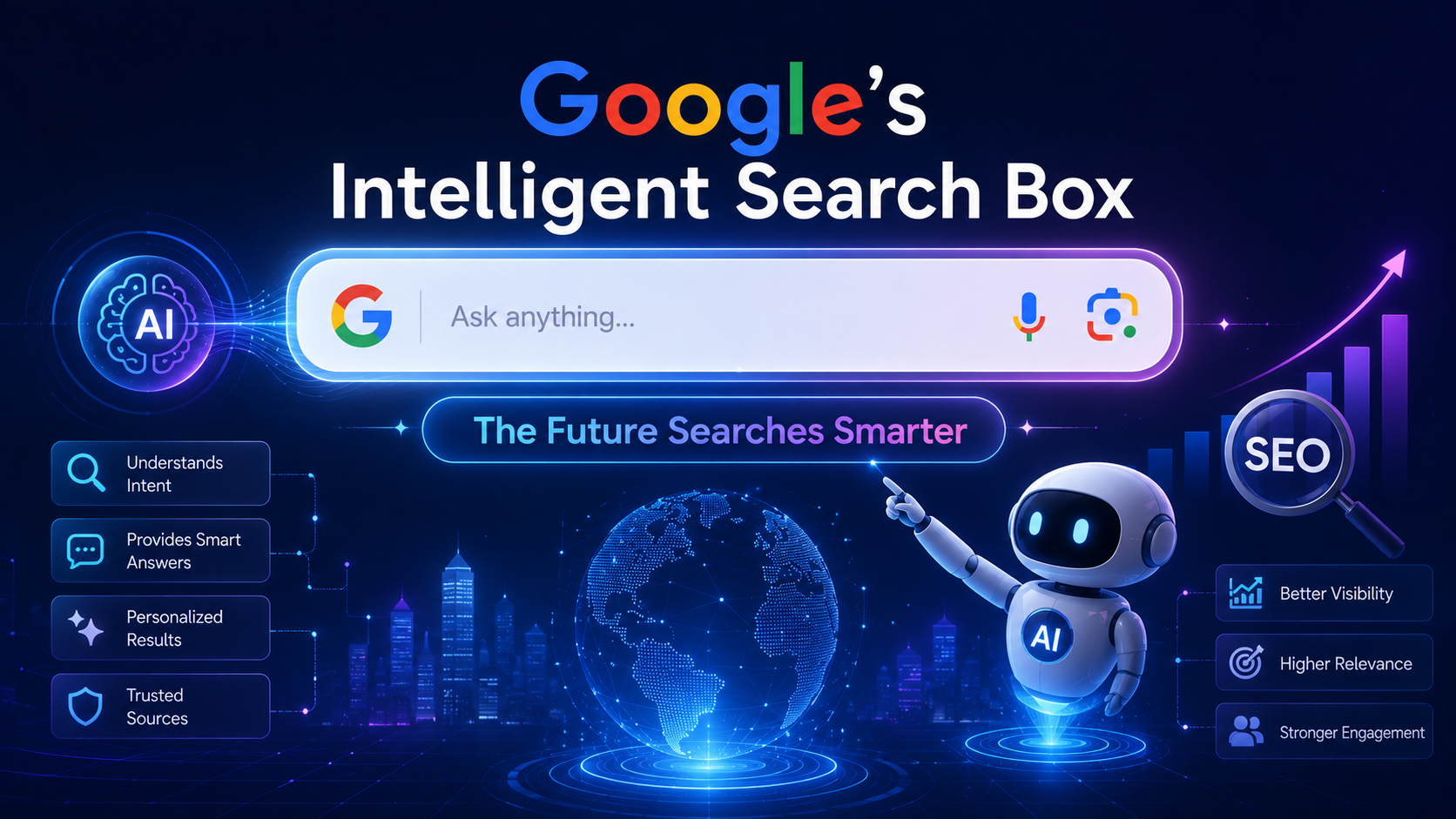
The search bar now dynamically expands as you type, designed explicitly for longer, more descriptive prompts rather than two-word keyword strings. Google’s Head of Search, Liz Reid, describes the AI-powered suggestion system as going “beyond autocomplete”; it proactively helps users articulate complex, nuanced questions they might not have known how to phrase before.
Crucially, the box accepts multimodal input, text, images, files, videos, and even open Chrome browser tabs. A user can upload a product photo and ask, “Where can I buy something similar under ₹2000 near me?” and Google will process the request end-to-end. This is not a lab experiment. It is live globally in all countries and languages where AI Mode is available.
The underlying model is Gemini 3.5 Flash, Google’s most capable and agent-optimized release, developed in partnership with Google DeepMind.
2. Seamless AI Overviews → AI Mode Flow (Live Since May 19, 2026)
Previously, AI Overviews appeared above organic results and served as an answer layer. Users had to choose between reading the AI summary or clicking a link. Now, users can flow directly from an AI Overview into AI Mode to continue the conversation, ask follow-up questions, dive deeper and refine their understanding, all without ever returning to a standard SERP.
Their context, query history, and source links persist throughout the conversation. This is now live on both desktop and mobile worldwide.
The SEO implication here is direct: a user who gets a sufficient answer inside AI Mode no longer needs to click to your site. The question is whether your content is what the AI is drawing from.
3. Information Agents, AI That Searches the Web For You (Summer 2026, Pro/Ultra First)
This is arguably the most consequential feature for the long-term future of search. Information Agents are autonomous AI systems that operate in the background, continuously scanning the web on a user’s behalf and delivering synthesized updates when conditions are met.
Think of a user who sets up an agent to monitor: “Alert me when any software development company in Chandigarh publishes a new case study related to e-commerce app development.” That agent will scan blogs, news sites, social posts, and real-time data sources, and it will surface your content if it qualifies, or your competitor’s if yours does not.
These agents will initially roll out to Google AI Pro and Google AI Ultra subscribers in the US this summer, with broader availability to follow globally.
The implication is that AI agents will increasingly perform searches on behalf of humans. People will spend less time choosing among ten blue links and more time acting on the synthesized outputs that those agents surface. This accelerates a trend already visible in AI Overview data, where clicks to source sites have declined even as search volume reaches all-time highs.
4. Generative UI, Search Results That Look Like Custom Web Pages (Summer 2026, Free for All)
Google’s new agentic coding capability, built on a platform called Google Antigravity, allows Search to generate completely custom interactive layouts in response to a query. Instead of listing links on a topic, Search might produce a real-time interactive simulation, a comparison table, or a dynamic visual explainer tailored to the question.
If someone searches “explain how MERN stack architecture handles state management,” Search might generate a custom animated diagram rather than link to one. By summer 2026, this feature will be free for all users.
5. Mini Apps Inside Search (Summer 2026, Pro/Ultra First)
Users will be able to ask Search to build them a personalized tool or tracker using natural language, no coding required. Examples: a wedding-planning dashboard that pulls data from their Google Calendar, a fitness tracker that integrates live weather and local gym data, and a competitor pricing monitor for their industry.
These mini apps live inside Search and use Antigravity with Gemini 3.5 Flash to assemble them in real time using live web data. This feature will launch first for Google AI Pro and Ultra subscribers, with broader availability to follow.
The SEO Impact: What Is Actually Changing, What Is Not
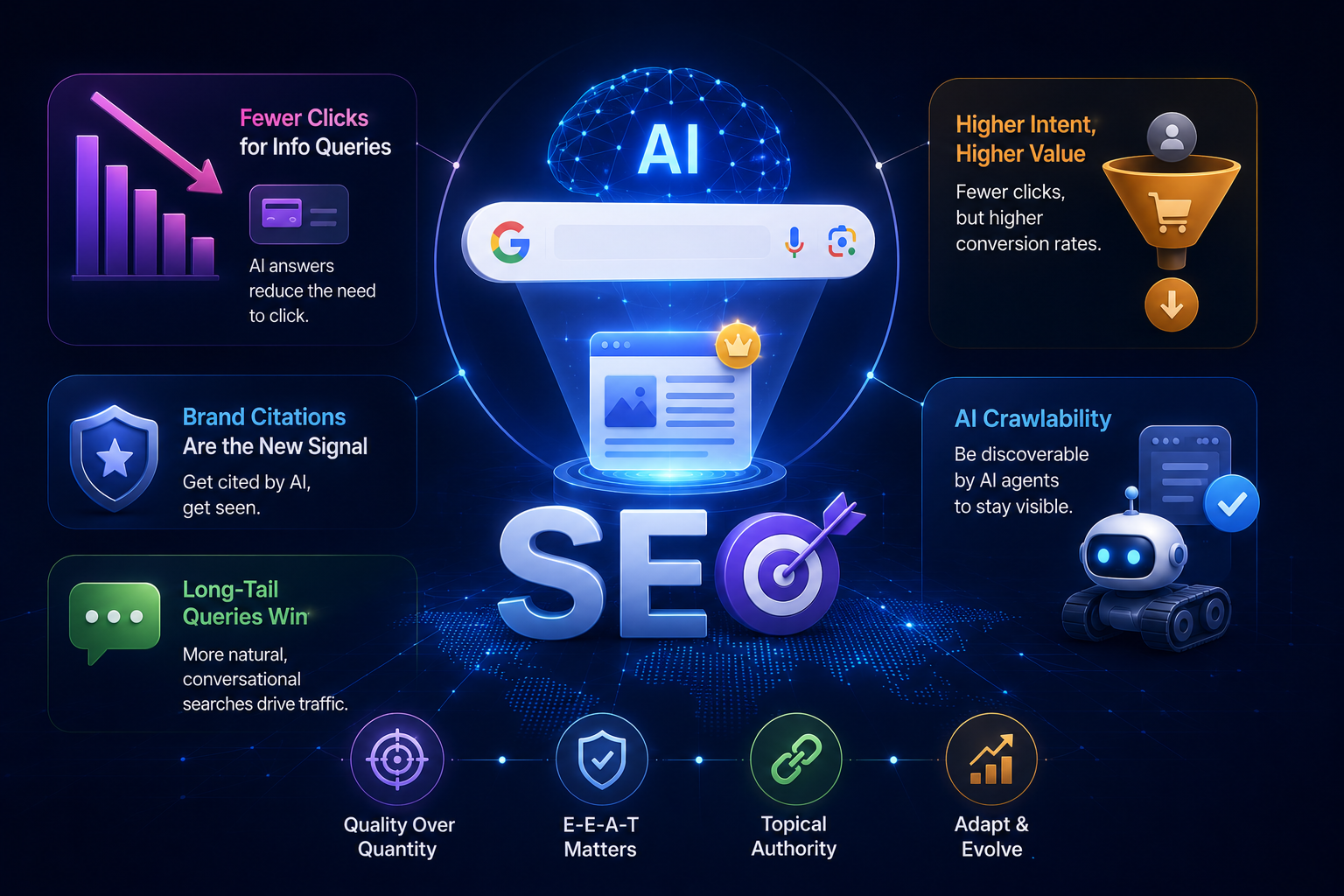
Let us be precise about what these changes mean for organic search in 2026 and beyond, because much of the commentary has been vague or alarmist without offering actionable guidance.
Click-Through Rates Will Fall for Informational Queries
This is not speculative. When users get complete, synthesized, conversational answers in AI Mode, with an interactive UI, follow-up capability, and persistent context, they have no reason to visit an external page for informational content. Travel guides, how-to articles, product explainers, and definitions are the categories most at risk.
Broad, shallow informational content will see the largest CTR drops. This type of content was already being eroded by AI Overviews; Information Agents will accelerate that erosion dramatically.
Clicks That Do Happen Will Have Higher Commercial Intent
The flip side: when a user leaves the AI interface and visits a website, it means the AI could not fully satisfy them. These visitors are bottom-of-funnel, high-intent, actively looking to buy, contact, or engage. Conversion rates on this traffic should rise even as volume falls.
Brand Citations in AI Responses Will Become the New Ranking Signal
When Google’s AI generates a response, it draws from sources it considers authoritative, accurate, and E-E-A-T-compliant (Experience, Expertise, Authoritativeness, Trustworthiness). Being cited in an AI Overview or Information Agent response functions like a position-zero ranking, but without the user ever seeing your URL unless they choose to explore further.
This means getting your brand mentioned and cited by Google’s AI is now a primary SEO goal, not a secondary one.
Long-Tail, Conversational Keywords Will Drive More Traffic Than Short Keywords
Because the Intelligent Search Box is designed for long, natural-language prompts, users will search in ways they previously could not. They will type full questions, multi-part scenarios, and contextual requests. Content that is structured to answer these naturally phrased, highly specific queries will see traffic gains, not losses.
Technical SEO for AI Crawlability Becomes Non-Negotiable
Information Agents and AI Mode pull data from the live web. If your site is not crawlable by AI bots, not structured with clear semantic markup, or not fast enough to be indexed in real time, you are invisible to these agents. Traditional SEO crawlability was important. AI crawlability is mandatory.
What Your SEO Strategy Must Look Like After This Change
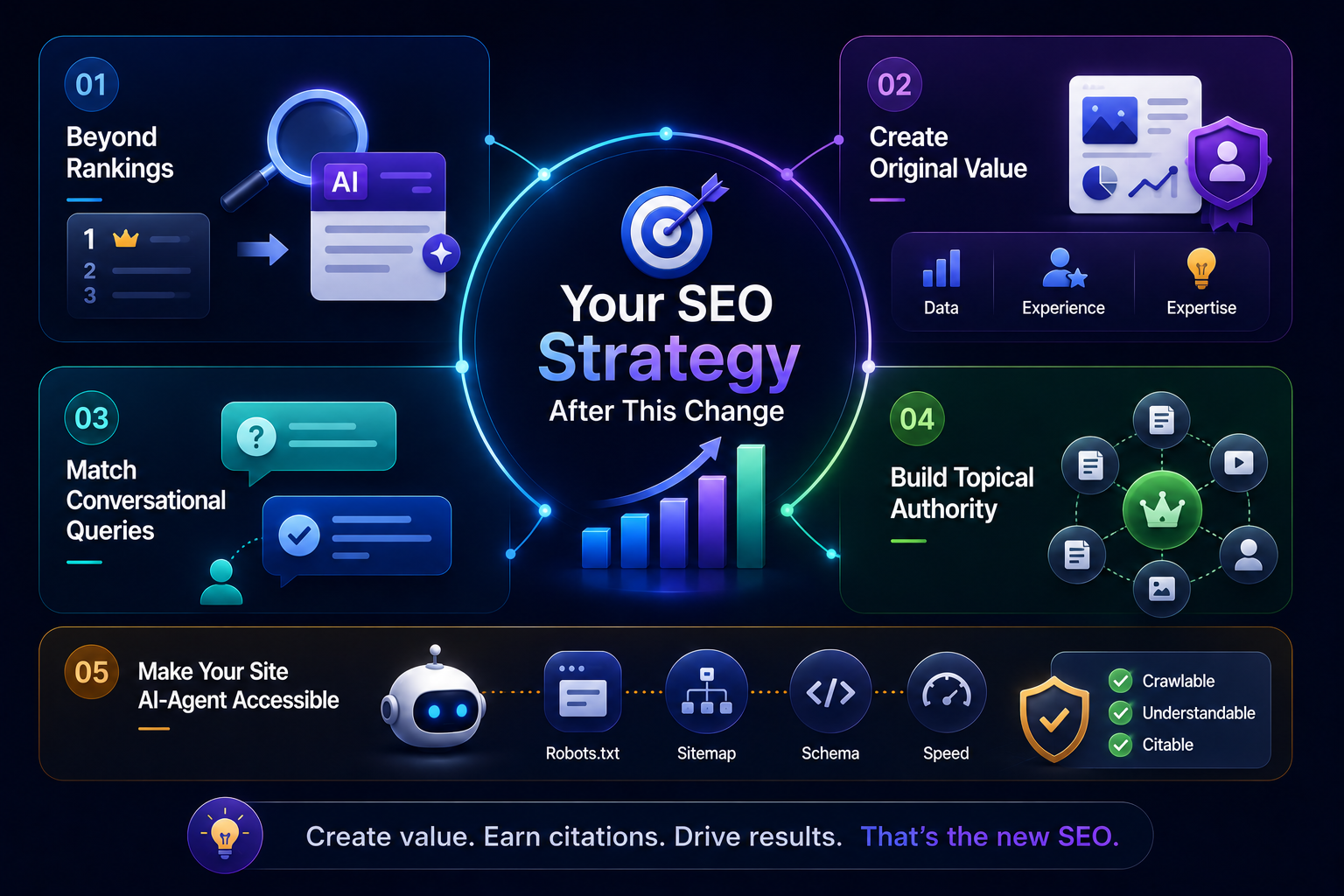
Stop Optimizing for Keyword Rankings Alone
Ranking #1 for a keyword means little if the user gets a complete answer in AI Mode without scrolling. Your content strategy must now target two goals simultaneously: ranking well enough to be cited as a source by Google’s AI, and providing enough depth that bottom-of-funnel users who click through find genuine value.
Publish Non-Commodity Content, Original Data, Real Experience, Expert Perspective
Google’s AI pulls from content that demonstrates real experience and expertise. Generic articles compiled from other generic articles are not cited. Original surveys, proprietary data, firsthand case studies, client results, and documented expert perspectives are cited. This is what “non-commodity content” means in the AI Search era.
Restructure Content for Conversational Query Matching
Every major page on your site should now address the question: “What is the most specific, natural-language question this page answers?” Then the content should answer it clearly, completely, and early, the way a knowledgeable person would answer a question in conversation, not the way a keyword-stuffed article would.
Build Topical Authority Across Your Full Domain
Information Agents do not cite isolated pages. They cite sources that demonstrate consistent, deep coverage of a subject area over time. A business that has published 50 well-structured, authoritative articles on custom software development is more likely to be surfaced by an agent than a business with one excellent page and nothing around it.
Ensure Your Site Is AI-Agent Accessible
Your robots.txt, sitemap, schema markup, and page speed all now affect whether AI agents can access, understand, and cite your content. Structured data, especially FAQ schema, HowTo schema, and Article schema, makes it dramatically easier for Gemini-powered systems to extract and surface your content correctly.
How Deftsoft Helps You Win in the AI Search Era
Deftsoft has been building organic visibility for clients across competitive industries for years. The transition to AI Search is the most significant shift we have navigated, and our service stack is built to handle exactly this kind of structural change.
Here is specifically what we do:
AI-Ready Content Strategy
We audit your existing content library to identify which pages are at risk of losing clicks to AI-generated responses, which pages have the authority signals needed to be cited by Information Agents, and which topics on your site represent genuine “non-commodity” knowledge gaps you can own. We then build a content roadmap that positions your brand as a cited authority, not just a ranked URL.
Conversational SEO and Long-Form Keyword Mapping
Our keyword strategy process now maps content to conversational, multi-intent, long-form query clusters, the type of prompts users enter into the Intelligent Search Box. We identify the questions your potential customers are articulating in natural language and ensure your pages provide clear, expert, satisfying answers to those exact questions.
Technical AI Crawlability Audits
We conduct deep technical audits that go beyond traditional crawlability to specifically evaluate how AI agents interact with your site. This includes AI bot access rules, structured data implementation, schema markup accuracy, Core Web Vitals compliance, and real-time indexation health. We make your site legible not just to Googlebot but to the AI systems now driving discovery.
E-E-A-T Building and Authority Development
We help you build the signals that Google’s AI weighs most heavily: authorship credibility, cited expertise, consistent publication history, original data assets, and digital PR that earns references on authoritative domains. These signals are what consistently surface a brand in AI-generated responses.
Ongoing AI Search Monitoring and Adaptation
The rollout of Information Agents and Generative UI is still underway. Summer 2026 will bring new data, new patterns, and new optimization opportunities. Deftsoft clients receive ongoing monitoring of how their brand appears (or does not appear) in AI Mode responses, and we iterate strategy as the landscape evolves. You will not be left figuring out what changed; we will tell you before it hits your traffic.
For Businesses Already Seeing Traffic Drops
If you have already noticed a decline in organic traffic in 2026 that does not correlate with a manual penalty or standard algorithm update, AI Overviews and early AI Mode usage are the most likely causes. Deftsoft offers a dedicated AI-impact traffic audit that isolates which query categories are being captured by AI responses and builds a recovery and adaptation plan specific to your site and industry.
Your organic traffic strategy needs to work for the AI Search era, not the 2020 era.
| Feature | Status | Who Has Access |
|---|---|---|
| Intelligent Search Box | Live (May 19, 2026) | All users globally where AI Mode is available |
| AI Overviews → AI Mode Flow | Live (May 19, 2026) | All users globally, desktop and mobile |
| Generative UI in Search | Summer 2026 | Free for all users |
| Information Agents | Summer 2026 | Google AI Pro & Ultra first, broader rollout to follow |
| Mini Apps in Search | Summer 2026 | Google AI Pro & Ultra first, broader rollout to follow |
| Personal Intelligence (Gmail, Photos, Calendar) | Rolling out now | 200 countries, 98 languages, no subscription required |
The window to adapt before Information Agents reach mainstream users is narrow. The businesses that establish AI-cited authority before summer 2026 will have a significant head start.
Frequently Asked Questions
Q: Will this update kill organic SEO entirely?
No, but it is changing what SEO delivers. Organic search is not dead; it is evolving from a volume-of-clicks model to a brand-authority-and-citation model. Businesses that build genuine topical authority will continue to benefit from organic search, including from being the sources that AI Mode and Information Agents cite and link to. Businesses with shallow, commodity content will see traffic drop.
Q: Does this mean AI Overviews will replace traditional search results?
Not entirely. Traditional results still appear alongside AI features for most queries, and for commercial, transactional, and local intent queries, blue-link results remain the primary click destination. What is changing is the share of informational queries in which users get complete answers within Google’s interface and never reach your site.
Q: What kind of content is most likely to be cited by Google’s AI?
Content that demonstrates genuine expertise, original research or data, firsthand experience, consistent topical depth across a domain, and clear, well-structured answers to specific questions. Google’s systems favor E-E-A-T (Experience, Expertise, Authoritativeness, Trustworthiness) signals. Content that merely summarizes what other sites say is unlikely to be surfaced.
Q: My site’s organic traffic has been declining since early 2026. Is this AI Search related?
Possibly. AI Overviews have been capturing informational clicks since 2024, and AI Mode has accelerated that trend in 2026. A proper AI-impact audit can isolate whether your decline is due to AI query capture, algorithm changes, technical issues, or a shift in search demand. Deftsoft offers this specific analysis.
Q: How do Information Agents decide which sites to surface?
Information Agents use the same trust and authority signals that Google Search has always relied on: domain authority, E-E-A-T, content freshness, structured data, and crawlability, but they prioritize real-time, specific, synthesizable content over general overview content. The more precisely your content answers a specific question with credible, original information, the more likely an agent will surface it.
Q: Will Deftsoft’s SEO services work for my industry specifically?
Deftsoft works across technology, e-commerce, professional services, healthcare, real estate, and education sectors. The principles of AI-era SEO, topical authority, E-E-A-T, conversational content structure, and technical crawlability apply across industries, but your content strategy, keyword mapping, and competitive positioning are tailored to your market. We start with an audit of your current visibility and your competitors’ before recommending any approach.
Q: Is there anything I can do right now before Information Agents roll out?
Yes, several things. Audit your current content for E-E-A-T signals and depth. Ensure your site is properly structured with schema markup. Identify your core topic clusters and fill gaps with original, expert-level content. Review your technical setup for AI bot accessibility. And establish a baseline measurement of how your brand currently appears in AI Mode responses so you can track changes over time. Deftsoft can handle all of this as part of an AI Search readiness engagement.
Recent Articles




Devraj
 26th May 2026