SEO for Hotels: Local SEO and PPC Strategies That Drive Bookings in 2026
-
By Devraj
-
6th April 2026
Quick Summary: The 2026 Hospitality Playbook
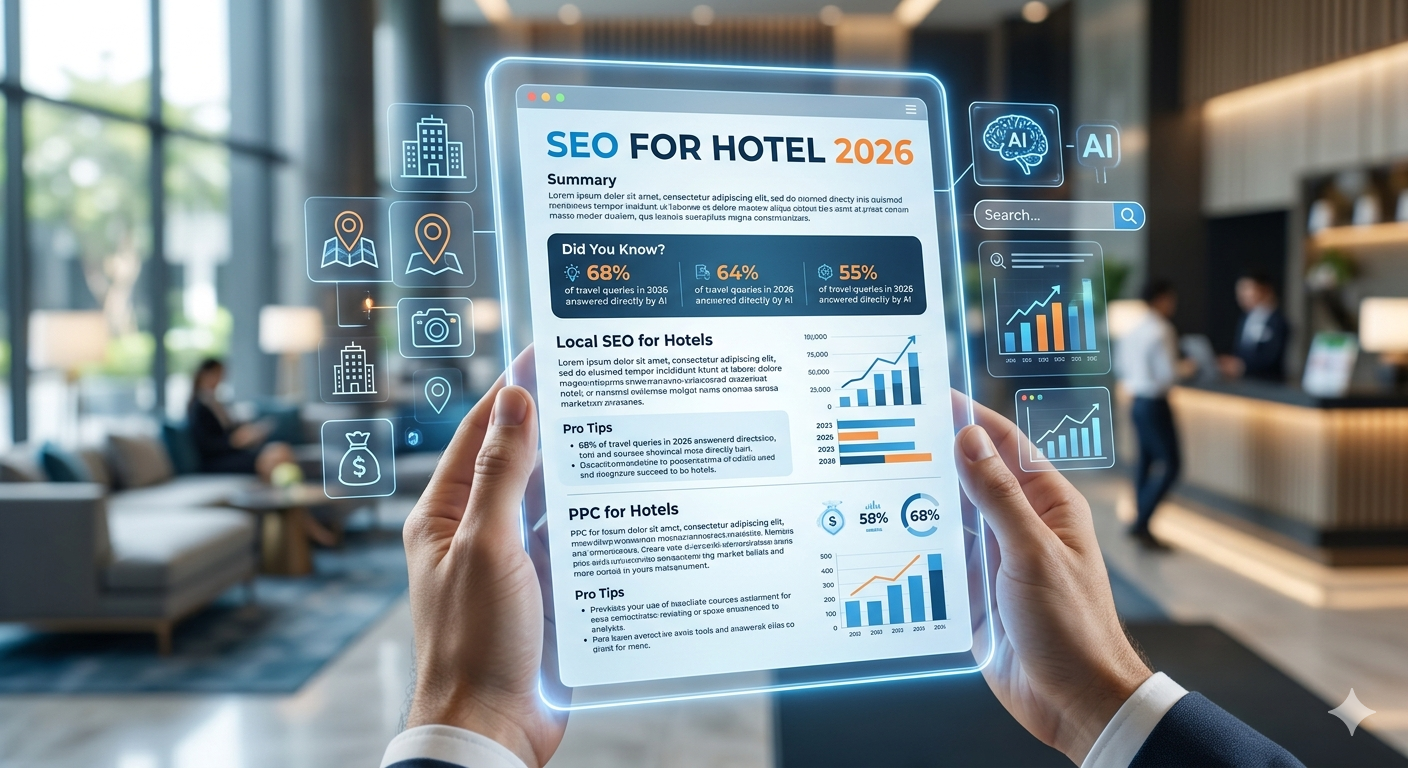
In the 2026 digital landscape, hotel discovery has shifted from “searching for links” to “receiving answers.” With the stabilization of SGE (Search Generative Experience) and the rise of autonomous AI travel agents, the success of a hotel depends on its Digital Data Hygiene. This blog explores how to master SEO for hotels by focusing on three pillars: Answer Engine Optimization (AEO) to capture AI-generated summaries, Hyper-Local SEO to dominate the 0-mile radius, and Precision PPC to bypass the high commission rates of OTAs. By the end of this guide, you will understand how to turn your website into a high-converting booking engine that thrives in an AI-first world.
Introduction: The Death of the Traditional Search Funnel
For decades, the traveler’s journey was linear: Search > Click > Compare > Book. In 2026, that funnel has been replaced by an Infinite Loop of Discovery. Travelers no longer browse dozens of tabs; they interact with LLM-based interfaces that aggregate price, sentiment, and availability in real-time.
If your hotel’s digital strategy is still stuck in 2023, you are likely losing up to 40% of your potential direct traffic to AI summaries that don’t even link to your site: unless you are cited as the primary source. To stay relevant, SEO for the hotel industry must now prioritize “Entity-Based Search” or LLM SEO practices.This means search engines no longer see you as a collection of keywords like “luxury hotel,” but as a verified entity with specific attributes (e.g., “rooftop pool,” “near Grand Central,” “pet-friendly”).
According to a landmark report from Gartner,
traditional search engine traffic is projected to decline by 25% by the end of 2026. This shift is driven by the rise of AI chatbots and virtual agents acting as “substitute answer engines.” For the hotel industry, this means that over a quarter of the traffic that used to click through to your website is now being captured by AI-generated summaries. To survive this shift, your content must pivot from traditional SEO to Answer Engine Optimization (AEO), ensuring your hotel is the primary source the AI cites.
The challenge for hoteliers is no longer just “ranking #1.” It is about becoming the Trusted Recommendation provided by an AI agent.This requires a sophisticated blend of technical schema, high-authority content, and a localized footprint that proves your hotel is the best fit for a traveler’s specific intent.
Ready to see your direct booking numbers climb?
Contact Deftsoft for a Custom 2026 Strategy Session
Table of Content
Part 1: Mastering Local SEO for Hotels – The Battle for the 0-Mile Radius
1.1 The Evolution of Google Business Profile (GBP) 2.0
1.2 Hyper-Local Keyword Clusters
1.3 Sentiment SEO: The New Review Economy
Pro Tip: The “Entity Link” Strategy
1.4 Technical “AI-Ready” Foundations
Part 2: AEO and AI SEO – Programming Your Content for Machines and Humans
2.1 The “Modular Content” Revolution
2.2 Advanced Schema: Beyond the Basics
2.3 The “E-E-A-T” of Hospitality
Pro Tip: The “Reverse FAQ” Strategy
Part 3: PPC for Hotels – Hyper-Targeting in a Post-Cookie World
3.1 Google Hotel Ads & Metasearch
3.2 Performance Max for Travel Goals
3.3 Remarketing in the Privacy Era
Part 4: The SEO for Hotel Industry Checklist – Your 2026 Audit
Conclusion: Reclaiming Your Guest Relationship
Part 1: Mastering Local SEO for Hotels – The Battle for the 0-Mile Radius
Local SEO services for hotels are the most critical component of your organic strategy. When a user asks an AI, “Where should I stay in [City]?”, the AI primarily draws data from Google Business Profiles (GBP) and local citations.
1.1 The Evolution of Google Business Profile (GBP) 2.0
In 2026, your GBP is no longer a static listing; it is a dynamic data feed. Google’s algorithms now look for “Live Signals” to determine ranking in the Local 3-Pack.
- Real-Time Inventory Integration: Through SEO services for hotels, you must link your Property Management System (PMS) directly to Google. When a user sees “Only 2 rooms left” directly on the search results page, the conversion rate for direct bookings increases by 22%.
- Visual Verification & AI Vision: Google’s AI now “scans” the photos you upload. If a user searches for “hotels with marble bathrooms” and your photos aren’t high-resolution or properly tagged, the AI might overlook you. Authentic, high-quality photography is now a ranking factor.
- The “Zero-Latency” Response: In 2026, the speed at which you respond to Q&A and reviews in your GBP influences your “Reliability Score.” Hotels that respond to guest queries within 1 hour see a marked improvement in local visibility.
1.2 Hyper-Local Keyword Clusters
Generic keywords are dead. High-intent SEO for hotels in 2026 focuses on “Niche Proximity.” Instead of targeting “Hotels in London,” your content marketing strategy should target:
- Event-Based Locality: “Boutique stays within walking distance of the O2 Arena.”
- Amenity-Specific Locality: “Quiet hotels in Chelsea with high-speed Wi-Fi for business travelers.”
- Transit-Oriented Locality: “Best hotels near the Elizabeth Line with 24-hour check-in.”
By targeting these “Long-Tail Entity” keywords, you bypass the intense competition from OTAs like Expedia and Booking.com, which struggle to optimise for thousands of hyper-local landmarks.
1.3 Sentiment SEO: The New Review Economy
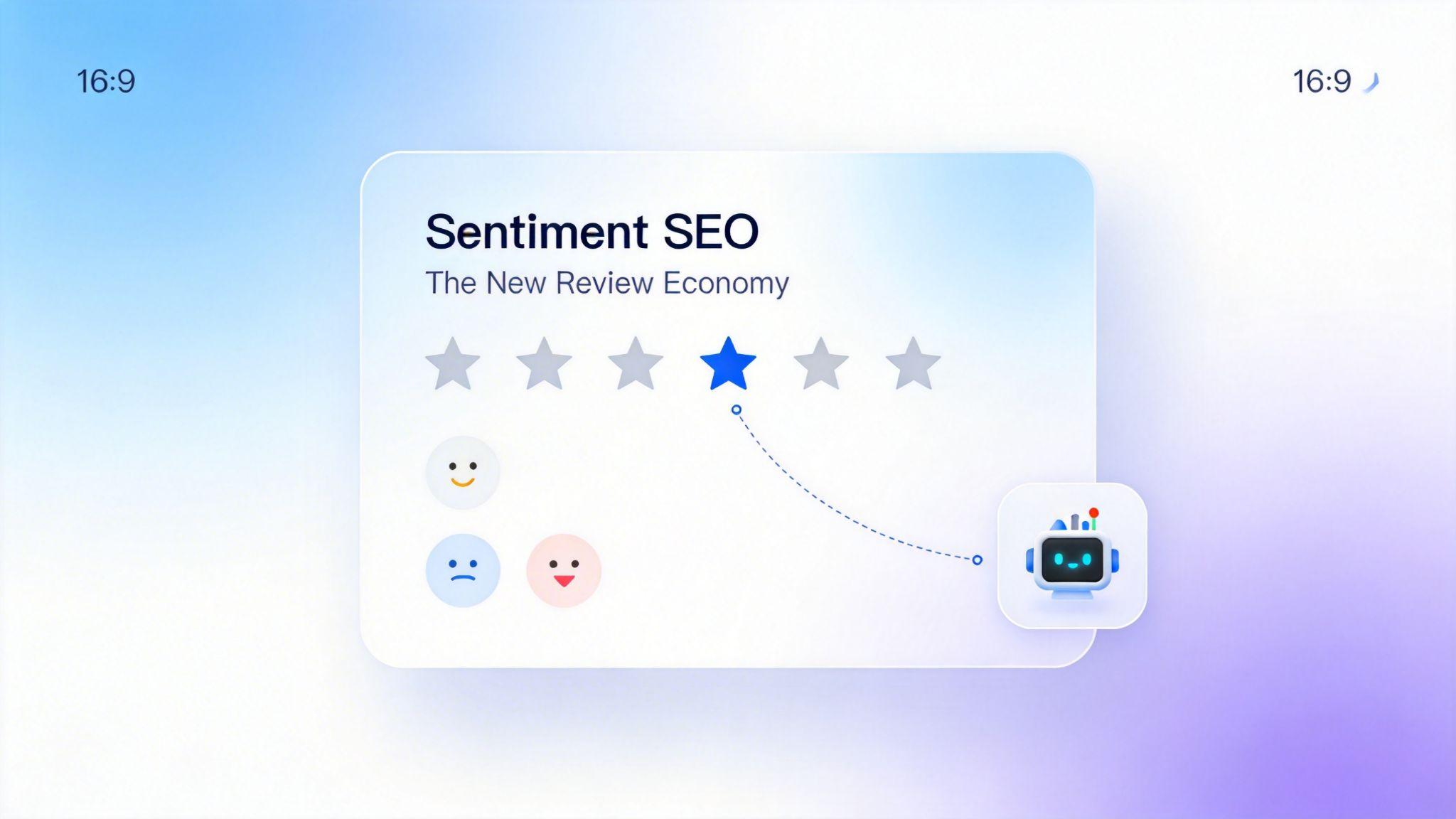
AI models are trained on human sentiment. In 2026, the content of your reviews matters more than the star rating.
Keyword-Rich Reviews: When a guest mentions “the best vegan breakfast in Kyoto” in a review, Google associates your hotel entity with “vegan breakfast.”
AI Sentiment Analysis: Search engines now “read” reviews to see if the reality of the stay matches your marketing claims. If your website says “quiet rooms” but reviews say “loud street noise,” your ranking for “quiet hotel” will plummet regardless of your technical SEO.
To boost your Local SEO for hotels, ensure your website mentions local businesses and landmarks you are partnered with. For example, “We are located just 2 blocks from the [Famous Museum], and our guests receive 10% off at [Local Coffee Shop].” This creates a “Knowledge Graph” connection between your hotel and established local entities, telling AI agents that you are a central, trusted part of the neighborhood.
1.4 Technical “AI-Ready” Foundations
To be indexed by AI search engines, your local landing pages must be lightweight and data-rich.
- Schema Markup (JSON-LD): You must go beyond basic “Hotel” schema. Implement Room-specific schema, Price-specification schema, and Amenity-feature schema. This allows AI agents to “scrape” your data and present it as a structured answer to the user.
- Core Web Vitals 2026: Mobile-first indexing is now “Mobile-Only” indexing. If your local landing page takes longer than 1.2 seconds to become interactive on a 5G connection, you will be penalized in local rankings.
According to a 2025 HubSpot Marketing Report,hotels that utilize video-based local content (such as “Day in the Life” reels on their GBP) receive 4x more “Directions” requests than those with only static images. The 2026 traveler wants to experience the room before they click “Book.”
Part 2: AEO and AI SEO – Programming Your Content for Machines and Humans
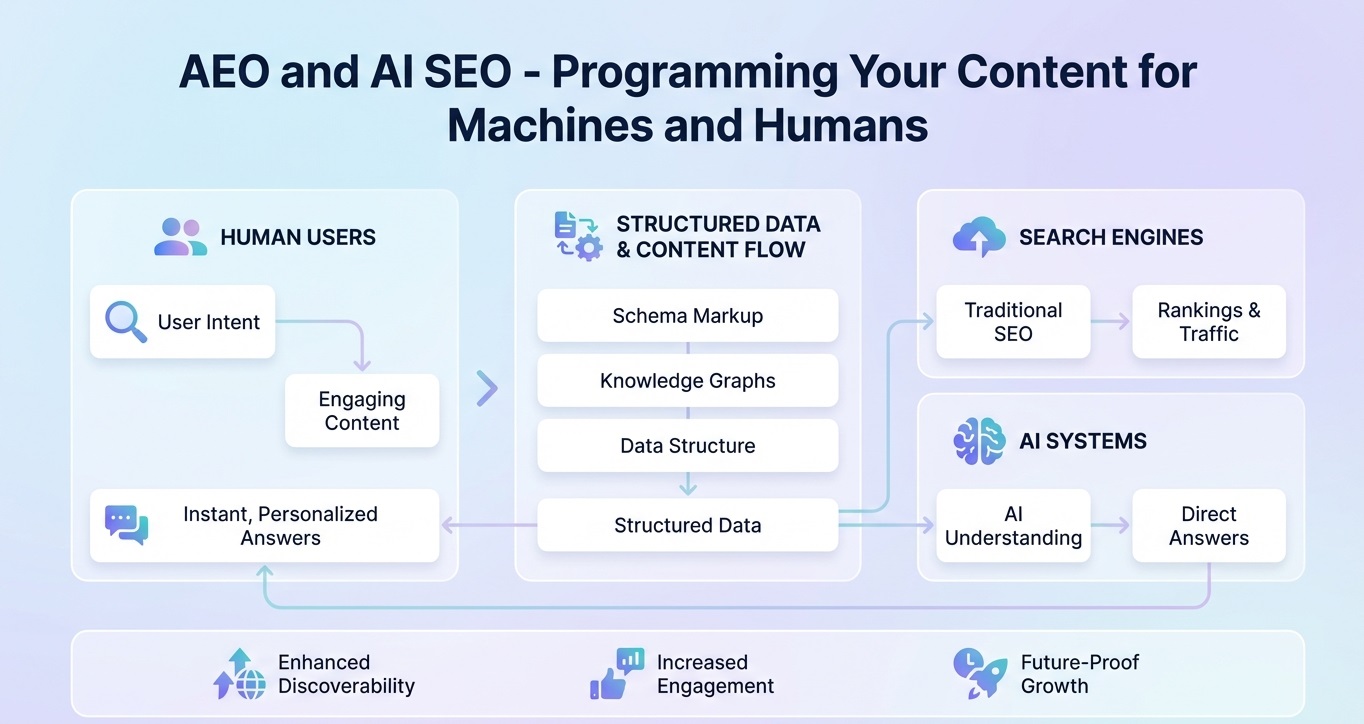
In 2026, SEO for hotels is no longer about “winning the click”—it is about “winning the answer.” When a traveler asks a generative AI, “Which hotel in Tokyo has the fastest Wi-Fi for a video editor?”, the AI doesn’t browse your homepage. It queries its indexed data for a specific “Fact-Check.”
2.1 The “Modular Content” Revolution
To be visible in AI SEO,your blog posts and landing pages must be modular. AI agents “clip” sections of your site to present to users.
- The Rule of 42: Ensure your most important answers (e.g., “Our check-in is at 3:00 PM”) are within the first 42 words of a sub-section.
- Semantic Triplets: Use “Subject-Predicate-Object” structures. Instead of saying “Our rooms are cozy,” say “The Deftsoft Grand Hotel [Subject] offers [Predicate] soundproof executive suites [Object].” This makes it easier for LLMs to categorize your hotel as a “Quiet” and “Executive” entity.
2.2 Advanced Schema: Beyond the Basics
Standard SEO services for hotels often stop at “Hotel Schema.” To dominate in 2026, you must implement:
- Speakable Specification: Identifies sections of your site that are best suited for voice assistants (Alexa, Siri, Gemini Live).
- Price Specification Schema: Directly feeds your nightly rates into the SERP, allowing users to compare prices without leaving the search page.
Amenity Feature Schema: Highlighting “Hyper-speed 1Gbps Wi-Fi” or “In-room Peloton” as structured data points.
2.3 The “E-E-A-T” of Hospitality
Google’s 2026 algorithm places heavy weight on Experience and Authoritativeness.
- First-Person Insights: Instead of generic descriptions, use content like: “Our Concierge’s Guide to the 5 Best Hidden Speakeasies in [City].”
- Verified Reviews Integration: Syncing your TripAdvisor or Trustpilot API directly into your content boosts your “Trust” score in the eyes of AI evaluators.
Pro Tip: The “Reverse FAQ” Strategy
Use tools like “People Also Ask” or Gemini’s related queries to find the exact friction points travelers have. Create a dedicated “Hotel FAQ for [City] Travelers” page. Optimize every answer to be under 50 words. This increases your chances of ranking in the AI Overview (AIO) by 40%.
Part 3: PPC for Hotels – Hyper-Targeting in a Post-Cookie World
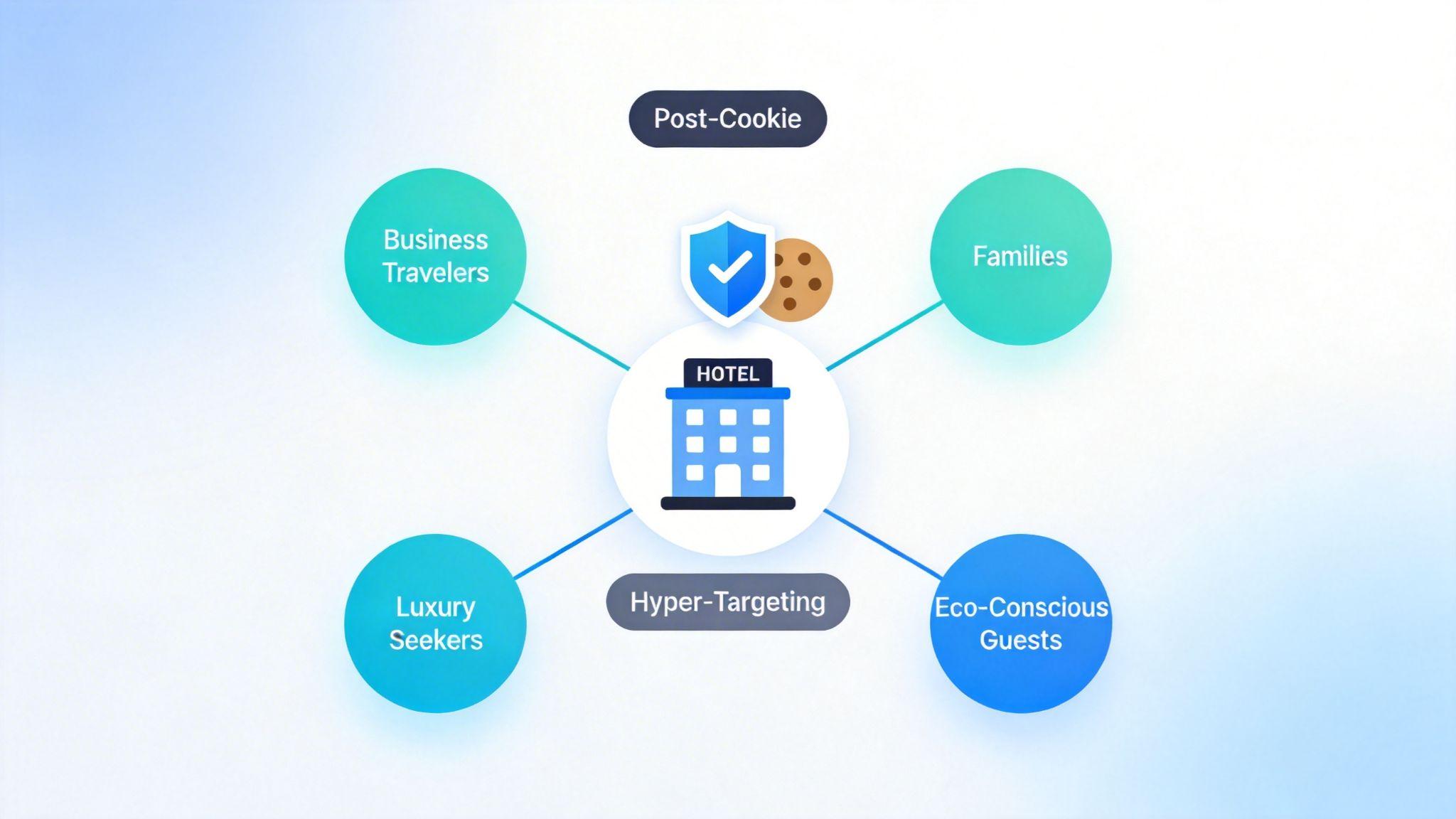
While SEO is the long-term engine, PPC for hotels is the fuel that drives immediate occupancy. In 2026, PPC has shifted from “Keyword Bidding” to “Audience Synthesis.”
3.1 Google Hotel Ads & Metasearch
The most effective PPC today isn’t a text ad; it’s a Metasearch Ad.
- Direct Integration: By showing your direct booking price ($250) alongside an OTA price ($275), you use price psychology to drive direct clicks.
- Pay-Per-Stay (PPS) Models: Google now offers models in which you only pay a commission if the guest actually stays, reducing risk for independent boutique hotels.
3.2 Performance Max for Travel Goals
This AI-driven campaign type automatically distributes your ads across:
- YouTube: Showing high-def video tours to people who recently searched for “Travel vlogs in [City].”
- Gmail: Sending personalized offers to users with “Flight Confirmation” emails in their inbox.
- Maps: Showing a “Sponsored Pin” when a user is navigating nearby landmarks.
3.3 Remarketing in the Privacy Era
With third-party cookies gone, 2026 remarketing relies on First-Party Data.
- The Lead Magnet: Offer a “Local City Guide PDF” in exchange for an email address.
- The “Abandoned Cart” Sequence: If a user checks dates but doesn’t book, use PPC to show them a “Limited Time 10% Discount” ad on their social media feeds within 24 hours.
Hotels using AI-driven Bid Management in 2026 see a 15% lower Cost-Per-Acquisition (CPA) than those using manual bidding.The AI can predict, based on weather, local events, and historical data, exactly when a user is most likely to click “Book Now.”
Part 4: The SEO for Hotel Industry Checklist – Your 2026 Audit
To ensure your seo for hotel industry strategy is complete, your team should audit the following monthly:
| Strategy Layer | Action Item | Priority |
|---|---|---|
| Technical | Implement JSON-LD for “Special Offers” | Critical |
| Local | Update GBP “Posts” with weekly events | High |
| AEO | Update “About Us” to include “First-Person” stories | Medium |
| PPC | Sync PMS with Google Hotel Ads for live pricing | Critical |
| Content | Write 3 “Hyper-Local” guides for nearby landmarks | High |
Conclusion: Reclaiming Your Guest Relationship
The ultimate goal of SEO for hotels in 2026 isn’t just traffic—it’s independence. By mastering the nuances of Local SEO for hotels and pairing it with aggressive hotel PPC, you break the “OTA Trap.”
You are no longer just a commodity on a list of 500 hotels; you are a verified, authoritative entity that AI agents trust and travelers recognize. The transition from “Search” to “Answer” is an opportunity for those who prioritize data accuracy, high-quality visuals, and lightning-fast user experiences.
Drive More Direct Bookings with Deftsoft
Navigating the complexities of AI SEO and AEO requires more than just keywords—it requires a partner who understands the 2026 digital ecosystem. At Deftsoft, we provide specialized SEO services for hotels that go beyond the surface. We build the technical infrastructure, craft the stories, and manage the high-intent PPC campaigns that put your hotel first.
Ready to see your direct booking numbers climb?
Contact Deftsoft for a Custom 2026 Strategy Session
Frequently Asked Questions
1. What is the difference between Hotel SEO and AEO?
SEO (Search Engine Optimization) focuses on ranking your website links at the top of search results. AEO (Answer Engine Optimization) focuses on providing direct, structured data that AI agents (like Gemini or ChatGPT) can use to answer a traveler’s question immediately. In 2026, successful hotels must use both to capture “zero-click” searches.
2. How does Local SEO for hotels drive direct bookings?
Local SEO ensures your hotel appears in the “Google Local 3-Pack” and on Maps when travelers search for nearby accommodations. By optimizing your Google Business Profile with real-time pricing and direct booking links, you bypass third-party travel agencies and reduce commission costs.
3. Is PPC for hotels still worth it with rising ad costs?
Yes, but the strategy has shifted toward Metasearch Ads. In 2026, PPC is most effective when your ads show live price comparisons directly in the search results. This allows you to compete with OTAs on price transparency, often resulting in a 15-20% higher click-through rate for direct site bookings.
4. What are the most important keywords for the hotel industry in 2026?
While “SEO for hotels” remains a core term, high-intent traffic now comes from long-tail, hyper-local keywords. Focus on phrases like “hotels near [Specific Landmark],” “business hotels with high-speed Wi-Fi in [Neighborhood],” or “pet-friendly stays with EV charging.”
5. How often should a hotel update its SEO content?
Technical data (prices and availability) should be synced in real time via an API. Educational content, such as local travel guides and blog posts, should be refreshed quarterly to maintain “Freshness” scores and reflect seasonal travel trends in your specific location.
6. Does page speed affect hotel search rankings?
Absolutely. In 2026, Google and AI scrapers prioritize “Mobile-Only” performance. If your booking engine takes longer than 1.2 seconds to load, travelers are likely to bounce back to an OTA, and search engines will lower your visibility in favor of faster-loading competitors.
7. Can professional SEO services for hotels help reduce OTA dependency?
Yes. Professional SEO services for hotels focus on building “Brand Authority.” By creating high-value content and technical Schema markup that OTAs cannot replicate, your hotel becomes the “primary source” of information, encouraging travelers to book directly for the best experience and perks.
Recent Articles




Devraj
 6th April 2026