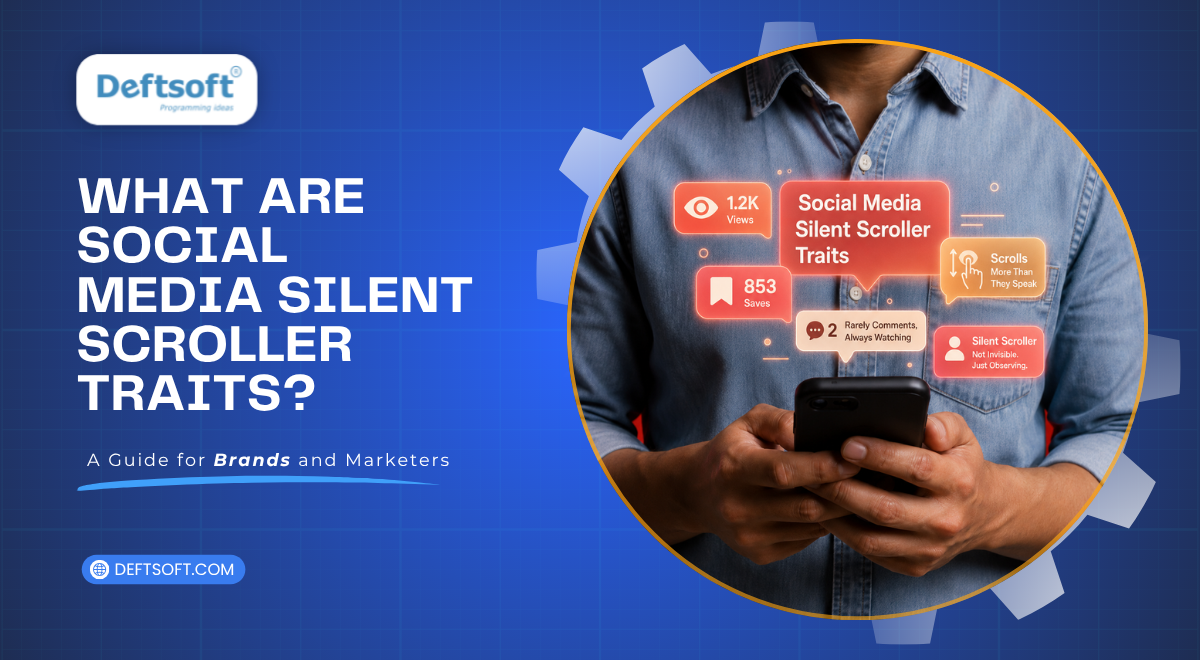
What Are Social Media Silent Scroller Traits? A Guide for Brands and Marketers
-
By Devraj
-
18th August 2026
Picture this: you open Instagram on your lunch break, scroll through fifteen posts, watch three Reels, check two Stories, and read the comments on a meme. Then you close the app without liking a single post, leaving a single comment, or posting anything yourself. If that sounds familiar, you might be what people now call a social media silent scroller someone who regularly consumes content without leaving any visible trace. No likes. No comments. No shares.
Silent scrolling doesn’t mean you dislike social media. Many silent scrollers spend more time on platforms than active users. They simply prefer consuming over contributing publicly. In 2026, this behaviour is far more widespread than most brands and marketers realise. This guide covers key social media silent scroller traits, why they matter, and how to adapt your social media marketing strategy to reach an audience that almost never raises its hand.
Want to turn your quietest followers into paying customers?
Learn how to build a high-converting social media marketing strategy that captures, engages, and converts passive scrollers.
Quick Navigation
What Is a Social Media Silent Scroller?
10 Signs You’re a Social Media Silent Scroller
1. You Scroll for Long Periods Without Interacting
2. You Rarely Post Anything Yourself
3. You Watch Stories but Almost Never Reply
4. You Know What’s Trending Without Joining the Conversation
5. You Read Comments More Than You Write Them
6. You Save or Share Content Privately Instead of Commenting
7. You Follow People You Never Interact With
8. You Scroll When You’re Bored, Stressed, or Waiting
9. You Know a Lot About People Who Barely Know You
10. You Prefer Watching Over Being Seen
Why Silent Scrollers Matter to Brands and Marketers
How Silent Scrollers Affect Social Media Marketing Metrics
How Can Brands Engage Silent Scrollers?
How to Convert Silent Scrollers Into Customers
How Brands Can Measure Silent Audience Behaviour
Social Media Content Strategies for Silent Scrollers
Final Thoughts: Are You a Social Media Silent Scroller?
What is a silent scroller on social media?
What are the common traits of a silent scroller?
Is silent scrolling the same as lurking?
Why do people scroll social media without liking or commenting?
Is being a silent scroller a bad habit?
How can you tell if someone is a silent scroller?
Do silent scrollers still count as engaged users?
How can brands or creators reach silent scrollers if they don’t interact?
What Is a Social Media Silent Scroller?
A social media silent scroller regularly uses platforms like Facebook, Instagram, TikTok, YouTube and LinkedIn as a passive consumer. They read, watch, and observe without engaging through likes, comments, shares, or original posts. The difference between an active user and a passive one comes down to visible interaction. Active users comment, share, and post publicly. Silent scrollers do none of this, at least not publicly. They might share something privately in a DM or save a post, but others can’t see their activity.
Not every social media user wants to be seen. Some want to watch, learn, or stay updated without leaving a digital footprint. Some value privacy. Others find passive consumption more relaxing than the social performance of posting. Many are introverts who follow conversations without needing to join them. Silent scrollers exist across every platform and make up a significant, often underestimated part of any audience, which is why understanding them matters for anyone delivering professional social media marketing services.
10 Signs You’re a Social Media Silent Scroller
1. You Scroll for Long Periods Without Interacting
You spend thirty or forty-five minutes on a platform and walk away having done nothing interactive. You view content, consume it, and move on without a single like, comment, or save. This is the defining trait. Viewing and engaging are not the same thing. Platforms track both, but only engagement shows up publicly. You can watch an entire video without ever clicking Like.
2. You Rarely Post Anything Yourself
Your profile looks completely dormant to anyone who visits, yet you’re online several times a day. No posts, no Stories, no reposts. Just a profile last updated months ago, quietly watching others. Some people don’t post because they value privacy. Others feel pressure to present perfectly online and find it easier to opt out. An inactive-looking profile doesn’t equal an inactive user.
3. You Watch Stories but Almost Never Reply
You see someone’s Story within minutes of posting, watch it through, and immediately move on. No reaction, no reply. You’re consistently among the first viewers, yet the person posting has no idea you’re there a reliable audience member they’ll never know they have.
4. You Know What’s Trending Without Joining the Conversation
You know the latest memes before your friends mention them. You’ve seen the viral video. You’re aware of the trending audio, the celebrity drama, and the challenge taking over Reels and YouTube videos this week, but you’ve formed opinions about all of it in complete silence. You absorbed it from the sidelines without ever commenting, sharing, or participating.
5. You Read Comments More Than You Write Them
The comments section is entertainment in itself. You scroll through replies, catch the funny ones, notice the arguments, and form strong opinions. But you don’t write one yourself. Comments happen to other people; you consume them as a reader, not a participant.
6. You Save or Share Content Privately Instead of Commenting
You save posts, bookmark articles, or forward content to a friend in a DM. This is still engagement, just invisible to everyone but you and the recipient. Silent scrollers aren’t disengaged; they engage privately rather than publicly. A brand’s post might get saved hundreds of times without a single public like.
This is why brands working with a good digital marketing company track saves and private shares alongside public engagement to get an accurate picture of content performance.
7. You Follow People You Never Interact With
You follow creators, brands, influencers, and old acquaintances, watching everything they post without a single like or message. They don’t know you follow them. You’ve never commented or engaged once. They’re performing to an audience they can only partially see, and silent scrollers make up a significant portion of that invisible crowd.
8. You Scroll When You’re Bored, Stressed, or Waiting
Social media becomes a default filler activity. Waiting for food? Open Instagram. Commuting? TikTok. Can’t sleep? YouTube. Silent scrollers treat social media as a background habit, something to occupy idle moments rather than an intentional choice. This is exactly why Facebook ads and short-form content need to capture attention within the first two seconds. You’re competing with an entire feed designed to do the same thing at the same time.
9. You Know a Lot About People Who Barely Know You
You know what an old university contact is doing professionally, where they holidayed, and what their renovation looks like without speaking to them in three years. Silent scrolling creates a one-sided flow of information. You feel like you know someone who has no idea you’ve been watching. It’s oddly intimate, which helps explain why catching up with old acquaintances sometimes goes suspiciously smoothly.
10. You Prefer Watching Over Being Seen
You enjoy consuming content from others but have no desire to put your own life, opinions, or work in front of an audience. Maybe it’s a personality preference; introverts often find public social media performance genuinely exhausting. Maybe it’s privacy. Maybe you simply don’t feel the need for external validation through likes and comments.
Whatever the reason, this preference for watching over being seen is a deeply embedded silent-scroller trait, and it’s far more widespread than platforms’ public engagement metrics suggest.
Why Silent Scrollers Matter to Brands and Marketers
Here’s the business-critical insight: silent scrollers are real customers. They research products by watching content, form brand opinions through passive exposure, and make purchasing decisions influenced entirely by content they consumed without ever clicking Like.
A post with 200 likes might have been seen by 8,000 people. The 7,800 who didn’t interact still saw it; some will buy, some will search your brand name, some will tell a friend. None of this shows up in your engagement rate.
For any digital marketing services team measuring only likes and comments, silent scrollers are a significant blind spot. Reach and impressions, often dismissed as vanity metrics, become more meaningful when your audience is largely silent.
How Silent Scrollers Affect Social Media Marketing Metrics
 Traditional social media metrics likes, comments, shares were built around active behaviour. Silent scrollers generate impressions and reach without generating engagement, creating a frustrating gap where content reaches thousands and influences real purchase decisions, but the dashboard shows low engagement rates.
Engagement rate alone is an incomplete metric when a significant portion of your audience is silent. Brands working with an experienced SEO agency or full-service digital partner look at a broader set of signals: saves, profile visits, website traffic from social, branded search volume, and direct conversions.
How Can Brands Engage Silent Scrollers?
Silent scrollers won’t respond to “comment below” or “tag a friend.” What works:
Create content worth saving. Tips, checklists, and tutorials get saved privately even without comments. Saves signal resonance more honestly than likes.
Use short-form video. Instagram Reels and YouTube videos are designed for passive consumption. A silent scroller watches a Reel to the end without interacting, but if the product is relevant, it still makes an impression.
Tell stories, not just facts. Silent scrollers follow brands like they follow people; they want something genuine. Brand storytelling and behind-the-scenes content get consumed even when they don’t get liked.
Design for DM sharing. If content can be forwarded in two taps, silent scrollers will share it privately without ever touching the public share button.
How to Convert Silent Scrollers Into Customers
Silent scrollers don’t follow a typical conversion path. They don’t comment asking for a link. They accumulate repeated brand impressions over days or weeks, form a quiet opinion, then act through a direct website visit, a branded search, or a purchase triggered by familiarity rather than a single click.
To support this:
- Retarget through paid ads. Video viewers who never clicked anything are still a warm audience. Facebook marketing retargeting reaches people who watched 50%+ of a video without engaging, often the highest-value paid audience available.
- Stay consistent. Silent scrollers respond to familiarity. Regular posting and a recognisable brand identity build the accumulated recognition that eventually drives action.
- Remove friction from the purchase path. Bio links, Story links, and clear profile information matter more for silent scrollers than for active users who will ask in comments.
For businesses using affordable SEO alongside social strategy, branded search volume often grows as social reach increases even when engagement looks flat. Silent scrollers search for brands they’ve seen, creating an indirect SEO benefit that’s easy to miss without the right tracking.
How Brands Can Measure Silent Audience Behaviour
You can’t count silent scrollers directly, but their footprints show up in the right data:
- Reach vs engagement ratio — a widening gap signals a growing silent audience
- Video completion rates — high completion with low likes = passive consumption
- Saves and bookmarks — frequently underused as a performance signal
- Profile visits — users checking your profile without following are often silent scrollers
- Website sessions from social — traffic arriving without a corresponding public engagement event
- Branded search volume — via Google Search Console; often rises alongside social reach growth
- Direct traffic — users who type your URL after seeing you on social without clicking any link
This data matters especially when evaluating the cost of hiring an SEO company alongside social spend. The two channels interact in ways that only become visible when you look beyond surface-level engagement metrics.
Social Media Content Strategies for Silent Scrollers
If a meaningful part of your audience is silent, your strategy needs to reflect it:
- Prioritise value over virality. Content that genuinely helps or entertains gets saved by silent scrollers even without going viral. Quality and relevance outperform trend-chasing for this audience.
- Be consistent, not sporadic. Silent scrollers won’t comment asking where you’ve been. They’ll just scroll past. Consistent posting keeps your brand visible to people who will never tell you they’re watching.
- Use carousels and educational posts. Multi-image carousels get swiped passively and saved regularly — even without a single like. They’re one of the best formats for silent audiences.
- Invest in short-form video. Instagram Reels and YouTube videos are the most-consumed, least-interacted-with formats online. Perfect for passive audiences.
- Drop comment-only CTAs. “Drop a if you agree” is invisible to silent scrollers. Drive frictionless actions instead — a bio link visit, a save, a swipe-up.
Brands working with a digital marketing company that understands both social behaviour and search intent are better placed to build content that converts both active and passive audiences.
Final Thoughts: Are You a Social Media Silent Scroller?
Let’s recap quickly. You might be a social media silent scroller if:
- You scroll for long periods without liking or commenting
- Your profile looks inactive despite frequent use
- You watch Stories but almost never reply
- You know what’s trending without joining the conversation
- You read comments more than you write them
- You save or privately share content instead of engaging publicly
- You follow people you’ve never once interacted with
- You scroll out of habit when bored, stressed, or waiting
- You know a lot about people who barely know you exist online
- You prefer watching over being seen
If several of these resonate, you’re part of a very large, very quiet majority.
Silent scrolling is common and isn’t automatically a problem. It’s simply a different way of engaging with digital content, one that reflects how many people actually use social media, as opposed to how platforms want us to use it. But for brands and marketers, understanding this behaviour is essential. The audience watching your content without clapping is often larger than the one that does. Creating content, running campaigns, and measuring performance without accounting for silent scrollers means making decisions on incomplete data. For brands like Deftsoft, understanding these silent interactions can help create more effective content and marketing strategies.
The best social media strategies in 2026 are built for both audiences—the vocal minority who engage publicly and the quiet majority who consume, remember, and eventually act.
How many of these silent scroller traits sound like you?
Ready to stop missing out on silent scrollers?
Partner with our team to upgrade your social media marketing strategy and start converting your invisible audience today.
Frequently Asked Questions
What is a silent scroller on social media?
A social media user who consumes content posts, videos, Stories, Reels without publicly engaging through likes, comments, or shares. Active in time spent, but invisible in standard engagement metrics.
What are the common traits of a silent scroller?
Scrolling without interacting, rarely posting, watching Stories without replying, saving instead of commenting, following accounts without engaging, and preferring to observe rather than participate in public conversations.
Is silent scrolling the same as lurking?
Yes, largely. Lurking is the older forum equivalent: reading without contributing. Silent scrolling is the social media version: consuming content across platforms without leaving public engagement.
Why do people scroll social media without liking or commenting?
Privacy preferences, introversion, social performance pressure, or simple habit. Many people find passive consumption more relaxing than managing the social expectations that come with posting or commenting publicly.
Is being a silent scroller a bad habit?
Not inherently. It becomes a concern only when it displaces sleep or focus. Many people genuinely prefer social media as a consumption tool rather than a performance platform, and that’s a valid choice.
How can you tell if someone is a silent scroller?
Their profile appears inactive despite frequent platform use. They rarely appear in comment sections or likes, but may consistently view Stories and watch videos. Reach and completion rate data reveal them even when engagement data doesn’t.
Do silent scrollers still count as engaged users?
Platforms count them in reach and impression data. Algorithms register video completion rates. They don’t contribute to public engagement metrics, but they often convert through direct website visits or branded search after repeated passive exposure.
How can brands or creators reach silent scrollers if they don’t interact?
Through consistent content worth watching, video retargeting ads, short-form Reels and Shorts, educational carousel posts that get saved, and building brand recognition strong enough that silent scrollers search for you when they’re ready to act.
Recent Articles




Devraj
 18th August 2026