What Is an SEO Funnel? A Complete Guide to Stages and Strategy
-
By Devraj
-
10th August 2026
Ranking on the first page of Google feels great but if that traffic never turns into leads, sign-ups, or sales, something is missing. Getting more clicks isn’t the same as getting more customers. That’s where the idea of an SEO funnel comes in.
An SEO funnel is the roadmap that takes someone from “I have a question” all the way to “I’m ready to buy.” Instead of treating every keyword the same way, an SEO funnel recognizes that people search differently depending on where they are in their decision-making journey. Someone typing “what is SEO” is not ready for a sales pitch. Someone typing “SEO agency in USA” almost certainly is.
Different search intents call for different SEO strategies and understanding this difference is what separates websites that only get traffic from websites that get results. In this guide, we’ll break down what an SEO funnel is, why it matters, the stages it’s built on, and how you can build one for your own business.
Stop Wasting Traffic on Unqualified Clicks
Learn how to align your content with search intent and turn everyday visitors into paying clients.
What Is an SEO Funnel?
In simple terms, an SEO funnel is a framework that maps search intent, keywords, content, website experience, and conversions into one connected journey. Rather than optimizing pages randomly, an SEO funnel makes sure every piece of content has a clear job to do whether that’s educating a beginner, comparing options, or closing a sale.
Here’s how the pieces connect:
- Search intent tells you what the user actually wants when they type a query.
- Keywords are the words people use to express that intent.
- Content is built to match that intent, at the right level of detail.
- Website experience guides the visitor smoothly from one page to the next.
- Conversions happen when the right content meets the right visitor at the right time.
There’s an important difference between simply attracting traffic and generating qualified leads. A blog post can bring thousands of visitors, but if none of them are looking to buy, that traffic doesn’t help the business grow. A well-structured SEO marketing funnel makes sure your content isn’t just visible, it’s actually working toward a business goal.
How Does an SEO Funnel Work?
At a basic level, users move through a journey that looks like this:
Search → Discovery → Consideration → Evaluation → Conversion → Retention
A person starts with a search query, discovers your website through organic results, considers whether your content answers their needs, evaluates your services against alternatives, converts by taking an action (like filling out a form), and ideally becomes a returning customer who trusts your brand for the long run.
Why Is an SEO Funnel Important for Your SEO Strategy?
Building your content around a funnel isn’t just a nice-to-have; it changes how effective your SEO actually is. Here’s why it matters:
- Targets users at different buying stages so you’re not showing a sales pitch to someone who’s just browsing.
- Aligns content with search intent, which improves rankings and user experience together.
- Improves qualified organic traffic instead of just raising the total visitor count.
- Helps move informational users toward commercial pages through smart internal linking.
- Supports lead generation and sales, not just brand visibility.
- Makes SEO performance easier to measure, since each stage has its own clear goal.
A solid SEO strategy funnel turns your website into a system — one where visitors are guided step by step instead of left to figure things out on their own. For businesses working with an AEO Insights Company, this approach can also help align SEO content with broader answer engine optimization goals.
What Are the Stages of an SEO Funnel?
Every SEO funnel is built around four core stages. Understanding each one helps you plan the right keywords and content for every part of the customer journey.
Stage 1: Awareness Top of the Funnel (TOFU)
At this stage, users are just identifying a problem or trying to learn something new. They aren’t thinking about brands yet they’re thinking about their question.
Keyword types:
- Informational keywords
- Question-based searches
- Problem-focused searches
- Broad topic keywords
Content examples:
- Blog posts
- Beginner guides
- How-to articles
- Educational videos
- Industry reports
SEO goal: Increase visibility and attract relevant users who may need your services later on.
Stage 2: Consideration Middle of the Funnel (MOFU)
Now the user understands their problem and is actively researching possible solutions. They’re comparing approaches and starting to narrow things down.
Keyword types:
- Comparison keywords
- Solution-focused keywords
- Service-related informational keywords
- “Best” and “vs.” searches
Content examples:
- Comparison guides
- Case studies
- Service guides
- Checklists
- Expert articles
SEO goal: Build trust and move users toward evaluating you as a real option.
Stage 3: Decision Bottom of the Funnel (BOFU)
At this point, users are ready to take action. They know what they need and are looking for the right provider.
Keyword types:
- Commercial keywords
- Transactional keywords
- Service + location keywords
- Pricing keywords
- “Hire” and “agency” keywords
Content examples:
- Service pages
- Product pages
- Pricing pages
- Demo/request pages
- Testimonials
- Client case studies
SEO goal: Turn qualified organic visitors into leads or customers.
Stage 4: Conversion and Retention
The funnel doesn’t have to end once someone converts. In fact, this is where long-term value really begins.
This stage covers:
- Customer onboarding
- Helpful support content
- FAQs
- Product/service guides
- Existing-customer resources
- Reviews and referrals
SEO goal: Support customer retention and encourage repeat conversions.
What Is an SEO Conversion Funnel?
An SEO conversion funnel is different from simply generating organic traffic. It’s specifically focused on turning visitors into leads by guiding them through a clear, intentional path.
Here’s a simple example of what that path might look like:
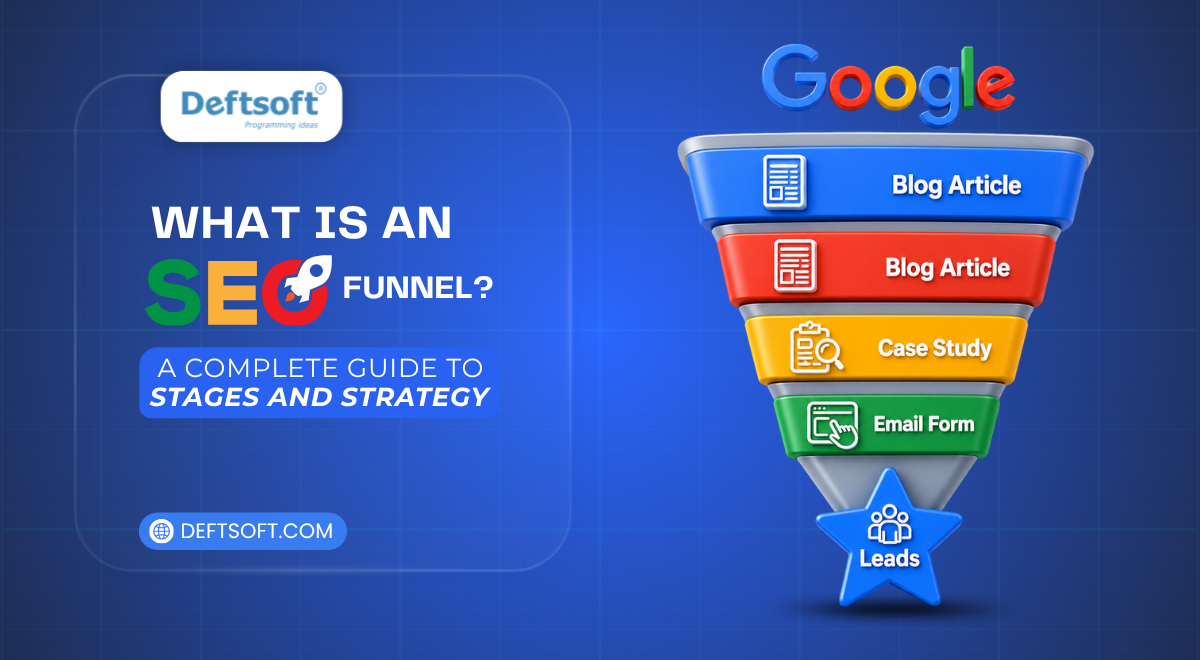
Google Search → Blog → Service Page → Case Study → Contact Form → Lead
To make this work well, a few things need to come together:
- Landing pages designed around a single, clear goal
- Internal linking that naturally guides visitors deeper into the site
- CTAs (calls to action) placed where they make sense, not just everywhere
- Conversion-focused content on decision-stage pages
- Trust signals like reviews, case studies, and client logos
Without these elements, even great rankings won’t translate into business growth.
How SEO Funnel Keywords Work at Different Stages
 Matching keywords to the right funnel stage is one of the most important parts of SEO strategy. Here’s how it typically breaks down:
Top-of-Funnel Keywords
- What is SEO?
- How does SEO work?
- SEO benefits
Middle-of-Funnel Keywords
- Best SEO strategies
- SEO agency vs freelancer
- How to choose an SEO service
Bottom-of-Funnel Keywords
- SEO agency in USA
- Affordable SEO services
- Hire an SEO agency
What Are Low Funnel Keywords?
Low funnel keywords are search terms used by people who are very close to making a decision. Because these searchers already know what they want, low-funnel keywords usually carry much stronger commercial intent than broad, informational searches.
The difference comes down to intent. Someone searching “what is SEO” is learning. Someone searching “affordable SEO services for small business” is shopping. Low-funnel keywords tend to convert at a much higher rate, even if their search volume is lower.
To create pages around low-funnel keywords, focus on service pages, location-based pages, and pricing pages that speak directly to a ready-to-act audience.
Examples of Low-Funnel Keywords
| Keyword Type | Example | Intent |
|---|---|---|
| Service | SEO services for small business | Looking for a specific service |
| Location | SEO agency in USA | Looking for a provider nearby or in a specific market |
| Action | Hire an SEO expert | Ready to take action |
| Pricing | Affordable SEO packages | Comparing cost before deciding |
| Comparison | Best SEO agency vs freelancer | Weighing final options |
How to Build an SEO Strategy Funnel
Building a working SEO funnel doesn’t have to be complicated. Here’s a practical, step-by-step approach.
Step 1: Define Your Target Audience
Understand who you’re trying to reach, what problems they have, and what questions they’re asking at each stage of their journey.
Step 2: Map the Customer Journey
Outline the path a typical customer takes from first hearing about a problem to becoming a paying client.
Step 3: Perform Keyword Research
Group your keywords according to funnel stage:
- Awareness
- Consideration
- Decision
- Conversion
Step 4: Match Keywords With Search Intent
Make sure every keyword you target lines up with the type of content someone actually wants to see.
Step 5: Create Content for Each Funnel Stage
Don’t just publish blog posts. Build a mix of educational, comparison, and commercial content so every stage of the funnel is covered.
Step 6: Build Internal Links Between Funnel Stages
Guide readers from top-of-funnel blog posts toward middle- and bottom-of-funnel pages using natural, relevant internal links.
Step 7: Optimize Conversion Paths
Make sure CTAs, forms, and contact pages are easy to find and simple to use.
Step 8: Measure and Improve Performance
Track how well each stage is performing and adjust your content and keyword strategy based on what the data shows.
SEO Funnel vs Traditional Sales Funnel
While they share a similar shape, an SEO funnel and a traditional sales funnel work in different ways.
| SEO Funnel | Traditional Sales Funnel |
|---|---|
| Driven by search behavior | Driven by sales activities |
| Uses organic search | Uses sales outreach/marketing |
| Content plays a major role | Sales communication plays a major role |
| Captures users through search | Captures prospects through multiple channels |
| Can generate traffic continuously | Often requires active sales processes |
This is one reason a sales funnel for SEO is so valuable once your content is ranking well, it can keep attracting and converting visitors long after it’s published, without the ongoing cost of active outreach.
How to Map Content to an SEO Funnel
A content mapping table makes it much easier to see whether your website has gaps at any stage of the funnel.
ConsiderationCommercial ResearchComparison/Case StudyEngagement
| Awareness | Informational | Blog/Guide | Traffic |
|---|---|---|---|
| Decision | Commercial | Service Page | Leads |
| Conversion | Transactional | Contact/Pricing Page | Sales |
| Retention | Informational | Support/Resource Content | Loyalty |
Common SEO Funnel Mistakes to Avoid
Even well-intentioned SEO strategies can fall short if they overlook the funnel. Watch out for these common mistakes:
- Targeting only high-volume keywords and ignoring more specific, lower-volume terms with strong intent.
- Ignoring search intent, which leads to content that doesn’t match what users actually want.
- Creating content without a conversion path, leaving visitors with nowhere to go next.
- Focusing only on top-of-funnel traffic while neglecting decision-stage content.
- Poor internal linking between related pages at different funnel stages.
- Using the same CTA everywhere, instead of tailoring it to the page’s purpose.
- Ignoring bottom-of-funnel keywords, which often convert better despite lower search volume.
- Not measuring conversions, making it impossible to know what’s actually working.
How to Measure SEO Funnel Performance
Tracking the right metrics at each stage helps you understand where your funnel is working and where it needs attention.
| Awareness | Consideration | Decision | Conversion |
|---|---|---|---|
|
|
|
|
SEO Funnel Example for an SEO Agency
To see how this all comes together, here’s a real-world example of an SEO funnel in action:
TOFU: “What is SEO?” ↓ MOFU: “How to choose an SEO agency?” ↓ BOFU: “SEO Agency in USA” ↓ Conversion: SEO service page → Contact form → Consultation
This is exactly the kind of funnel Deftsoft builds for clients’ content that educates first, builds trust in the middle, and makes it easy to take the next step once a visitor is ready to talk business.
Ready to Build an SEO Funnel That Actually Converts?
Driving traffic is only half the battle. Let Deftsoft’s SEO experts audit your current strategy and design a high-converting content funnel tailored to your business.
Final Thoughts: Turning SEO Traffic Into Conversions
An SEO funnel is about more than rankings, it’s about matching content to intent at every step of the customer journey. When your top-of-funnel content educates, your middle-of-funnel content builds trust, and your bottom-of-funnel content makes it easy to take action, your website stops being just a source of traffic and starts being a real growth engine.
Successful SEO isn’t only about getting to page one. It’s about guiding the entire customer journey, from that very first search to a long-term customer relationship. That’s the approach Deftsoft takes with every SEO strategy we build: one that turns search visibility into real, measurable business results.
FAQs
What is an SEO funnel?
An SEO funnel is a strategy that aligns search intent, keywords, and content with each stage of a customer’s journey, from first discovering a brand to becoming a customer.
What are the stages of an SEO funnel?
The main stages are Awareness (TOFU), Consideration (MOFU), Decision (BOFU), and Conversion/Retention.
What is the difference between an SEO funnel and a sales funnel?
An SEO funnel is driven by organic search behavior and content, while a traditional sales funnel relies more heavily on direct sales outreach and multi-channel marketing.
What are low-funnel keywords?
Low-funnel keywords are search terms used by people who are close to making a purchase decision, such as “affordable SEO services for small business” or “hire an SEO agency.”
How does SEO help the marketing funnel?
SEO brings in relevant traffic at every stage of the marketing funnel and supports it with content that matches what users are searching for, from early research to final decision.
How do you create an SEO funnel?
Start by defining your audience, mapping their journey, researching keywords by funnel stage, and building content and internal links that guide visitors toward conversion.
What is an SEO conversion funnel?
An SEO conversion funnel is the specific path a visitor takes from a search query to a completed action, such as filling out a contact form or booking a consultation.
Recent Articles





Devraj
 10th August 2026