AI Transformation Is a Problem of Governance: Why Businesses Need the Right AI Strategy & Technology Partner
-
By Devraj
-
4th August 2026
Businesses everywhere are racing to adopt AI. From chatbots and automation tools to full-scale machine learning systems, companies of every size are experimenting with artificial intelligence in the hope of moving faster and working smarter. But here’s what most businesses are discovering the hard way: simply implementing AI tools does not guarantee successful AI transformation. Buying access to a model, plugging it into a workflow, or rolling out an AI assistant company-wide is the easy part. Making it actually work, safely, reliably, and in a way that holds up under scrutiny, is a different challenge entirely.
That challenge has a name, and it’s not a technology problem. AI transformation is a problem of governance. Without the right AI strategy, the right technology, proper security, and a clear governance framework, even the most advanced AI tools tend to underdeliver, create new risks, or quietly fail. This is exactly why choosing the right AI strategy consulting and technology partner has become one of the most important decisions a business can make in 2026.
Don’t let poor governance stall your AI initiative.
Ensure your technology investment delivers measurable ROI.
Quick Navigation
What Does “AI Transformation Is a Problem of Governance” Mean?
Why AI Transformation Requires More Than AI Tools
The Biggest AI Governance Challenges Businesses Face
Accountability and Responsibility
What Is an AI Governance Framework?
How to Build an Effective AI Transformation Strategy
1. Define Clear Business Goals
2. Identify High-Value AI Use Cases
4. Establish AI Governance Policies
6. Monitor and Improve AI Systems
The Role of an AI and Technology Partner in Business Transformation
Why Businesses Should Choose the Right AI Technology Partner
How Deftsoft Helps Businesses Navigate AI Transformation
Secure and Scalable Technology Solutions
Long-Term AI Support and Optimization
AI Governance vs. AI Transformation: What’s the Difference?
What Happens When Businesses Ignore AI Governance?
The Future of AI Transformation Is Responsible AI Governance
Frequently Asked Questions About AI Transformation and Governance
What Does “AI Transformation Is a Problem of Governance” Mean?
In simple terms, AI transformation means using artificial intelligence to genuinely change how a business operates, not just adding a chatbot here or an automation there, but building AI into how decisions get made, how work gets done, and how value gets delivered through technologies such as AI Agent Development. AI governance is the set of policies, controls, and oversight structures that make sure this happens responsibly. It covers how AI systems are built, deployed, monitored, and held accountable for their outcomes.
The core idea behind “AI transformation is a problem of governance” is that AI adoption involves far more than technology alone. It’s a combination of several connected pieces working together: AI strategy (what you’re trying to achieve and why), data governance (whether your data is trustworthy and well-managed), security (protecting systems and sensitive information), compliance (meeting legal and regulatory requirements), risk management (understanding what could go wrong), and accountability (knowing who’s responsible when something does). The same governance-first approach applies across digital initiatives, whether an organization is implementing enterprise AI solutions or developing a Google Ads for Doctors SEO outline to ensure marketing campaigns are strategically planned, compliant, measurable, and aligned with business objectives.
When any one of these pieces is missing, even a technically well-built AI implementation can fail. Poor governance can undermine an otherwise successful project; a model that performs perfectly in testing can still create real damage in production if there’s no oversight, no clear ownership, and no plan for when something goes wrong.
Why AI Transformation Requires More Than AI Tools
It’s tempting to think that adopting AI is as simple as giving employees access to ChatGPT, plugging an AI Agent Development model into a workflow, or turning on an automation tool. In practice, that rarely leads to real transformation, and often creates new problems instead. A few reasons why:
- Lack of clear business objectives. Many businesses adopt AI because it feels necessary, not because they’ve identified a specific problem it should solve. Without a clear goal, it’s nearly impossible to measure whether the AI initiative actually worked, even in specialized projects such as Crypto Wallet Development.
- Poor-quality or inaccessible data. AI systems are only as good as the data behind them. Gartner projects that 60% of AI projects unsupported by AI-ready data will be abandoned this year, and the common thread in most of these failures is poor or unavailable data, not the model itself.
- Security and privacy risks. Employees experimenting with public AI tools can unintentionally expose confidential business or customer information, creating real security and compliance exposure.
- Employee adoption challenges. Even a well-built AI tool fails if employees don’t trust it, don’t understand how to use it, or actively work around it.
- Lack of internal AI expertise. Most businesses simply don’t have the in-house knowledge to design, deploy, and govern AI Software Development correctly, which is exactly why an experienced AI implementation services partner matters.
- Integration with existing systems. AI tools that don’t connect cleanly with existing software, CRMs, or business processes tend to create more friction than value.
- Difficulty measuring ROI. Without clear objectives and proper tracking, it becomes very hard to prove that an AI investment actually paid off.
The Biggest AI Governance Challenges Businesses Face
Data Privacy and Security
Protecting sensitive business and customer data is one of the most immediate governance challenges businesses face. When employees enter confidential information into public AI tools without oversight, that data can end up stored, processed, or even used to train systems outside the company’s control, a risk many businesses don’t fully realize until it’s too late.
AI Compliance and Regulations
Regulatory compliance is becoming harder to ignore. The EU AI Act’s obligations are phasing in through 2027, with a major wave, including rules for high-risk systems, taking effect on August 2, 2026, and penalties reaching up to €35 million or 7% of global annual turnover for the most serious violations. Yet recent readiness research found that 78% of enterprises had not yet taken meaningful steps toward compliance. Beyond broad regulation, many industries carry their own specific requirements, and businesses need clear documentation of how and why AI systems make decisions.
AI Accuracy and Reliability
AI models can produce confident-sounding but incorrect information, commonly called hallucinations. Without human oversight and proper validation processes, inaccurate AI-generated content or decisions can move through a business unnoticed until real damage is done.
Accountability and Responsibility
When an AI system makes a mistake, who’s actually responsible? This question trips up more businesses than it should. Without clearly defined roles and responsibilities from the start, accountability gaps tend to surface only after something has already gone wrong.
Shadow AI
Shadow AI refers to employees using AI tools that haven’t been reviewed, approved, or secured by the business. It’s one of the fastest-growing governance risks, uncontrolled AI adoption across an organization creates blind spots that traditional IT security wasn’t built to catch. Recent research reflects just how fast this is being taken seriously: the share of organizations reporting a Chief AI Officer jumped from 26% to 76% in a single year, largely in response to exactly this kind of unmanaged exposure.
What Is an AI Governance Framework?
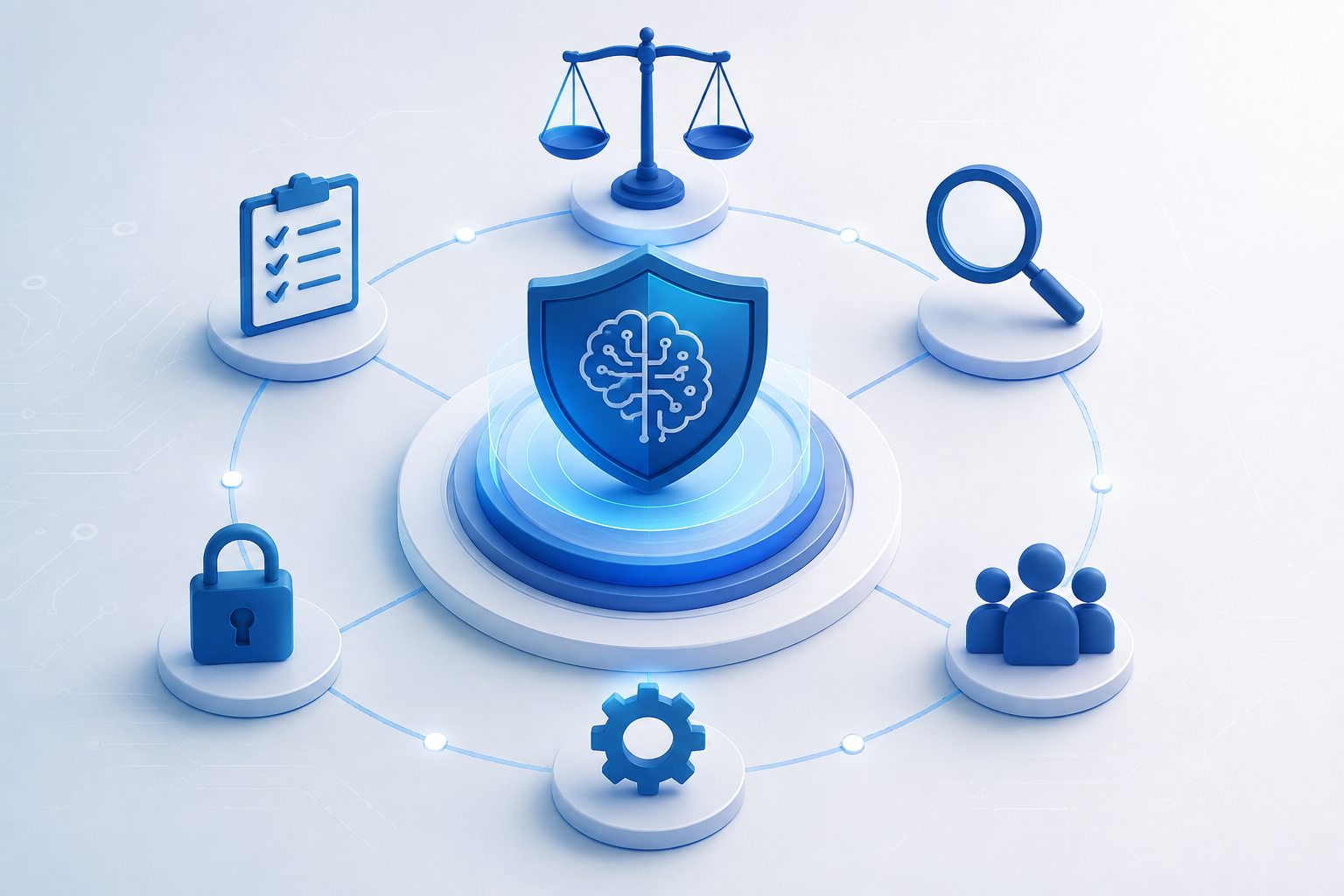 A practical AI governance framework brings structure to all of the challenges above. The key components typically include:
- AI policies and guidelines defining acceptable use across the organization
- Data governance ensuring information used by AI systems is accurate, secure, and properly managed
- Security controls protecting AI systems and the data they access
- Risk assessment processes to identify potential issues before deployment
- AI model monitoring to track performance and catch problems early
- Human oversight built into decision points that matter
- Compliance management aligned with relevant regulations and industry standards
- Employee training so staff understand both the capabilities and the risks of AI tools
- Regular audits and reviews to keep governance current as AI systems and regulations evolve
Notably, this isn’t just a defensive investment. Gartner has found that organizations deploying dedicated AI-governance platforms are 3.4 times more likely to achieve high governance effectiveness, meaning strong governance isn’t just about avoiding risk, it’s a genuine driver of successful AI adoption.
How to Build an Effective AI Transformation Strategy
1. Define Clear Business Goals
Successful AI transformation starts with a business problem, not a piece of technology. Before evaluating any AI tool, businesses should be clear about what outcome they’re trying to achieve- reduced costs, faster response times, better decision-making, and let that goal guide the technology choice, not the other way around.
2. Identify High-Value AI Use Cases
Not every part of a business benefits equally from AI. Strong starting points typically include customer service automation, predictive analytics, intelligent document processing, business process automation, and custom AI-powered applications built around a specific need.
3. Assess Data Readiness
AI is only as reliable as the data behind it. This means evaluating data quality, how accessible that data actually is across the organization, how securely it’s stored, and whether the underlying data infrastructure can actually support AI workloads.
4. Establish AI Governance Policies
This means clearly defining what acceptable AI use looks like within the organization, establishing approval processes for new AI tools or use cases, and creating risk management procedures before problems arise, not after.
5. Implement AI Securely
Secure implementation includes proper access controls, encryption, secure APIs, strong cloud security practices, and thorough data protection measures built in from the start rather than added later.
6. Monitor and Improve AI Systems
AI systems aren’t “set and forget.” This step includes ongoing performance monitoring, regular accuracy checks, continuous security monitoring, and consistent optimization as the system and business needs evolve.
The Role of an AI and Technology Partner in Business Transformation
Given everything above, it’s clear why most businesses can’t successfully navigate AI transformation alone. This is where the right technology partner becomes essential, not just for building AI tools, but for helping a business think through strategy, risk, and long-term sustainability.
A strong AI and technology partner supports businesses across AI strategy and consulting, AI readiness assessment, custom AI development, AI integration, machine learning solutions, generative AI solutions, cloud infrastructure, data engineering, cybersecurity, AI governance implementation, and ongoing maintenance and support. Rather than treating each of these as a separate vendor relationship, businesses benefit far more from working with one partner who understands how all of these pieces connect.
Why Businesses Should Choose the Right AI Technology Partner
Not every IT vendor is equipped to handle the full scope of AI transformation. When evaluating a potential AI strategy consulting or implementation partner, businesses should look for:
- Proven technical expertise, not just marketing claims
- Real experience with AI and emerging technologies, not a recently added service line
- Strong security practices built into how they work, not bolted on afterward
- A genuine understanding of business requirements, not a one-size-fits-all technology pitch
- Scalable technology solutions that can grow alongside the business
- Data privacy and compliance knowledge, particularly as regulation continues to expand
- Post-development support, since AI systems need ongoing attention, not a one-time deployment
- The ability to integrate AI with existing systems, rather than forcing a business to rebuild everything around a new tool
How Deftsoft Helps Businesses Navigate AI Transformation
At Deftsoft, we work as an experienced technology partner helping businesses move from AI experimentation to practical, governed, real-world implementation- the step where most organizations struggle the most.
Beyond AI transformation, Deftsoft also helps businesses strengthen their digital presence through custom software development, cloud solutions, cybersecurity, digital marketing, and affordable SEO services, enabling organizations to combine AI-driven innovation with long-term online growth.
AI Strategy and Consulting
Deftsoft helps businesses identify which AI opportunities are actually worth pursuing, based on real business goals rather than industry hype, and builds a clear implementation roadmap around those priorities.
Custom AI Development
Through Deftsoft’s AI Development Services and Generative AI Development capabilities, we build AI-powered applications and solutions tailored specifically to a business’s actual requirements, rather than adapting a generic off-the-shelf tool.
AI Integration
We integrate AI into existing software, websites, applications, CRMs, and business systems, so new AI capabilities work with what a business already has, instead of forcing a disruptive rebuild.
Secure and Scalable Technology Solutions
Backed by Deftsoft’s Cybersecurity Services and Cloud Services, every AI implementation is built with security, scalability, and data protection considered from day one, not added as an afterthought once a system is already live.
Long-Term AI Support and Optimization
AI transformation doesn’t end at deployment. Deftsoft provides ongoing maintenance, performance monitoring, continuous improvement, and scaling support as a business’s AI needs evolve, supported by our broader Custom Software Development and Machine Learning Development expertise, along with dedicated AI Consulting Services throughout the relationship.
Ready to explore how AI can transform your business while maintaining security, governance, and scalability?
AI Governance vs. AI Transformation: What’s the Difference?
| AI Transformation | AI Governance |
|---|---|
| Adopting AI technologies | Managing AI responsibly |
| Automating processes | Establishing rules and policies |
| Building AI solutions | Managing AI risks |
| Improving efficiency | Ensuring security and compliance |
| Driving innovation | Creating accountability |
These aren’t competing priorities; they’re two halves of the same effort. Successful AI transformation requires both: the ambition and technology to drive innovation, paired with the governance structure to make sure that innovation doesn’t create bigger problems than it solves.
What Happens When Businesses Ignore AI Governance?
The consequences of weak or missing AI governance are not hypothetical. Businesses that skip this step commonly face data breaches, privacy violations, regulatory penalties, biased AI decisions, incorrect business decisions based on flawed AI output, security vulnerabilities, direct financial losses, and a lasting loss of customer trust.
The scale of this risk is growing quickly. The AI Incident Database logged 362 recorded AI incidents in 2025, up 55% from 233 the year before, according to Stanford HAI’s AI Index. And when incidents do happen, most businesses aren’t ready to respond: nearly 60% of organizations that experienced an AI incident rated their own response as only satisfactory or outright negative, according to McKinsey research. In other words, most businesses aren’t just underprepared to prevent AI governance failures; they’re underprepared to handle them when they happen.
The Future of AI Transformation Is Responsible AI Governance
AI adoption is not slowing down; if anything, it’s accelerating. Gartner projects that 40% of enterprise applications will include task-specific AI agents by the end of 2026, up from less than 5% just a year earlier. But that same growth is why governance can’t be treated as optional. Gartner also predicts that by 2027, 40% of enterprises will demote or decommission autonomous AI agents specifically because of governance gaps that only became visible after something went wrong in production.
Businesses need governance frameworks that evolve alongside their technology, not static policies written once and forgotten. Responsible AI should become part of an organization’s long-term digital transformation strategy, not a separate compliance checkbox handled after the fact. Ultimately, the combination of AI strategy, governance, and real technology expertise will be what separates businesses that get lasting value from AI from those that end up rolling back their own investments.
Frequently Asked Questions About AI Transformation and Governance
What does “AI transformation is a problem of governance” mean?
It means that successfully adopting AI depends on far more than the technology itself; it requires clear strategy, strong data practices, security, compliance, and accountability working together. Without proper governance, even well-built AI systems tend to underperform or create new risks.
Why is AI governance important for businesses?
AI governance protects businesses from data breaches, compliance violations, biased or inaccurate AI decisions, and reputational damage, while also making AI implementations more reliable and effective. Strong governance has been shown to significantly improve the chances of a successful AI deployment, not just reduce risk.
What are the biggest challenges of AI transformation?
Common challenges include unclear business objectives, poor data quality, security and privacy risks, employee resistance to adoption, lack of internal AI expertise, integration difficulties with existing systems, and trouble measuring real ROI.
What should an AI governance framework include?
A solid framework includes clear AI policies, data governance practices, security controls, risk assessment processes, AI model monitoring, human oversight, compliance management, employee training, and regular audits and reviews.
How can businesses implement AI securely?
Secure AI implementation involves strong access controls, encryption, secure APIs, robust cloud security, and comprehensive data protection measures built into the system from the very beginning of development.
Do businesses need an AI technology partner?
Most businesses lack the specialized in-house expertise required to design, deploy, secure, and govern AI systems effectively. An experienced AI technology partner brings that expertise, along with a structured approach to strategy, security, and compliance.
How can an IT company help with AI transformation?
An experienced IT company can guide AI strategy and consulting, build custom AI solutions, integrate AI with existing systems, implement strong security and governance practices, and provide long-term support, helping a business move from AI experimentation to genuine, sustainable transformation.
Recent Articles




Devraj
 4th August 2026