Why Adobe Commerce Is the Best Platform for B2B Ecommerce Growth in 2026
-
By Devraj
-
9th March 2026
Introduction
The way businesses buy and sell online has changed dramatically in recent years. B2B commerce is no longer limited to email orders, spreadsheets, or manual procurement processes. In 2026, digital commerce platforms have become the core infrastructure that supports how companies manage purchasing, pricing agreements, and long-term supplier relationships. Modern buyers expect the same seamless experience they encounter in B2C shopping. They want fast ordering, personalized catalogs, transparent pricing, and efficient workflows. At the same time, businesses require advanced governance, integration capabilities, and operational control.
For organisations aiming to achieve sustainable B2B Ecommerce Growth, choosing the right technology platform is one of the most important strategic decisions they will make. Among the many e-commerce platforms available today, Adobe Commerce stands out as one of the most powerful and scalable solutions designed specifically for complex B2B operations. Formerly known as Magento Commerce, Adobe Commerce provides advanced features that support enterprise-scale procurement systems, custom pricing models, multi-user accounts, and deep integrations with existing enterprise technology.
When implemented correctly with the support of an experienced Ecommerce Development Service provider, Adobe Commerce can transform how businesses operate digitally. Companies gain the ability to streamline procurement, automate processes, and create scalable e-commerce ecosystems that evolve with their growth.
This guide explores why Adobe Commerce continues to lead the market in 2026 and why it has become the preferred platform for businesses seeking long-term B2B ecommerce success.
What Is Adobe Commerce for B2B Ecommerce?
Adobe Commerce is an enterprise ecommerce platform designed to support complex B2B purchasing workflows. It enables businesses to manage company accounts, contract-based pricing, bulk ordering, and approval processes within a scalable digital commerce system.
Unlike traditional ecommerce platforms that focus primarily on consumer shopping experiences, Adobe Commerce is built to support enterprise procurement operations. Businesses can create structured buying environments where different roles, such as buyers, managers, and finance teams, participate in purchasing decisions.
These capabilities make Adobe Commerce one of the most powerful platforms for companies seeking sustainable B2B Ecommerce Growth, especially when implemented with the help of an experienced Ecommerce Development Service provider.
How Adobe Commerce Powers Scalable B2B Procurement Infrastructure
Traditional ecommerce platforms were designed primarily for consumer transactions. B2B commerce, however, involves much more complexity. Companies must handle multi-level approval processes, contract-based pricing, negotiated catalogues, and large recurring orders. Adobe Commerce approaches ecommerce from a broader perspective. Instead of treating digital commerce as a simple storefront, it serves as a procurement infrastructure that mirrors how real organisations buy.
This means businesses can build structured digital environments where procurement policies, internal hierarchies, and purchasing workflows are accurately reflected within the platform. By digitising these processes, companies can eliminate many of the inefficiencies associated with manual procurement systems. Buyers gain faster access to the products they need, while internal teams maintain control over pricing rules, approvals, and spending limits.
As a result, Adobe Commerce becomes more than just an ecommerce platform. It becomes the operational backbone of modern B2B purchasing.
Key B2B Features of Adobe Commerce
One reason Adobe Commerce is widely used by large enterprises is its extensive suite of built-in B2B capabilities. These features are designed to support the complex operational requirements that most B2B organisations face.
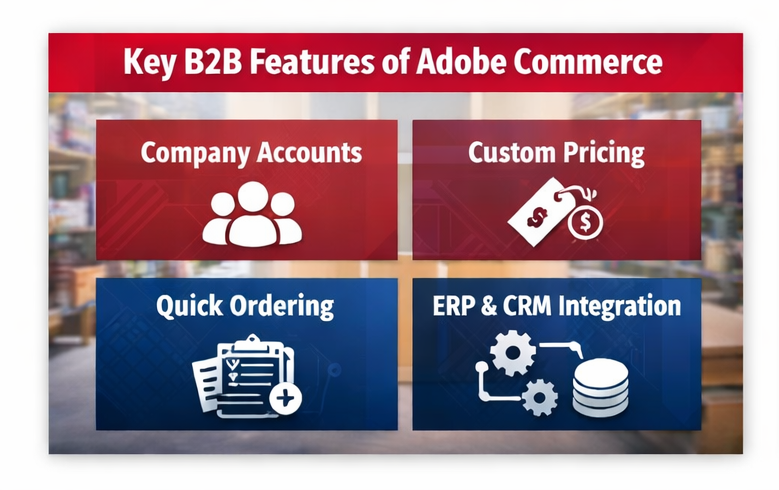
Some of the most powerful features include:
- Company accounts with multi-user permissions
- Custom catalogues and negotiated contract pricing
- Bulk ordering tools and quick order forms
- Requisition lists for repeat purchasing
- Configurable approval workflows
- Advanced inventory and order management
- Multi-store and multi-currency support
- ERP, CRM, and third-party integrations
- AI-powered product recommendations
These capabilities allow businesses to build highly customised procurement experiences while maintaining centralised control over operations. With the support of an experienced Ecommerce Development Service provider like Deftsoft, organisations can configure these features to align with their procurement policies and internal workflows.
Benefits of Adobe Commerce for B2B Businesses
Adobe Commerce has become a preferred ecommerce platform for enterprises because it offers capabilities specifically designed for B2B commerce operations.
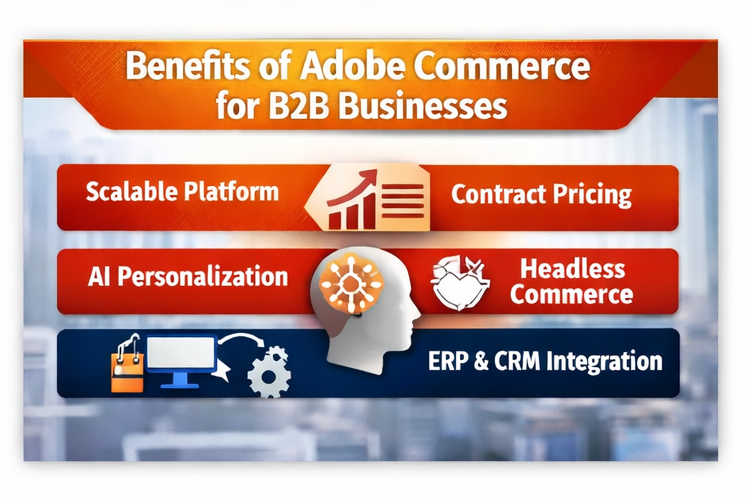
Some of the key benefits include:
- Scalable architecture that supports enterprise-level ecommerce growth
- Advanced B2B purchasing workflows designed for complex procurement structures
- Custom catalogues and negotiated pricing for contract-based customer relationships
- Flexible integrations with ERP, CRM, and third-party business systems
- AI-driven product recommendations and personalisation
- Headless commerce architecture for modern digital experiences across multiple channels
These benefits allow businesses to build ecommerce systems that support long-term operational efficiency while delivering seamless purchasing experiences for corporate buyers.
How Adobe Commerce Company Accounts Simplify B2B Governance
One of the most powerful features in Adobe Commerce is the Company Accounts system, which allows businesses to mirror their customers’ internal purchasing structures. In many B2B organisations, purchasing decisions are rarely made by a single individual. Instead, multiple stakeholders participate in the process, including buyers, managers, finance teams, and procurement officers.
Adobe Commerce enables businesses to replicate this structure digitally by allowing companies to create hierarchical user roles within each account.
Common roles include:
- Buyer
- Senior Buyer
- Approver
- Procurement Manager
- Finance Controller
Each role can have different permissions and spending limits. For example, a buyer may be able to create orders up to a certain amount, while larger purchases may require approval from a finance controller. This type of role-based governance ensures that purchasing remains efficient while still maintaining strict operational oversight.
By implementing well-structured company account systems, businesses can stabilize operations and support predictable growth.
How Shared Catalogues in Adobe Commerce Manage B2B Contract Pricing
B2B pricing structures are rarely simple. Most businesses operate with negotiated contracts, volume discounts, regional price tiers, or industry-specific agreements. Managing this complexity manually can quickly become overwhelming. Adobe Commerce solves this challenge through its Shared Catalogue system.
Shared catalogues allow businesses to control both product visibility and pricing for specific customer groups. Instead of building separate storefronts or manually adjusting prices for each client, businesses can assign customized catalogs to different companies.
This approach allows organisations to maintain:
- Contract-based pricing for key clients
- Regional pricing strategies
- Industry-specific product assortments
- Volume-based discount structures
The result is a disciplined and scalable pricing strategy that reduces errors, minimises invoice disputes, and improves customer trust. For companies experiencing rapid B2B Ecommerce growth, this capability becomes essential for managing large customer bases with diverse pricing agreements.
How Approval Workflows in Adobe Commerce Protect B2B Purchase Velocity
Approval processes are necessary in B2B procurement. However, poorly designed workflows can slow down purchasing and frustrate buyers. Adobe Commerce addresses this challenge through configurable approval workflows that balance compliance with efficiency.
Businesses can define rules based on:
- Order value thresholds
- Product categories
- Company hierarchy levels
- Procurement policies
For example, small orders may be approved automatically, while high-value purchases are routed to financial controllers for verification. The key advantage of this system is transparency. Buyers can track the status of their orders directly within the platform rather than relying on manual email approvals.
This visibility helps maintain purchasing velocity while ensuring financial oversight and compliance.
The Engine of Repeat Procurement: Quick Order and Requisition Lists
In most B2B companies, repeat purchases represent the majority of total revenue. Procurement teams often order the same products repeatedly, making efficiency a top priority. Adobe Commerce supports this behaviour through two highly valuable tools.
1. Quick Order
The Quick Order feature allows buyers to place orders rapidly by entering SKUs directly or uploading bulk order files. This eliminates the need to navigate through multiple product pages.
2. Requisition Lists
Requisition lists allow procurement managers to save predefined product bundles for recurring purchases. These lists can be reused across teams, ensuring consistent ordering and reducing mistakes.
Together, these tools transform ecommerce from a browsing experience into a highly efficient ordering system designed specifically for professional buyers.
AI-Driven Personalisation and Intelligent Commerce Workflows
Artificial intelligence has become a major driver of ecommerce innovation. Adobe Commerce integrates advanced AI capabilities through Adobe Sensei, allowing businesses to deliver personalised shopping experiences while maintaining strict B2B governance. AI can analyse customer behaviour to identify patterns in purchasing activity. These insights allow businesses to recommend relevant products, forecast future demand, and optimise marketing strategies.
Unlike many consumer-focused personalisation systems, Adobe Commerce ensures that recommendations always respect negotiated pricing agreements and shared catalogue restrictions. This means businesses can deliver intelligent recommendations without compromising contract-based pricing structures. AI-powered analytics also help businesses better understand how buyers interact with the platform, enabling continuous optimisation of the customer journey.
Headless Commerce Architecture for Future Scalability
The digital commerce landscape continues to evolve rapidly. Businesses must deliver consistent experiences across multiple channels, including websites, mobile apps, marketplaces, and even IoT devices. Adobe Commerce supports this flexibility through a headless commerce architecture that separates the frontend experience from backend commerce operations.
This approach allows businesses to create custom digital experiences without disrupting the core commerce engine.
For example, companies can build:
- Mobile-first B2B ordering apps
- Voice-assisted ordering systems
- Custom procurement portals
- IoT-based reordering systems
Because Adobe Commerce uses an API-first architecture, developers can integrate new digital channels while maintaining a stable backend system. Organizations adopting headless commerce often rely on experienced Ecommerce Development Services to design scalable architectures that support future growth.
Seamless Integration with ERP, CRM, and Content Systems
In B2B commerce, ecommerce platforms rarely operate in isolation. They must integrate with a wide range of enterprise systems, including:
- Enterprise Resource Planning (ERP) systems
- Customer Relationship Management (CRM) platforms
- Product Information Management systems
- Inventory and fulfillment software
Adobe Commerce is designed for integration. Its flexible architecture allows businesses to synchronise data across multiple systems, ensuring that pricing, inventory, and customer data remain consistent. For example, businesses can connect Adobe Commerce with ERP systems to ensure accurate stock levels during checkout.
Content integration also plays a crucial role in B2B commerce. Buyers often require technical documentation, compliance certifications, installation guides, and product specifications before making purchasing decisions. Adobe Commerce integrates seamlessly with Adobe Experience Manager, enabling businesses to combine product information with educational content to support informed purchasing decisions.
Adobe Commerce vs Other B2B Ecommerce Platforms
While several ecommerce platforms offer B2B capabilities, Adobe Commerce consistently stands out for its flexibility and enterprise-level scalability.
| Platform | Best For | Limitations |
|---|---|---|
| Adobe Commerce | Complex B2B workflows and customization | Requires expert implementation |
| Shopify Plus | Simple ecommerce operations | Limited advanced B2B capabilities |
| Salesforce Commerce | CRM-driven enterprise commerce | Higher cost and complexity |
| BigCommerce | Mid-market ecommerce businesses | Limited customisation flexibility |
Adobe Commerce offers the greatest level of customisation and operational control, making it ideal for organisations with complex procurement requirements.
Key Takeaways
- Adobe Commerce provides a scalable foundation for complex B2B ecommerce operations
- Company accounts allow businesses to mirror real-world procurement structures
- Shared catalogues enable contract-based pricing and customer-specific product assortments
- Approval workflows maintain compliance while protecting purchasing speed
- AI-powered personalisation improves product discovery and customer engagement
- Headless architecture allows businesses to build flexible digital commerce ecosystems
Why Deftsoft Is the Right Partner for Adobe Commerce Implementation
While Adobe Commerce provides powerful capabilities, successful implementation requires deep technical expertise and strategic planning. This is where Deftsoft’s Ecommerce Development Service plays a critical role.
At Deftsoft,the focus goes beyond launching an ecommerce store. The goal is to build a digital commerce architecture that aligns with real-world procurement processes and long-term business goals.
Deftsoft helps businesses:
- Design scalable Adobe Commerce architectures
- Integrate ecommerce platforms with ERP and CRM systems
- Build headless commerce experiences
- Optimise performance and scalability
- Implement advanced B2B features and workflows
By combining technical expertise with strategic planning, Deftsoft enables businesses to fully unlock the potential of Adobe Commerce.
Common Challenges When Implementing Adobe Commerce
While Adobe Commerce provides powerful capabilities for B2B ecommerce, implementing the platform successfully requires careful planning and technical expertise.
Some common challenges businesses face include:
- Configuring complex B2B purchasing workflows
- Integrating the ecommerce platform with legacy ERP systems
- Managing large product catalogs and customer-specific pricing
- Optimising platform performance for high traffic volumes
- Designing scalable headless commerce architectures
These challenges can be addressed effectively by working with an experienced Ecommerce Development Service provider like Deftsoft, which understands both the technical architecture and operational requirements of enterprise ecommerce systems.
With the right implementation strategy, businesses can fully unlock the capabilities of Adobe Commerce and build scalable digital commerce ecosystems.
Final Thoughts
The future of digital commerce will continue to be shaped by automation, personalisation, and scalable technology platforms. For businesses seeking sustained B2B Ecommerce Growth, Adobe Commerce provides one of the most powerful foundations available today. Its advanced features, flexible architecture, and enterprise integration capabilities make it the preferred platform for organisations that require both control and scalability.
However, technology alone is not enough. Achieving real business impact requires thoughtful implementation and strategic planning. Partnering with an experienced Ecommerce development service provider like Deftsoft ensures that your Adobe Commerce platform is designed to support both current operations and future growth.
Businesses that invest in the right digital commerce infrastructure today will lead the market tomorrow.
FAQ
What is Adobe Commerce used for in B2B ecommerce?
Adobe Commerce is used to manage complex B2B purchasing processes, including company accounts, custom pricing, bulk ordering, approval workflows, and enterprise system integrations.
Is Adobe Commerce good for large B2B companies?
Yes. Adobe Commerce is designed for enterprise-scale operations and supports complex procurement systems, multi-store environments, and advanced integrations.
Why do companies choose Adobe Commerce for B2B ecommerce?
Companies choose Adobe Commerce for its flexibility, scalability, advanced B2B features, and integration with existing enterprise systems.
Is Adobe Commerce the same as Magento?
Adobe Commerce is the enterprise version of Magento. It includes additional features such as cloud hosting, AI capabilities, advanced B2B functionality, and deeper integration with Adobe Experience Cloud.
How does Adobe Commerce support B2B Ecommerce Growth?
Adobe Commerce supports B2B Ecommerce Growth with advanced features, including company accounts, custom pricing catalogues, bulk ordering tools, and approval workflows. These capabilities help businesses streamline procurement, automate purchasing processes, and deliver personalised buying experiences to corporate customers.
Do businesses need an Ecommerce development service to implement Adobe Commerce?
Yes. While Adobe Commerce offers powerful built-in features, successful implementation usually requires a professional Ecommerce Development Service. Experienced developers can customise the platform, integrate ERP and CRM systems, optimise performance, and configure B2B workflows to match real business procurement processes.
Can Adobe Commerce integrate with existing business systems?
Yes. Adobe Commerce is designed to integrate seamlessly with enterprise systems, including ERP platforms, CRM software, payment gateways, and inventory management tools. These integrations ensure that product data, pricing, inventory, and customer information remain synchronised across the entire business ecosystem.
Recent Articles




Devraj
 9th March 2026