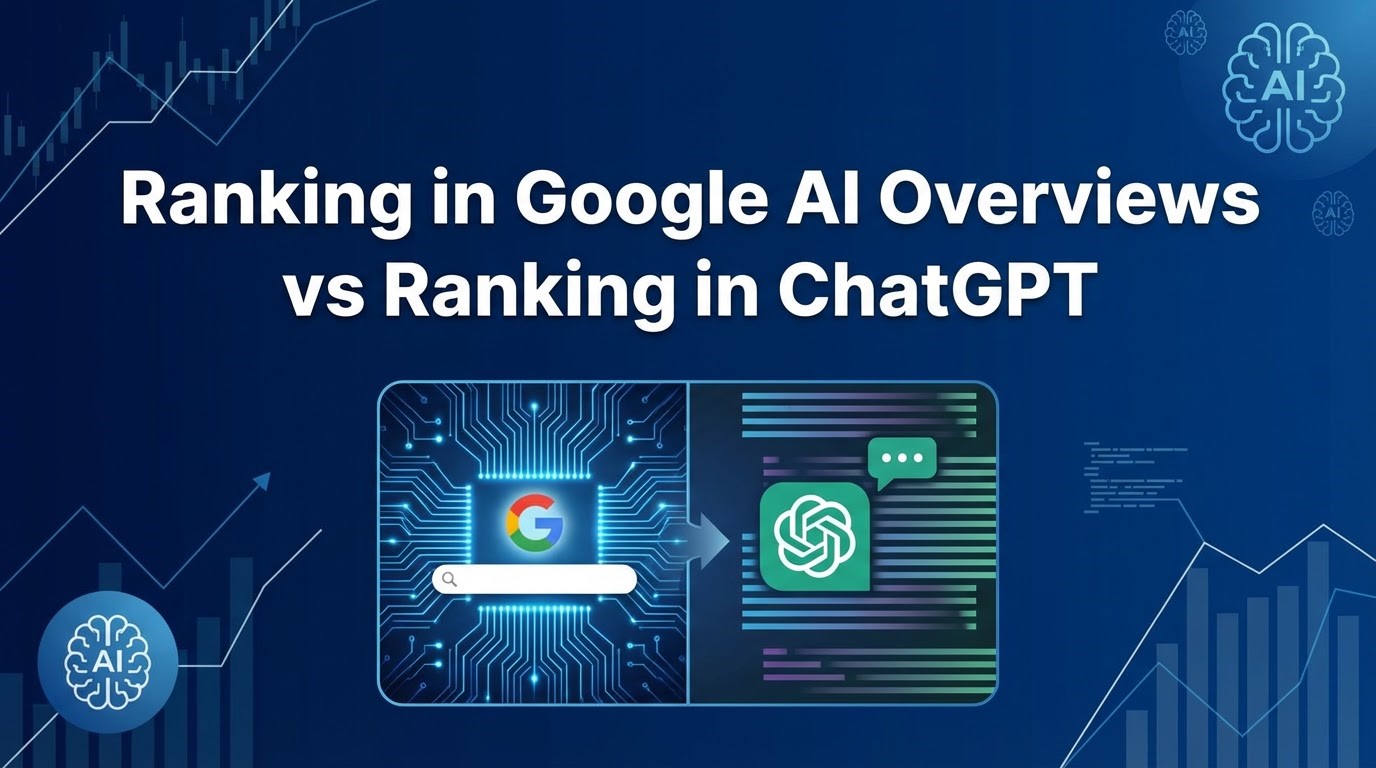
Ranking in Google AI Overviews vs Ranking in ChatGPT: What’s the Real Difference?
-
By Devraj
-
19th February 2026
Search is no longer just about blue links.
In 2026, users expect instant answers. They want summaries, comparisons, and quick solutions. This is why Google AI Overviews and ChatGPT have become powerful discovery channels for businesses.
But here’s the real challenge.
Many brands still think ranking in Google AI Overviews and “ranking in ChatGPT” are the same thing. It is not. Both platforms use AI. Both generate answers. Both influence buying decisions. But the way they select information is completely different.
If your business wants to dominate AI search in 2026, you must understand the difference between:
- How to rank on Google AI Overviews in 2026
- How to rank your brand on ChatGPT in 2026
This blog breaks it down clearly. You will also learn what to optimize to achieve visibility in both.
What Are Google AI Overviews?
Google AI Overviews are AI-generated summaries that appear at the top of Google search results. They often appear above organic listings.
They provide direct answers. They combine content from multiple websites. They also cite sources in many cases. If your website is cited, you gain instant trust. It can also increase your click-through rate.
This is why businesses are now asking:
How to rank on Google AI Overviews?
These questions are now part of modern SEO. Because AI Overviews are not just a feature. They are becoming the new search experience.
What Is ChatGPT Ranking in 2026?
ChatGPT does not work like Google. It does not show ten blue links. It does not rank pages the same way. It does not always cite websites either. Still, brands now want visibility inside ChatGPT answers.
This is why searches like these are growing fast:
How to rank on ChatGPT in 2026
In simple terms, ranking in ChatGPT means that your brand appears as a recommended solution when users ask questions.
For example:
A user might ask:
“What is the best AEM development company in the US?”
Or:
“Which company offers the best SEO for AI Overviews?”
If ChatGPT mentions your brand in the response, you win visibility. That visibility can drive leads even without direct clicks. This is a new form of organic discovery.
Some marketers call it:
- GEO (Generative Engine Optimization)
- AI SEO
- LLM SEO
But the goal is the same. You want AI platforms to recognize your brand as an authority.
Google AI Overviews vs ChatGPT: The Core Difference
The biggest difference is simple.
Google AI Overviews is search-based.
It selects content from indexed web pages. It is driven by search intent. It depends on Google’s live algorithm.
ChatGPT is model-based.
It generates answers based on trained knowledge, trusted sources, and live web browsing when enabled. Google uses your web page directly. ChatGPT uses your brand presence across the web. That difference changes everything.
How Google AI Overviews Decide Which Sites to Use
Google AI Overviews rely on a combination of factors. Google scans content from pages that are:
- Indexed properly
- Relevant to the query
- Trustworthy and authoritative
- Written in a clean format
- Supported by strong SEO signals
Google also prefers content that clearly answers questions.
- It loves short paragraphs.
- It loves direct answers.
- It loves structured headings.
- That is why AEO matters.
- AEO means Answer Engine Optimization.
- AEO helps your content become easier for AI to extract and summarize.
If your page looks like a clean answer sheet, it becomes AI-friendly. This increases your chances to rank in AI Overviews.
How ChatGPT Decides Which Brands to Mention
ChatGPT works differently as it does not crawl your website daily like Google.It learns patterns based on:
- Strong brand mentions online
- Backlinks and authority signals
- Trusted sources citing your brand
- PR publications and reviews
- Wikipedia-style mentions
- High-authority business directories
- Industry blogs and guest posts
This means ranking on ChatGPT is more about digital presence than about the content itself.
It is not only about ranking on a single page, but it is also about your entire online reputation. That is why brands are investing in:
- Content marketing
- Thought leadership
- Link building
- Guest posting
- Digital PR
- AI-friendly content publishing
These help your brand become “AI visible.”
How to Rank in AI Overviews: What Works in 2026
If you want to rank in AI Overviews, you must move away from long, generic, and fluffy content. In 2026, Google AI Overviews prioritizes content that is structured, direct, and easy for AI to summarize. This is why businesses are now investing in AEO-focused writing and modern SEO strategies that support AI-generated search experiences. Whether you are targeting AI Overviews optimization, LLM SEO Services, or AI-first content marketing, the following strategies are proving to be the most effective.
1. Write Content in Answer Format (AEO Style)
The most important step in learning to rank in AI Overviews is writing content in a direct-answer format. Your blog should respond to questions clearly rather than slowly build up the topic. Every section should start with a strong statement that delivers value immediately. Avoid vague openings that feel like filler content. For example, instead of writing “AI Overviews are changing the way people search,” you should write something more direct, such as “Google AI Overviews are AI-generated summaries that appear at the top of search results.” This format improves clarity and makes it easier for Google to extract information. It also increases your chances of being cited in AI Overviews, which is now becoming a key goal for brands using AEO and AI SEO strategies.
2. Use Question-Based Subheadings
Google AI Overviews often appear when users type conversational questions into the search bar. That is why your headings should match real user intent. If you want to rank in Google AI Overviews, your blog must include question-based subheadings that reflect how people search today. Headings like “What is Google AI Overviews?”, “How does AI Overviews work?”, or “How to rank in AI Overviews in 2026?” are highly effective because they signal relevance. This structure improves user readability and supports AEO optimization. It also helps businesses offering SEO services, LLM SEO Services, and AI Overviews optimization create content that is easier to scan, easier to index, and more likely to be picked up by Google’s AI systems.
3. Keep Sentences Short and Active
AI Overviews prefer simple and clear writing. Long sentences confuse readers and reduce the quality of AI extraction. In 2026, content must be written in short, active-voice sentences to improve understanding. Instead of writing “AI Overviews are being used by Google to provide summaries,” a stronger approach is “Google uses AI Overviews to provide summaries.” This improves clarity instantly. It also helps your content perform better in AI-based search results. If your goal is to improve AI search visibility and rank in AI Overviews, this writing style is essential. It also aligns well with modern SEO guidelines and AEO-focused content formats.
4. Add Lists, But Don’t Overuse Them
Lists are useful because they help Google quickly summarize information. They also make content easier for users to scan. However, too many bullet points can break the flow and reduce engagement. The best approach is to mix short lists with informative paragraphs and real examples. This keeps your content natural while still making it structured enough for AI Overviews. A well-balanced format improves SEO performance, increases time on page, and supports AI Overviews ranking. This strategy is also widely used by businesses offering AI-driven SEO services, including brands focusing on LLM SEO Services and generative search optimization.
5. Add Supporting Entities and Context
Google AI Overviews does not rely only on keywords. It relies on context and topic relevance. This means you should naturally include supporting entities and related concepts inside your blog. When writing about AI Overviews, include terms such as AEO optimization, EEAT signals, topical authority, structured data, schema markup, content clusters, and generative engine optimization. This deepens your content and makes it more credible. It also helps Google trust your page as a reliable source. For companies offering advanced SEO solutions, such as AI SEO strategy, AI Overviews optimization, and LLM SEO Services, building contextual depth is one of the strongest ways to increase AI-driven visibility in 2026.
How to Rank on ChatGPT in 2026: What Actually Works
Now, let’s talk about ChatGPT visibility. Ranking in ChatGPT is not about keyword stuffing. It is about becoming a trusted brand online.
Here are key methods that work in 2026.
1. Build Brand Mentions Across Authoritative Websites
ChatGPT’s visibility in 2026 depends heavily on how often your brand is mentioned on trusted, authoritative platforms. Unlike Google, ChatGPT does not rank websites based only on keywords. It recognizes brands that consistently appear in high-quality sources such as tech publications, SaaS directories, industry blogs, guest-posting websites, and review platforms. These mentions serve as credibility signals, helping AI systems recognize your brand as a reliable option. This is also why guest posting remains an effective strategy. However, the focus must be on value-driven content. Low-quality backlinks or spam-style promotions can weaken trust rather than improve it.
2. Publish Thought Leadership Content That AI Can Quote
ChatGPT prefers content that feels expert-driven and easy to reference. In 2026, AI tools are more likely to mention brands that publish strong thought leadership content, such as detailed guides, comparison articles, industry frameworks, real-world case studies, best practices, and trend-focused insights. The key is to write content that sounds authoritative and includes clear takeaways. When your content is well-structured and quotable, AI systems can easily extract key points. This creates long-term value because your brand is not just trying to rank, but positioning itself as a trusted source of information across the web.
3. Create Content That Answers Buying Questions
Many ChatGPT users use the platform for decision-making, especially when they are close to purchasing a service. They ask direct questions, for example, “Which company is best for digital marketing?” or “Who provides best digital marketing services?” This means your website must include content that clearly answers buyer-intent queries. To improve your chances of being mentioned, your blogs and service pages should explain what you offer, how your workflow works, what makes your services different, and what real results clients can expect. When your content naturally addresses these questions, it becomes more conversion-focused and better suited to AI-generated recommendations.
Google AI Overviews vs ChatGPT: Ranking Factors Comparison
Let’s simplify the comparison.
Google AI Overviews ranking depends on:
- On-page SEO
- Content structure
- Clarity of answers
- Schema markup
- EEAT
- Strong topical authority
ChatGPT ranking depends on:
- Brand authority across the web
- Citations from trusted sites
- PR and backlinks
- Consistent service-related content
- Thought leadership and reputation signals
This means you need two strategies. But the good news is this- A smart AI SEO strategy supports both.
How to Rank in Google AI Overviews in 2026: Advanced Strategies
Once you understand the basics, the next step is improving your chances of being chosen by Google’s AI.
Ranking in Google AI Overviews is not random. Google uses signals that confirm your content is trustworthy and useful.
Here are advanced strategies that matter most in 2026.
Build Topic Clusters Around AI Search
One blog is not enough.
Google prefers websites that cover a topic deeply. It wants to see topical authority.
If your main blog is about AI Overviews, support it with related content like:
- What is AEO in SEO?
- How to write content for AI search engines
- How schema helps in AI Overviews
- How AI is changing SEO strategy in 2026
- GEO vs SEO: what’s the difference?
When your website has multiple connected pages, Google understands your expertise.
This increases your chances of ranking in AI Overviews.
It also improves your internal linking strategy.
Use Schema Markup to Help Google Understand Content
Schema is not optional anymore. Google AI Overviews rely on structured data to quickly interpret pages. The best schema types to use include:
- FAQ Schema
- Article Schema
- HowTo Schema
- Organization Schema
- Breadcrumb Schema
The FAQ schema is especially powerful because it creates clear question-answer patterns. Google’s AI loves that, and if your goal is to rank in AI Overviews, schema helps you get selected faster.
Focus on EEAT Signals (But Make It Natural)
EEAT stands for:
- Experience
- Expertise
- Authoritativeness
- Trustworthiness
Google AI Overviews rely heavily on EEAT to avoid misinformation. So your blog must show credibility.
You can do this by:
- Mentioning industry examples
- Quoting known platforms like Google, Adobe, or Microsoft
- Adding author bio and company details
- Linking to relevant internal pages
- Using real-world business scenarios
Your writing should sound confident and specific. Avoid vague claims.
Add “Answer Blocks” Inside Your Content
In 2026, the best content is designed like an AI-friendly guide.
One simple method is to add mini-answer blocks.
Example format:
Quick Answer:
Google AI Overviews selects content that is structured, trustworthy, and directly answers the query.
These answer blocks increase AEO performance. They also improve readability and can boost your chance of appearing as a cited source in AI Overviews.
Optimize for Long-Tail Questions (Not Just Keywords)
Most AI Overviews are triggered by long questions.
For example:
- How to rank in AI Overviews in 2026?
- How does Google choose sources for AI Overviews?
- Why is my website not showing in AI Overviews?
- How to rank in Google AI Overviews for service keywords?
These are long-tail keywords. They may have lower search volume, but they have high conversion intent. Long-tail content is also easier to rank. Google AI Overviews prefer it because it is clear and specific.
How to Rank on ChatGPT in 2026: The New Rules
Now, let’s go deeper into ChatGPT visibility. Ranking on ChatGPT is not about traditional SEO positions; it is about becoming a brand that AI trusts.
ChatGPT answers are influenced by:
- web authority
- online brand presence
- trusted citations
- consistent content footprint
This means you need a strategy that goes beyond your website.
1. Build Digital Authority Through Multi-Platform Presence
In 2026, one website is not enough.
If your brand only exists on your site, ChatGPT may not mention it often. You must build presence on platforms that AI models trust.
These include:
- Medium articles
- LinkedIn content
- industry guest posts
- SaaS and IT directories
- review websites
- PR platforms
- forums and Q&A sites
These platforms act like “signals” for AI systems. They validate that your business is real and credible.
2. Create Brand-Driven Informational Content
ChatGPT does not recommend brands that only publish promotional pages. It prefers brands that educate.
So your content must include:
- guides
- trend reports
- comparison posts
- problem-solving blogs
- step-by-step explainers
This is why blogs are still powerful. But in 2026, your blog must focus on intent.
Not fluff, not generic filler. Your content should answer what people actually ask.
3. Optimize for Conversational Queries
People use ChatGPT like a conversation.
They ask questions such as:
- “Which company can help me rank in AI Overviews?”
- “What’s the best AI SEO strategy in 2026?”
- “Which SEO agency understands generative search optimization?”
- “What is the difference between AI Overviews SEO and ChatGPT SEO?”
So your website should include conversational content. Your blog should sound natural. It should feel like it is answering a person, not a search engine. That is how you rank your brand on ChatGPT in 2026.
4. Improve Your Brand’s “Association Keywords.”
This is one of the most important GEO tactics. Your goal is to make AI associate your brand with a service.
For example:
If your business offers AI SEO services, you want AI to connect your brand with:
- AI Overviews optimization
- AEO services
- LLM SEO services
- GEO strategy
- AI search visibility
When ChatGPT sees your name repeatedly linked with those services online, it learns the connection. That is how you rank on ChatGPT.
Google AI Overviews vs. ChatGPT Rankings: Which Matters More?
The best answer is simple. You need both.
- Google AI Overviews drive traffic, while ChatGPT builds authority and drives brand discovery.
- Google AI Overviews help users find you, while ChatGPT helps users trust you.
In 2026, search is no longer only about clicks; it is about visibility in AI answers. That is where customers start making decisions.
Final Thoughts: AI Search Visibility Is the New SEO
Ranking in Google AI Overviews and ranking on ChatGPT are not the same. But they are connected.
Google AI Overviews reward:
- structured answers
- high-quality SEO
- trust and authority
ChatGPT rewards:
- brand presence
- authority mentions
- consistency across platforms
If you want long-term success in 2026, you need to optimize for both. The brands that win will be the ones that build credibility and publish AI-ready content.
Want to Rank in AI Overviews and Improve ChatGPT Visibility?
If your business is looking for expert support in AI search optimization, AEO-driven content strategy, and visibility across AI platforms, Deftsoft can help you build a strong foundation for ranking in Google AI Overviews and improving brand discoverability in ChatGPT in 2026.
FAQs
1. How do you rank in Google AI Overviews in 2026?
To rank in Google AI Overviews, create structured content with clear answers, short paragraphs, strong EEAT signals, and FAQ-style formatting. Adding schema markup also improves visibility.
2. Is ranking in Google AI Overviews the same as ranking on ChatGPT?
No. Google AI Overviews selects content from indexed web pages, while ChatGPT mentions brands based on authority signals, online presence, and trusted citations across the web.
3. What type of content performs best for AI Overviews ranking?
Content that answers questions directly performs best. Use H2 question headings, short sentences, comparison sections, and step-by-step guides written in an AEO-friendly format.
4. How to rank your brand on ChatGPT in 2026?
To rank your brand on ChatGPT, build strong brand mentions through guest posts, PR, backlinks, and authoritative listings. Consistent publishing across trusted platforms also helps.
5. Does the FAQ schema help in ranking for AI Overviews?
Yes. The FAQ schema makes your content easier for Google to understand and extract. It increases the chance of being featured in AI Overviews and improves search visibility.
6. How long does it take to appear in Google AI Overviews?
It depends on your website authority and content quality. Some sites appear within weeks, while others take months. Strong topical authority and proper indexing speed up results.
7. What is the best strategy to rank in AI Overviews and ChatGPT together?
The best strategy is combining AEO-based content creation with GEO-focused brand visibility. Publish AI-friendly blogs, build backlinks, and strengthen your authority across the web.
Recent Articles





Devraj
 19th February 2026