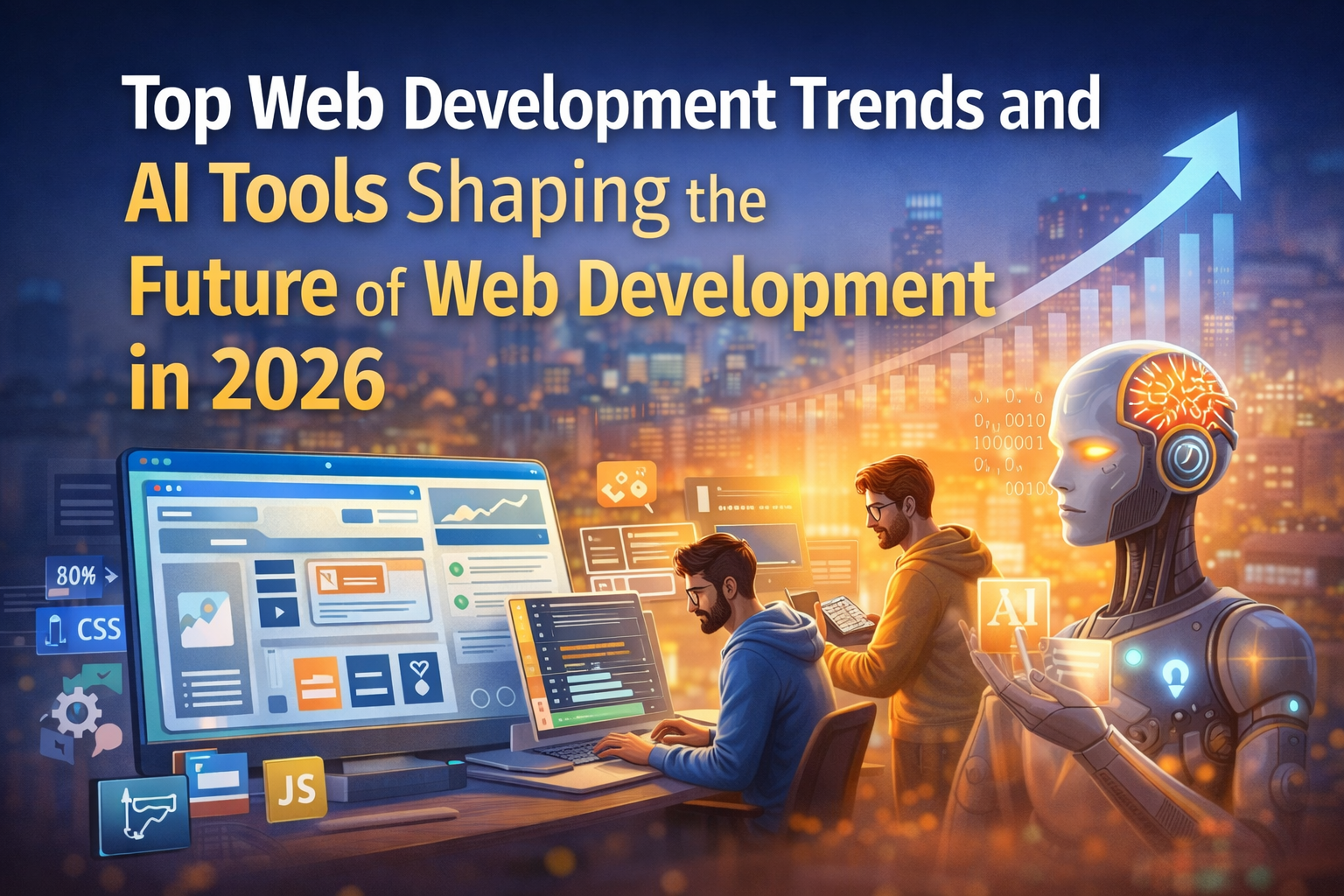
Top Web Development Trends and AI Tools Shaping the Future of Web Development in 2026
By Devraj
13th March 2026
The web has evolved far beyond simple static websites. In today’s digital economy, websites function as business platforms, customer experience hubs, marketing engines, and sales channels all at once. As we move through 2026, web development is entering a new phase driven by artificial intelligence, automation, cloud infrastructure, and advanced frameworks.
Businesses now expect websites to be fast, scalable, secure, and intelligent. Customers expect seamless user experiences across devices, personalized interactions, and real-time functionality. Developers, on the other hand, are adopting powerful
web development tools and technologies that help them build modern digital platforms faster than ever before.
The future of web development is being shaped by several key trends, including AI-assisted coding, headless architectures, and progressive web apps. Companies that stay ahead of these changes will be better positioned to deliver better digital experiences and maintain a competitive edge.
This article explores the top web development trends and AI tools shaping the future of web development in 2026, and how businesses can leverage these innovations.
The Rapid Evolution of Web Development
Over the last decade, web development has transformed dramatically. Early websites were primarily informational, with limited interaction and functionality. Today, websites operate more like full digital applications capable of handling complex workflows, transactions, and integrations.
Modern web development focuses on several key goals:
- Delivering high performance and fast loading speeds
- Creating seamless user experiences across devices
- Integrating websites with other business systems
- Enabling scalable architectures for future growth
Cloud computing, API-driven architectures, and advanced frameworks have enabled the creation of powerful digital platforms that were unimaginable just a few years ago. As digital transformation continues across industries, businesses must invest in modern web technologies to meet growing user expectations and support long-term growth.
AI in Web Development: A Game Changer for Developers
Artificial intelligence is rapidly transforming the way developers design, build, and maintain websites. Instead of replacing developers, AI is acting as a powerful assistant that improves productivity and reduces development time. AI-powered tools for web development help developers perform several tasks more efficiently, including code generation, testing, debugging, and optimization.
Developers are now using AI to:
- Generate code snippets
- Automate repetitive tasks
- Identify bugs faster
- Improve application performance
- Create smarter user interfaces
Some of the most popular AI tools used by developers include:
- GitHub Copilot – An AI-powered coding assistant that suggests code while developers write programs, helping them complete tasks faster.
- ChatGPT and AI coding assistants – Developers use AI tools to solve coding problems, generate documentation, and optimize code.
- Codeium and Tabnine – AI coding assistants that provide intelligent autocomplete suggestions to help developers write code more efficiently.
The integration of AI into development workflows allows teams to focus more on architecture, innovation, and user experience rather than repetitive coding tasks.
Headless Architecture and Composable Web Development
One of the biggest shifts in modern web development is the adoption of headless architecture. Traditional websites connect the frontend interface directly to the backend system. In contrast, headless architecture separates these two layers.
This approach allows developers to build flexible user interfaces while connecting them to powerful backend services through APIs.
Headless development offers several advantages:
- Greater flexibility in design and development
- Improved performance and scalability
- Easier integration with multiple digital channels
- The ability to deliver content across websites, apps, and devices
Popular headless development technologies include:
- Next.js
- Nuxt.js
- Strapi
- Contentful
- Sanity
This architecture is especially useful for businesses that want to deliver consistent digital experiences across websites, mobile apps, and other digital platforms.
Progressive Web Apps Are Redefining Web Experiences
Progressive Web Apps,commonly known as PWAs, combine the best features of traditional websites and mobile applications.
PWAs offer several advantages:
- Faster loading times
- Offline access
- Improved mobile performance
- App-like user experiences
Unlike traditional mobile apps, PWAs do not require downloads from app stores. Users can access them directly through their browsers while still enjoying many app-like features. Companies such as Starbucks, Pinterest, and Uber have successfully adopted PWAs to improve user engagement and performance.
As mobile usage continues to grow, Progressive Web Apps will remain one of the most important web development trends in 2026.
Serverless and Cloud-Native Development
Another major trend shaping the future of web development is serverless computing. Traditional web infrastructure requires businesses to maintain physical or virtual servers. Serverless architecture removes this requirement by allowing developers to run applications in cloud environments managed by service providers.
Popular serverless platforms include:
- AWS Lambda
- Google Cloud Functions
- Azure Functions
- Vercel
- Netlify
Serverless development offers several benefits:
- Reduced infrastructure management
- Automatic scaling based on demand
- Lower operational costs
- Faster deployment cycles
This technology allows development teams to focus on building features rather than managing servers.
Modern Frontend Frameworks Driving Web Innovation
Frontend frameworks play a critical role in creating dynamic and interactive user interfaces. Over the years, several frameworks have emerged as industry standards. Some of the most widely used frontend technologies in 2026 include:
- React – One of the most popular frameworks for building interactive user interfaces.
- Next.js – Built on React and offers advanced features such as server-side rendering and performance optimization.
- Vue.js – Widely used for building lightweight and flexible web applications.
- Svelte – Growing in popularity due to its simplicity and strong performance advantages.
These frameworks help developers build modern web applications that are fast, responsive, and scalable.
Low-Code and No-Code Development Platforms
Low-code and no-code development tools are becoming increasingly popular among businesses that want to launch projects quickly. These platforms allow users to create applications with minimal coding knowledge.
Popular low-code platforms include:
- Webflow
- Bubble
- OutSystems
- Appgyver
While these tools cannot replace professional developers for complex projects, they are useful for building prototypes, internal tools, and simple applications. Low-code platforms also allow development teams to focus on advanced functionality while non-technical teams handle basic tasks.
Web Performance and Core Web Vitals Optimization
Website performance is a critical factor for both user experience and search engine rankings. Google’s Core Web Vitals metrics have made performance optimization even more important.
Developers now focus on:
- Faster page loading times
- Optimized images and assets
- Efficient JavaScript execution
- Improved mobile performance
Technologies such as edge computing and content delivery networks help deliver content faster to users across the globe. Businesses that prioritize performance gain higher search visibility and improved user engagement.
Security as a Core Component of Modern Web Development
As websites become more complex, the importance of cybersecurity in web development has increased a lot. Cyber threats are increasing, and businesses must ensure that their websites are protected against vulnerabilities.
Modern web security practices include:
- Secure authentication systems
- Encrypted data transmission
- Regular security testing
- Protection against cross-site scripting attacks
Developers also rely on automated security tools to identify vulnerabilities during the development process. Building secure websites is essential for protecting user data and maintaining customer trust.
How Deftsoft Helps Businesses Build Future-Ready Websites
As web technologies continue evolving, businesses need experienced development partners who understand modern architectures and tools. Deftsoft offers professional web development services designed to help businesses build scalable, high-performance websites.
The company specializes in:
- Custom website development
- Modern frontend frameworks
- API integrations
- Performance optimization
- Scalable web architectures
By combining modern technologies with experienced development teams, Deftsoft helps businesses create digital platforms that are ready for the future. Companies that invest in modern web development strategies today will be better positioned to compete in the rapidly evolving digital landscape.
The Future of Web Development
Looking ahead, several technologies will continue shaping the future of web development. Artificial intelligence will become more deeply integrated into development workflows. Developers will rely on AI not only for coding assistance but also for automated testing and performance optimization.
Web experiences will become more immersive, with technologies such as augmented reality and real-time collaboration tools gaining popularity. Voice interfaces and conversational AI will also play a larger role in how users interact with websites.
As digital ecosystems become more complex, businesses will need scalable platforms and experienced development teams to manage these technologies effectively.
Conclusion
Web development is evolving at an unprecedented pace. Artificial intelligence, modern frameworks, cloud infrastructure, and advanced development tools are transforming how websites are built and maintained.
The top web development trends in 2026 reflect a shift toward automation, scalability, and intelligent digital experiences. Businesses that adopt modern web technologies early will have a significant advantage in delivering better user experiences and supporting long-term growth. Partnering with experienced development teams such as Deftsoft ensures that businesses can leverage the latest innovations and build websites that are both powerful and future-ready.
FAQs
What are the top web development trends in 2026?
Some of the top web development trends in 2026 include AI-assisted coding, headless architecture, progressive web apps, serverless computing, and modern frontend frameworks such as React and Next.js.
How is AI used in web development?
AI is used in web development to automate coding tasks, detect errors, generate documentation, improve performance, and create intelligent user experiences.
What tools do developers use for modern web development?
Developers use tools such as React, Next.js, Vue.js, Docker, GitHub, and cloud platforms like AWS and Vercel to build modern web applications.
What is headless web development?
Headless development separates the frontend interface from the backend system, allowing developers to create flexible user experiences while connecting them through APIs.
Why are Progressive Web Apps important?
Progressive Web Apps provide faster loading speeds, offline access, and app-like experiences without requiring downloads from app stores.
Are low-code platforms replacing developers?
Low-code platforms are useful for simple projects and prototypes, but professional developers remain essential for complex applications and scalable systems.
Why should businesses invest in modern web development?
Modern web development improves website performance, enhances user experience, increases security, and enables businesses to scale their digital platforms effectively.
Recent Articles




Devraj
 13th March 2026