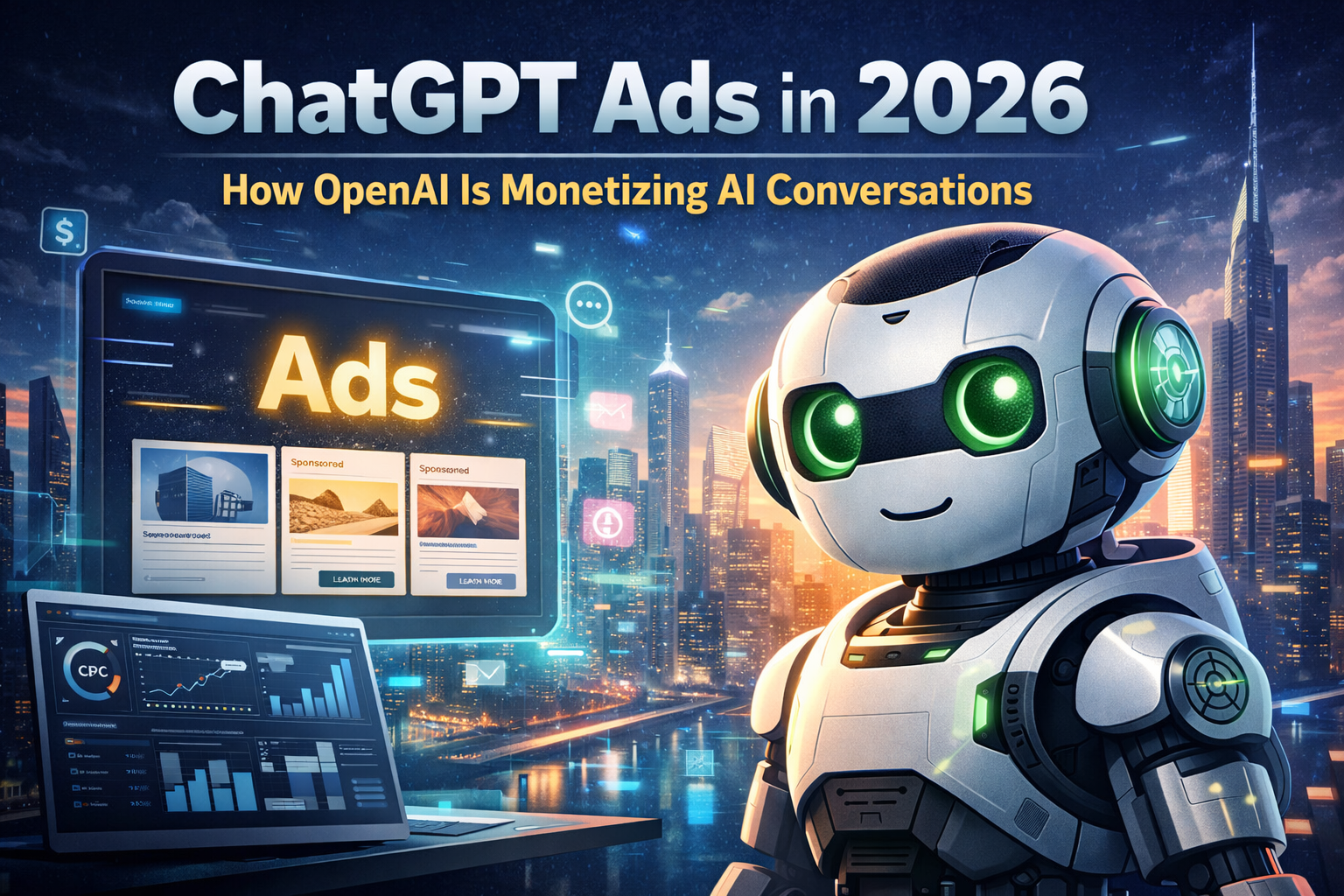
ChatGPT Ads Explained: How OpenAI Is Monetizing AI Conversations in 2026
By Devraj
3rd March 2026
For years, ChatGPT operated without advertising. Its monetization model relied primarily on subscriptions and enterprise licensing. That changed in 2026. Advertising is now part of ChatGPT’s ecosystem, not as a disruptive banner system, but as a carefully structured revenue layer designed to preserve trust while expanding access.
The introduction of ChatGPT ads represents more than a new placement option for marketers. It signals a structural shift in how AI platforms sustain themselves financially and how brands participate in conversational discovery environments. This article explains what ChatGPT ads actually are, whether they are permanent, how they function technically, how advertisers can access them, and what this means for digital strategy moving forward.
Why OpenAI Introduced Ads in 2026
Large-scale AI systems are computationally intensive. Every user query requires inference processing across advanced language models running on GPU infrastructure. As adoption scaled globally, the cost of maintaining free access grew substantially. Subscription plans such as Plus and Enterprise generate meaningful revenue, but they do not cover the full cost of operating a globally accessible AI system at scale. Advertising introduces a diversified revenue stream that subsidizes free-tier usage while preserving premium ad-free experiences for higher-tier subscribers.
The monetization strategy follows a familiar digital pattern: free access supported by ads, premium tiers without ads. However, implementing this model within a conversational or generative AI environment poses challenges that traditional platforms do not face, primarily regarding trust, neutrality, and privacy. OpenAI’s stated approach has been cautious. Ads must not alter the integrity of answers. They must be clearly labeled. They must respect user privacy. And they must avoid sensitive conversational categories.
Will ChatGPT Have Ads Long Term?
As of 2026, ads appear for Free and certain lower-tier subscription users. Paid tiers such as Plus, Pro, and Enterprise remain ad-free. This tiered deployment strongly suggests that advertising is not a temporary experiment but an integrated component of the long-term model.
However, it is equally clear that OpenAI does not intend to embed advertising inside the AI’s reasoning layer. Ads will not influence the generation of answers. Instead, they will appear as separate sponsored placements within the interface.
The structural separation between answer generation and ad placement is essential. If that boundary erodes, trust in AI systems would decline rapidly. Maintaining this separation appears to be a core principle guiding the rollout.
What ChatGPT Ads Actually Look Like
ChatGPT ads are not injected into the response text. They do not appear as recommended phrases within the AI’s generated answer. Instead, they are displayed in clearly marked sponsored sections adjacent to or below responses. The format resembles contextual recommendation cards rather than traditional banner ads. They may include a brand name, a short description, and a link. The placement is designed to align with conversational context without blending into the AI’s voice.
For example, if a user engages in a multi-step discussion about selecting CRM software for a mid-sized company, a sponsored CRM platform may appear in a separate labeled section. The AI’s recommendation itself is not paid. The sponsored placement is visually and structurally distinct. This is a critical distinction from search advertising, where paid listings often appear directly above organic results and compete for the same visual space.
How ChatGPT Ads Are Targeted
OpenAI has not publicly released a detailed technical specification explaining the exact targeting logic behind ChatGPT ads. However, based on official statements and early rollout observations, ads appear to be matched to conversation themes rather than triggered by traditional keyword bidding.
Unlike search advertising, where advertisers bid on specific queries, ChatGPT operates in multi-turn conversations. Reports and early interface testing suggest that sponsored placements are shown in relation to the broader topic being discussed within a session, not a single typed phrase.
OpenAI has emphasized that conversation data is not directly shared with advertisers. Instead, ad delivery is handled within the platform’s internal systems, with privacy controls available to users. Sensitive categories are restricted, and ads are displayed separately from generated responses to preserve answer neutrality.
Because OpenAI has not yet published a formal advertiser-facing targeting framework, the full mechanics of how ads are ranked, selected, or rotated remain proprietary. What is clear is that ChatGPT advertising is being introduced cautiously, with visible labeling and structural separation from AI-generated content.
How to Run Ads on ChatGPT in 2026 (Current Status)
As of 2026, ChatGPT advertising is not yet a fully open, self-serve ad platform comparable to Google Ads or Meta Ads. Instead, it is in a structured rollout phase.
OpenAI has publicly indicated that advertising is part of its long-term monetization strategy, and industry reports have noted integrations with select programmatic advertising partners. However, broad public access to a direct “ChatGPT Ads Manager” interface does not currently exist.
At present, advertising inventory within ChatGPT appears to be:
- Rolled out in controlled phases
- Available primarily through select programmatic partnerships
- Structured within curated contextual environments
- Limited by geography and subscription tier
This means brands cannot simply log into an OpenAI dashboard and launch ads independently. Instead, participation depends on evolving partnerships and approved advertising channels.
What This Means for Advertisers
Brands interested in early participation should:
- Monitor official OpenAI announcements regarding ad platform expansion
- Engage with enterprise-level programmatic partners that may gain access to conversational AI inventory
- Prepare contextual-first creative strategies rather than keyword-only ad campaigns
- Develop AI-compatible brand positioning that aligns with conversational discovery
The infrastructure is forming, but it is not yet as mature or publicly accessible as traditional search or social ad ecosystems.
Are ChatGPT Ads Aggressive?
Reports vary depending on user tier and region. Free-tier users may see more visible placements than paid subscribers. However, the ads are generally structured as contextual suggestions rather than intrusive overlays.
The design philosophy appears focused on maintaining user trust. Ads are clearly labeled and positioned to avoid interrupting the flow of conversation. Whether that balance holds as advertising demand increases remains to be seen.
The Strategic Impact on Digital Marketing
The deeper implication of ChatGPT ads lies in the behavioral change they drive. Consumers increasingly use AI systems for research, comparison, vendor evaluation, and solution exploration. This shifts early-stage decision-making into conversational environments. If high-intent research begins inside AI platforms rather than search engines, advertising strategies must evolve accordingly. Brands that dominate traditional SEO but ignore AI-driven discovery surfaces may lose visibility during critical consideration phases.
Conversational AI introduces a new layer of discovery. It is not replacing search; it is complementing it. The competitive landscape now includes paid conversational placements and organic AI visibility optimization through structured content strategies such as AEO (Answer Engine Optimization) and AI SEO.These approaches focus on building authoritative, extractable, and semantically clear content that AI systems can confidently reference when generating answers.
Marketers must therefore think in two parallel tracks. The first is paid presence through structured ChatGPT ads. The second is organic authority, achieved through AI SEO frameworks, topical depth, structured formatting, and trust signals that improve inclusion in AI-generated responses and systems such as Google AI Overviews. These are distinct strategies, but their outcomes are interconnected in the evolving conversational search ecosystem.
Paid Visibility vs Organic AI Ranking: The Emerging Dual Strategy in 2026
One critical dimension often overlooked in discussions about ChatGPT ads is the relationship between paid placements and organic AI visibility. In 2026, brands are not only asking how to run ads on ChatGPT, but also how to appear naturally within AI-generated answers. This mirrors what has happened with Google’s AI-powered summaries, commonly known as AI Overviews. Just as businesses now compete to be cited inside Google AI Overviews rather than only ranking in traditional blue links, brands are beginning to consider how conversational AI systems evaluate, reference, and surface authoritative sources.
Ranking in AI overviews and ChatGPT is not about keyword density but about structured clarity, topical authority, and trust signals.
Paid advertising may offer visibility within the interface, but it does not guarantee inclusion in AI-generated answers. That inclusion depends on content quality, domain credibility, semantic clarity, and the extent to which information is structured for extraction. In practical terms, this creates a dual-visibility model: sponsored exposure through emerging ChatGPT ads and organic discoverability through AI-optimized strategies. The brands that will win in this environment are not simply the highest bidders; they are the ones that build authoritative content ecosystems that AI systems can confidently reference. As conversational interfaces continue to reshape search behavior, understanding the distinction between paid conversational placements and organic AI citation becomes a strategic necessity rather than a technical detail.
The Risks OpenAI Must Manage
Advertising inside AI systems carries reputational risk. If users perceive that answers are influenced by advertisers, trust will erode quickly. If ads appear in sensitive conversations, backlash could follow.
OpenAI’s current framework attempts to mitigate these risks by restricting ads in sensitive categories, separating sponsored content from generated responses, and maintaining subscription-based ad-free tiers. The success of ChatGPT advertising will depend not only on revenue but on maintaining credibility in an environment where neutrality is paramount.
Where This Is Heading
If adoption continues, conversational advertising could become a defined category in digital media planning. Standardized measurement systems, AI-specific brand safety frameworks, and conversational attribution models are likely to develop over the next few years. ChatGPT ads are not simply another display inventory source. They represent an early phase of monetizing AI-mediated intent. The brands that understand this shift early will be better positioned as conversational interfaces continue integrating into daily digital behavior.
Advertising inside AI conversations is no longer hypothetical. It is operational, evolving, and strategically significant in 2026. And for businesses looking to adapt to both paid conversational placements and broader AI-driven visibility strategies, working with an AI-focused digital transformation partner like Deftsoft can provide the technical and strategic alignment required for this new landscape.
FAQs
1. Will ChatGPT have ads permanently?
Yes, ChatGPT includes ads for Free and select lower-tier users in 2026. However, paid plans such as Plus, Pro, and Enterprise remain ad-free. OpenAI uses advertising to support free access while preserving premium experiences.
2. What are ChatGPT ads?
ChatGPT ads are clearly labeled sponsored placements shown within the ChatGPT interface. They appear separately from AI-generated responses and do not influence the creation of answers.
3. How do ChatGPT ads work?
ChatGPT ads are triggered by conversational context rather than by keywords alone. The system analyzes the topic and intent of a conversation and displays relevant sponsored content in a separate section of the interface.
4. Do ChatGPT ads affect AI answers?
No. ChatGPT ads do not change or influence the AI’s generated responses. Sponsored content is displayed separately to maintain answer integrity and user trust.
5. How to run ads on ChatGPT in 2026?
Brands can run ads on ChatGPT through approved advertising partners integrated with OpenAI’s ecosystem. Campaigns are typically managed via programmatic platforms that offer contextual targeting based on conversational themes.
6. Are ChatGPT ads personalized?
ChatGPT ads may use contextual relevance and optional personalization settings. Users can manage ad preferences, and OpenAI states that conversation data is not directly shared with advertisers.
7. How are ChatGPT ads different from Google search ads?
ChatGPT ads are based on conversational context and multi-step dialogue rather than single keyword searches. Unlike search ads that appear above results, ChatGPT ads are displayed separately within the AI interface and are clearly labeled as sponsored content.
Recent Articles



Devraj
 3rd March 2026