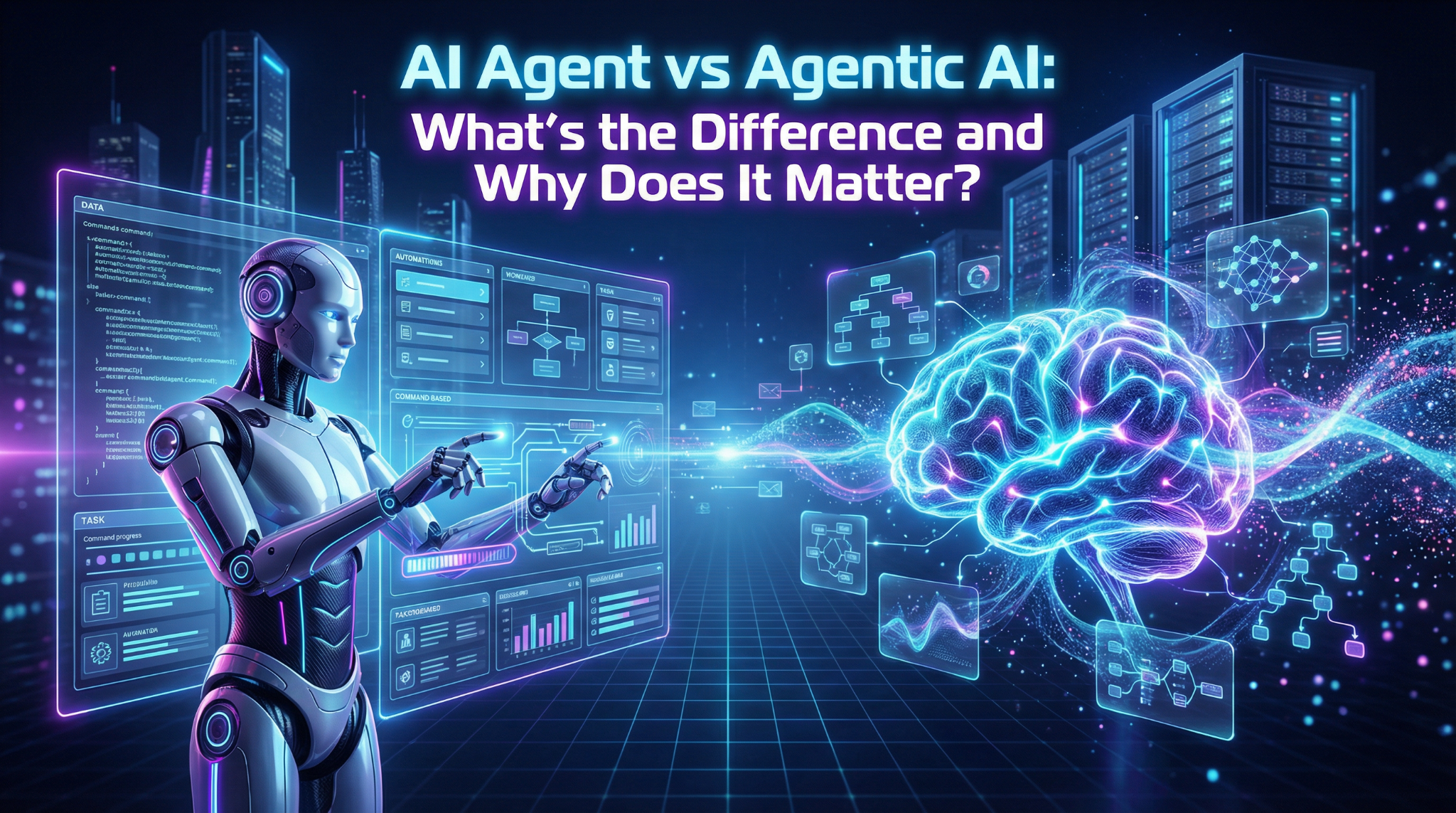
AI Agent vs Agentic AI: What’s the Difference and Why Does It Matter?
By Devraj
24th February 2026
Artificial intelligence is no longer just a buzzword. It’s becoming a core part of how businesses work, how apps run, and how decisions are made, often without any human having to click a button. Two terms you’ll keep hearing are AI Agent and Agentic AI. People use them interchangeably, but they’re not quite the same thing. And when you’re evaluating AI solutions for your business, understanding that distinction isn’t just academic; it directly shapes how you invest, build, and scale. Let’s break it all down in plain language.
What Is an AI Agent?
Think of an AI agent as a smart helper with a specific job to do. You give it a task, it figures out how to complete it, and it gets it done, sometimes on its own, sometimes with a little guidance from a human in the loop.
An AI agent can perceive its environment (e.g., by reading data or listening to inputs), make decisions, and take actions to achieve a defined goal. It could be as simple as a chatbot answering customer questions, or as complex as a program that monitors your server, detects a problem, and fixes it — all without you lifting a finger. Traditional AI agents were largely rule-based and limited in scope. Modern versions are far more adaptive, using machine learning to handle nuance and variation in real-world conditions.
Key traits of an AI agent:
- It has a clear goal or task.
- It can take actions (click, write, send, analyze).
- It reacts to changes in its environment.
- It can work on its own within set boundaries.
What Is Agentic AI?
Agentic AI takes things a step further. Instead of being given a single task, this system can plan, make multi-step decisions, and even create subtasks on its own to achieve a much larger goal. It’s not just reacting, it’s reasoning, strategizing, and adapting.
Imagine asking an assistant not just to “send this email” but to “plan my entire product launch campaign, coordinate with the design team, set up the schedule, and send updates.” These systems can handle that kind of complex, open-ended goal. It breaks down the objective, decides what steps to take, uses available tools, adjusts when things go wrong, and keeps going through to completion.
What makes this approach particularly powerful is its operation at the systems level, often by orchestrating specialized agents working together toward a shared outcome. Rather than having a single system handle everything sequentially, it assigns roles, sequences actions, and manages information flow across the entire pipeline, making it fundamentally different from earlier rule-based systems.
Key traits of agentic AI:
- It breaks big goals into smaller steps on its own.
- It can use tools, browse the web, run code, and more.
- It adapts its plan if something goes wrong.
- It can manage long, multi-step tasks from start to finish.
AI Agent vs Agentic AI: The Simple Difference
| AI Agent | Agentic AI | |
|---|---|---|
| Scope | Handles specific, defined tasks | Handles broad, complex goals |
| Decision-making | Follows set rules or models | Plans and decides dynamically |
| Independence | Works within boundaries | High level of autonomy |
| Example | Customer support chatbot | Full marketing campaign manager |
In short, every agentic AI system uses AI agents, but not every AI agent is agentic. Think of AI agents as the building blocks, and agentic AI as the full construction.
The Evolution From Generative AI to AI Agents to Agentic AI
To understand where AI is heading, it helps to see the progression from generative AI to AI agents to agentic AI. This evolution is not just a series of upgrades; it represents a shift in how deeply artificial intelligence can participate in business operations.
Generative AI was the breakthrough that brought AI into the mainstream. Tools like ChatGPT and code assistants demonstrated that machines could create content, summarize information, and communicate with remarkable fluency. Yet generative AI remains fundamentally reactive. It responds to prompts but does not remember context beyond a session, initiate actions independently, or interact directly with external systems. It is powerful, but it still depends on human direction.
AI agents introduced a critical advancement: the ability to act. By combining language intelligence with tool usage, AI agents can access data, execute workflows, interact with software systems, and complete defined tasks. They move beyond generating responses to actually performing work.
Agentic AI extends this capability further. Instead of handling a single task, it interprets broader goals, breaks them into structured steps, coordinates multiple agents, monitors progress, and adapts dynamically when obstacles arise. In effect, it manages outcomes rather than isolated actions.
Together, generative AI, AI agents, and agentic AI form a layered progression, from creation to execution, to strategic orchestration, shaping the future of enterprise AI systems.
The Evolution from Traditional AI Agents to Agentic Systems
Traditional AI agents were largely deterministic; they followed predefined rules and responded predictably to specific inputs. Earlier systems could route a support ticket or check inventory, but they couldn’t plan a strategy or adapt mid-task.
Today, this shift in AI capability represents one of the most significant leaps in applied AI development. Instead of isolated tools, we now have interconnected systems capable of reasoning, storing memory, and making autonomous decisions. Integrating multiple AI agents into a single workflow enables these systems to tackle the complexity that once required large human teams.
For businesses evaluating AI solutions, this evolution is critical to understand. The question is no longer just “can AI automate this task?” but “can AI reason through this problem, adapt in real time, and deliver outcomes we can measure?”
AI Agents in Mobile App Development
Your mobile app is often the first thing a customer touches. Mobile App Development with AI agents can make that experience smarter, faster, and more personalized.
Here’s what AI agents can do inside mobile apps:
- Personalized recommendations: Like how Netflix knows what you want to watch next. AI agents analyze user behavior and suggest content, products, or actions in real time.
- In-app support: Instead of making users dig through FAQs, an AI agent can answer their questions right inside the app, in plain language.
- Smart onboarding: AI agents can guide new users through an app step by step, adjusting the flow based on what that specific user is doing or struggling with.
- Voice and gesture control: Agents can interpret voice commands or gestures to make apps more accessible and hands-free.
- Predictive features: Like autofill, smart calendar scheduling, or alerting a user before they run out of something they order regularly.
AI Agents in Game Development
Games are one of the most exciting places to see AI agents in action. They’ve been part of gaming for a decade, but modern game development with AI agents is on a whole different level.
- Smarter NPCs (Non-Player Characters): Traditional game characters follow scripts. AI-powered NPCs can react to what you do, remember past interactions, and even develop their own “personalities” over time.
- Dynamic difficulty adjustment: AI agents can observe how a player is performing and adjust the game’s challenge level in real time, keeping it fun — not too easy and not frustratingly hard.
- Procedural content generation: AI agents can create new levels, maps, quests, or storylines on the fly, meaning no two playthroughs feel exactly the same.
- Game testing and bug detection: AI agents can automatically play through thousands of scenarios, uncovering bugs and edge cases that human testers might miss.
- Cheat detection: In multiplayer games, AI agents monitor player behavior patterns to detect cheating without slowing down the game.
For marketing teams evaluating AI solutions, the ROI case is often strongest here — the impact on revenue and retention is direct and measurable.
AI Agents in Digital Marketing
Marketing is all about sending the right message to the right person at the right time. Digital Marketing AI agents are incredibly good at this, at scale.
- Content personalization: Agents dynamically adjust what users see based on their profile, behavior, and intent, creating individually crafted experiences at scale.
- Automated ad campaigns: Agents run, monitor, and adjust paid campaigns in real time, responding to performance data faster than any human team.
- Lead scoring and nurturing: Agents rank leads by conversion likelihood and deliver personalized sequences at the right stage of the buyer journey.
- Social media management: Agents schedule content, respond to comments, flag escalations, and draft posts based on trending topics.
- Analytics and reporting: Agents pull data from multiple sources, identify patterns, and surface insights so teams can spend less time in dashboards.
For marketing teams evaluating AI solutions, the ROI case is often strongest here — the impact on revenue and retention is direct and measurable.
Agentic AI in Different Fields
Agentic AI is transforming virtually every industry, and integrating multiple AI agents into existing workflows is already delivering measurable results:
- Healthcare: These intelligent systems can help diagnose conditions by analyzing patient data, recommend evidence-based treatment plans, manage scheduling, and monitor patients remotely through connected devices, reducing the burden on clinical staff while improving outcomes.
- Finance and Banking: From real-time fraud detection to algorithmic trading to personalized financial advice, these intelligent systems help financial institutions move faster, reduce risk, and serve customers more effectively.
- Education: Intelligent agents act as adaptive tutors, adjusting pacing to each student’s style. Agentic systems can manage entire personalized learning paths, including assessments and feedback.
- E-commerce and Retail: Agents power product recommendations, real-time pricing, inventory management, and personalized shopping journeys.
- Manufacturing and Supply Chain: AI-powered systems monitor production lines continuously, predict equipment failures before they happen, coordinate logistics in real time, and automatically reorder supplies when stock falls below a threshold.
- Legal: Agents help lawyers research cases, review contracts, and flag risks, compressing hours of manual work into minutes.
- Real Estate: Agents match buyers with properties based on nuanced preferences, automate valuations, and coordinate scheduling across multiple parties, streamlining what is traditionally a fragmented, time-intensive process.
- HR and Recruitment: Agents screen resumes, rank candidates, and schedule interviews, freeing hiring teams to focus on conversations that matter.
- Customer Service: Agents handle inbound queries, resolve routine issues, and escalate complex cases intelligently, 24/7.
- Cybersecurity: Advanced AI systems monitor networks continuously, detect anomalies and threats in real time, and can initiate automated responses to neutralize attacks before they escalate, often faster than any human team could react.
From Understanding AI to Actually Implementing It
Understanding these two technologies is the first step. The real challenge begins when you move from concept to production, where reliability and performance matter every day.
Building a capable system in a demo is one thing. Making it run reliably within real business workflows at scale is a very different challenge. It involves clear objectives, quality data pipelines, API integrations, decision logic, safety guardrails, and continuous monitoring.
Agentic AI systems add another layer of complexity: multi-step reasoning, tool orchestration, adaptive planning, and long-term memory management. Integrating multiple AI agents into a unified system that collaborates effectively without conflicting or compounding errors requires careful architectural thinking from the very start. Without the right foundation, these systems can become unpredictable, inefficient, or insecure.
Businesses that need capable AI development partners who understand both the technical depth and the operational realities involved. This is where structured AI development becomes critical , turning intelligent ideas into production-ready systems that actually deliver measurable business outcomes.
AI Development Services: Building the Brains Behind the Business
Whether you need a focused agent or a full, orchestrated AI system across departments, it all starts with the right development approach: thoughtful design, secure data integration, rigorous testing, and ongoing monitoring as your business evolves.
A good AI development company like Deftsoft doesn’t just build you a model; they help you figure out what you actually need and how to make it work reliably in the real world.
AI development services typically cover:
- Custom AI model development
- Integration with existing software and APIs
- AI workflow automation
- Testing, fine-tuning, and deployment
- Ongoing maintenance and improvement
Why Work With an AI Agent Development Company?
Building a production-ready system is complicated. You need the right data, architecture, and logic to make it genuinely useful, not just impressive in a demo. The gap between prototype and scalable deployment is where most AI projects stall.
An AI agent development company like Deftsoft brings experience across industries and use cases. Instead of spending months figuring out what works, you get a team that has already built and deployed systems that perform under real-world conditions, shortening your path from idea to impact. Building an AI agent from scratch is complicated. You need the right data, the right model, and the right logic to make it actually useful, not just impressive in a demo.
What sets a great AI development company apart:
- Custom AI model development
- Integration with existing software and APIs
- AI workflow automation
- Testing, fine-tuning, and deployment
- Ongoing maintenance and improvement
Why Deftsoft Is the AI Development Partner You Need
At Deftsoft, AI is not just a conversation topic; it is a capability we actively design, build, and deploy. We specialize in developing intelligent systems that move beyond experimentation and deliver measurable business value. From task-driven AI agents to fully orchestrated agentic AI architectures, our team brings both strategic understanding and technical execution to every project.
Our experience spans mobile applications, gaming platforms, marketing automation systems, SaaS products, and enterprise-grade workflows. We understand that no two organizations approach AI with the same objectives. Some begin with a focused use case, such as automating customer interactions or optimizing internal processes. Others aim to build coordinated AI ecosystems that integrate across departments and platforms. In both scenarios, our approach remains consistent: align technology with real business outcomes.
What differentiates Deftsoft is our ability to bridge intelligence and implementation. We don’t just integrate AI models; we design scalable infrastructures, ensure system interoperability, embed governance mechanisms, and create solutions that evolve as your business grows.
Whether you are deploying your first AI agent or architecting a comprehensive agentic AI framework, we provide the technical depth, strategic guidance, and long-term partnership required to turn AI ambition into operational advantage.
If you’re ready to explore how intelligent systems can transform your workflows, Deftsoft is ready to build the future with you.
FAQs
What is the main difference between an AI agent and agentic AI?
An AI agent handles a specific, defined task. Agentic AI autonomously manages complex, multi-step goals, often by coordinating multiple AI agents within a larger system.
Is ChatGPT an AI agent?
ChatGPT is an AI model. When it’s given tools and memory to complete tasks on its own, it becomes an AI agent.
Can small businesses use AI agents?
Yes. Agents can be built to fit any budget and business size, from a simple customer support bot to a full automation system that handles entire workflows.
How long does it take to build an AI agent?
It depends on complexity. A focused agent can be ready in a few weeks; a full agentic AI system with multi-agent coordination may take a few months.
Are AI agents safe to use in my business?
Yes, when built correctly. A good AI development company will include safety checks, human oversight options, and clear boundaries for what the agent can and can’t do.
What industries benefit most from AI agents?
Healthcare, finance, retail, gaming, marketing, education, and manufacturing all see strong returns, but almost every industry that handles repetitive, data-heavy processes can benefit.
Do I need to replace my staff with AI agents?
No. These systems work alongside your team, handling repetitive or data-heavy tasks so your people can focus on higher-value, more creative work.
What is the cost of developing an AI agent?
Costs vary based on features, integrations, and complexity. Contact Deftsoft for a tailored quote based on your specific needs.
Can AI agents learn and improve over time?
Yes. They can be built to learn from interactions and continuously improve with more data, fine-tuning, and feedback loops, which is why ongoing monitoring matters.
What makes Deftsoft different from other AI development companies?
Deftsoft combines technical depth with real-world business understanding, delivering AI solutions that are practical, reliable, and built to grow with your business. We specialize in both individual agent development and full agentic AI systems that deliver results at scale.
Recent Articles


Devraj
 24th February 2026